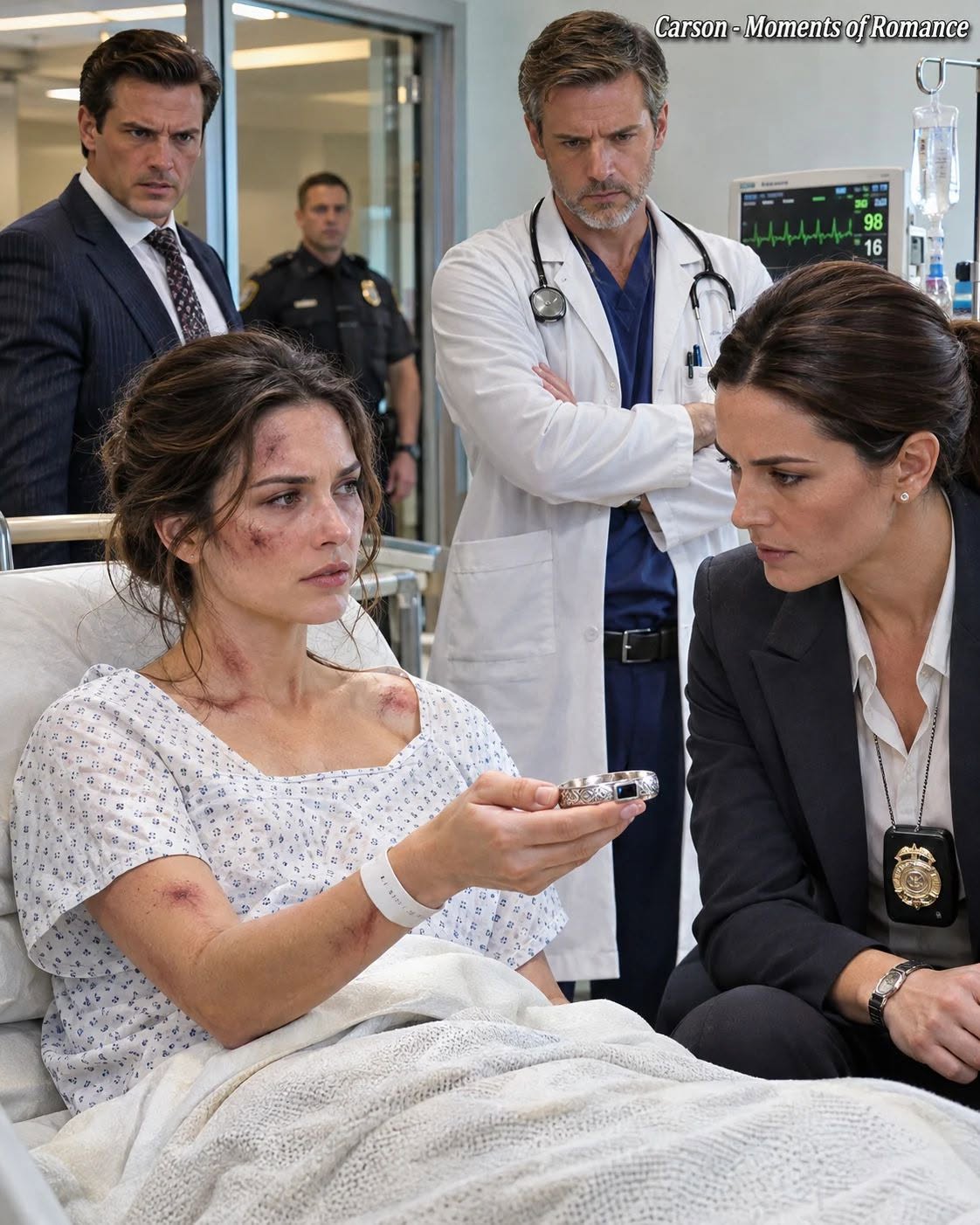
 The scent of antiseptic was sharp enough to sting, but the pain throbbing across the left side of my face was worse. Every breath pulled at cracked ribs, sending sharp lightning through my chest. Through the narrow glass pane of Room 412 at St. Catherine’s Hospital, I could see my husband, Richard Carter.
He was performing.
Richard stood beneath the fluorescent lights of the corridor in his custom-tailored charcoal suit, gesturing with open palms toward two uniformed patrol officers. He ran a hand through his immaculately styled silver-flecked hair, shaking his head with an expression of profound, theatrical anguish. To anyone watching, he was a devastated titan of industry, a loving billionaire whose fragile wife had taken a terrible tumble on Italian marble.
He didn’t know I was awake. And he certainly didn’t know that the doctor who admitted me, Dr. Daniel Brooks, had already documented twelve distinct contusions across my torso—some fresh and purplish-black, others faded to the sickly yellow of last week’s fury.
Inside the quiet room, Detective Sarah Mitchell leaned closer over the side of the hospital bed. Her badge gleamed against her dark blazer. In her gloved palm rested my silver chain bracelet.
“You’re certain about this, Mrs. Carter?” Sarah asked, her voice low and steady. “If Richard realizes you gave this to law enforcement, his lawyers will descend on this precinct within the hour. The Carter name carries a lot of weight downtown.”
“Let them come,” I whispered, tasting the faint metallic tang of blood behind my teeth. “He’s arrogant because he thinks I’m broken. He thinks I’m still the terrified girl who signed away her voice four years ago. Turn the clasp counterclockwise three times.”
Sarah frowned slightly, examining the chunky silver links. With precise fingers, she gripped the magnetic clasp and twisted. On the third click, the interior housing popped open with a faint metallic snap. Tucked neatly inside the hollowed core was a micro-drive no larger than a fingernail, coated in matte black polymer.
“My father was a systems engineer before he passed his shares of Carter Development down to me,” I said, every word costing me effort. “He taught me that men who build towers on deceit always leave paper trails. For eleven months, every time Richard opened his private terminal in our study, every time he forged board signatures, every time he struck me… I archived it.”
Sarah’s eyes widened slightly. “You have video?”
“Audio, video, financial transfers, offshore routing numbers,” I answered, locking eyes with her. “And the real reason Julian Hayes died four years ago.”
Sarah inhaled sharply. Julian Hayes had been Richard’s founding partner—a brilliant visionary whose sudden leap from a penthouse balcony had cleared the path for Richard to seize full control of the firm. The death had been ruled a suicide within forty-eight hours, swept under the rug by an obliging district attorney who later retired to a private estate in Martha’s Vineyard.
Before Sarah could respond, the door handle rattled.
Dr. Daniel Brooks stepped in first, his broad shoulders intentionally blocking the view into the room. Behind him, Richard pushed forward, his velvet voice dripping with false concern.
“Doctor, please, that is my wife,” Richard demanded, his voice carrying the practiced resonance of a man accustomed to commanding boardrooms. “I have rights here. Emily! Sweetheart, can you hear me? I’m right here.”
Sarah smoothly pocketed the micro-drive, turned on her heel, and faced the doorway. Dr. Brooks stood his ground, his arms crossed over his white coat, a thick medical chart clutched in his hand.
“Mr. Carter, as I informed you ten minutes ago, this is a restricted trauma unit,” Dr. Brooks said calmly, his gaze unyielding. “Your wife has suffered a severe concussion, fractured ribs, and multiple blunt-force injuries. Given the nature of her trauma, the hospital is mandated by state law to permit law enforcement to conduct an independent assessment before visitors are permitted.”
Richard’s eyes flashed with a cold, venomous spark that I knew all too well. It was the look he gave me right before he raised his hand. But within a fraction of a second, his veneer snapped back into place. He smiled, a thin, polished smirk.
“Mandated? I donate three million dollars annually to St. Catherine’s pediatric wing, Dr. Brooks,” Richard said softly, taking a step inside. “I suggest you remember whose name is on the pavilion downstairs before you lecture me on protocol.”
He turned his gaze toward the bed. When his cold blue eyes met mine, his smile hardened. He saw my open eyes. He saw the cold hatred staring back at him. For four years, I had lowered my gaze whenever he entered a room. I had trembled, wept, and apologized for breathing wrong.
Tonight, I didn’t look down.



