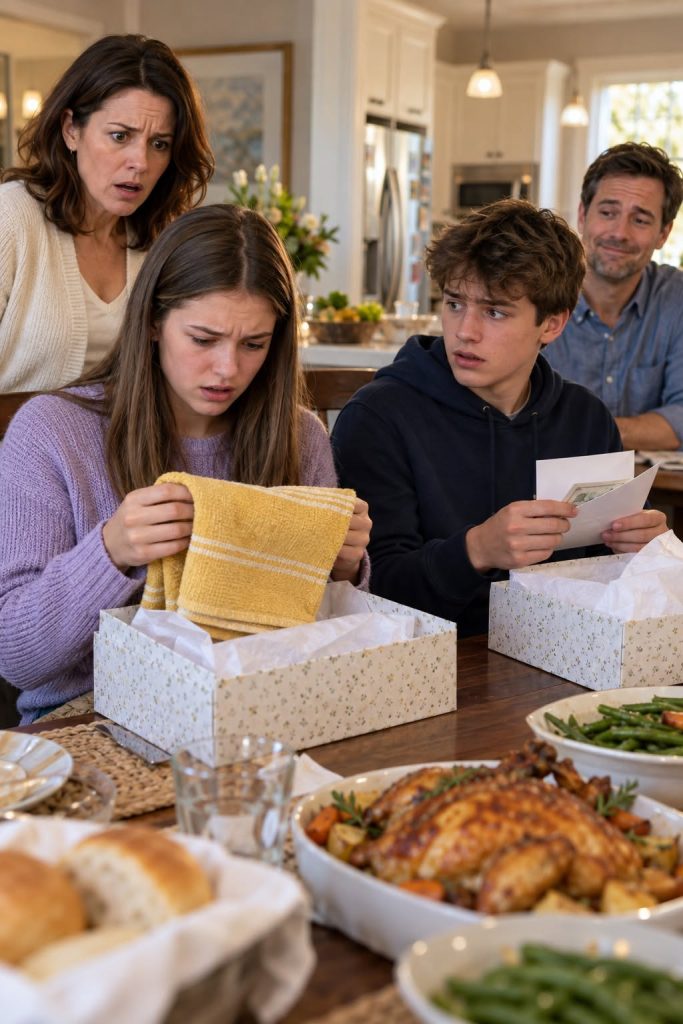
“Yes, she is,” I said, walking over to kiss both of their heads. “And tonight, nobody is cooking. We are ordering three large pizzas from the wood-fired place downtown.”
“With extra garlic knots?” Evan pleaded.
“With double garlic knots,” I promised.
As Evan went back to adjusting his balsa wood trusses, Paige touched my wrist. She gestured toward the far wall of the kitchen, right next to the pantry door.
There, mounted in a clean, elegant black wood frame with a double-matted white border, was a small square of fabric.
It wasn’t Colin’s yellow dish towel.
Months ago, on the day Colin left, Paige had taken scissors to that awful yellow towel, cutting it into tiny shreds and throwing it into the yard-waste compost bin behind the shed. But the following week, Elaine had given Paige a new piece of cloth: a hand-woven linen napkin, embroidered along the border with delicate forget-me-nots, which Elaine’s own grandmother had stitched sixty years ago in Virginia.
Framed beside it was the torn birthday card Elaine had originally written, smoothed out, repaired with archival tape, and preserved forever:
*For summer arts camp & bright horizons. Love, Grandma.*
“I keep it right there,” Paige whispered, looking up at the frame with steady, peaceful brown eyes. “Just to remind myself.”
“Remind yourself of what, honey?”
“That nobody gets to define what my future is worth,” she said simply. “Except the people who truly love me.”
***
Chapter 10 – A Future Reclaimed
Fourteen months after the night Colin Mercer walked out of our lives, the auditorium at the Governor’s School for the Arts was buzzing with the electric hum of hundreds of proud parents, mentors, and students.
It was mid-July. Outside, the afternoon heat shimmered over the campus lawn, but inside the air-conditioned gallery hall, the atmosphere was cool, elegant, and filled with light.
The annual Summer Showcase was the culmination of six intensive weeks of study for the state’s top high school artists. Paige had won a full merit-and-tuition residency funded by the very portfolio she had developed using Elaine’s art trust fund.
I stood in the center of the exhibition space, dressed in a light linen sundress, holding Elaine’s arm. At seventy-one, Colin’s mother looked radiant, wearing a tailored lavender suit, her pearl earrings catching the track lighting overhead.
Beside us, Evan was practically bursting out of his navy blazer. He was an inch taller now, his shoulders broader from varsity track, clutching a large bouquet of white lilies and pink peonies he had insisted on picking out himself at the florist that morning.
“Do you see her piece yet?” Evan asked, craning his neck over the crowd of patrons. “She said it was in the contemporary watercolor pavilion, section four.”
“Patience, Evan,” Elaine chuckled, patting his forearm. “A good gallery exhibition is meant to be savored, not sprinted through like your four-hundred-meter hurdles.”
“I just want to make sure we get a good spot before the jury panel comes through,” Evan mumbled, though his grin gave away his genuine, overflowing pride.
We turned the corner into Pavilion Four, and there, surrounded by a small cluster of admiring visitors, was Paige.
She was standing beside her display, wearing a dark green wrap dress, her brown hair falling over her shoulders in soft, polished waves. She held a small program notebook, answering questions from an elderly couple with poise, warmth, and an effortless confidence that took my breath away.
Behind her, mounted on the central white display partition, hung her centerpiece artwork.
It was a large-scale, breathtaking triptych of mixed media and watercolor.
The first panel depicted an ornate, shadowy dining table set with heavy silver and sharp cutlery, the atmosphere heavy, gray, and oppressive, with an empty chair pushed back in haste.
The second panel was a storm of vibrant, chaotic color—deep blues, crashing golds, and fractured lines of white light, symbolizing an upheaval, a breaking of chains, a household coming apart and reforming.
The third panel was pure, radiant light. It showed an open doorway leading out into a sunlit meadow of blooming forget-me-nots. Standing in the doorway were three silhouettes—a mother, a brother, and a grandmother—their arms linked, looking out toward an endless horizon.
In the brass placard beneath the frame, the title was engraved in clean, modern typography:
*THE ARCHITECTURE OF BELONGING*
*Paige Vance – Age 16*
*Dedicated to Elaine, Lena, and Evan: Who taught me that family is not a debt to be paid, but a gift freely given.*
I pressed my fingertips against my lips, a sudden wave of joyful, overwhelming emotion catching in my throat. Beside me, Elaine’s hand tightened on my arm, her blue eyes shining with proud, unrestrained tears.
“Look at that,” Elaine whispered, her voice trembling with absolute adoration. “Just look at what our girl built.”



