It was Tessa, Caleb’s younger sister. We hadn’t spoken since I’d blocked her parents, but her message contained twelve screenshots from the family group chat.
My hands shook as I read.
Caleb had started the plan before Diane ever suggested a name. He’d written, If she signs willingly, fine. If not, we already have a sample from the mortgage paperwork.
Richard had replied, Make sure the hospital thinks this was her idea.
The next message landed like a punch.
Diane: And if she refuses, tell them she’s having a breakdown.
I called Tessa. “Why are you sending me this?”
“Because they told me you wanted help,” she whispered. “Tonight Dad asked me to lie to a social worker. I won’t.”
She had one more secret. Diane wasn’t the mastermind Caleb claimed to be protecting. Caleb had drafted the entire scheme after I refused to quit my job and move into his parents’ basement. His parents had agreed to help him make me look unfit so they could raise the baby under their roof.
A sharp pressure suddenly gripped my body. The nurse checked me and called the obstetrician. It was time to push.
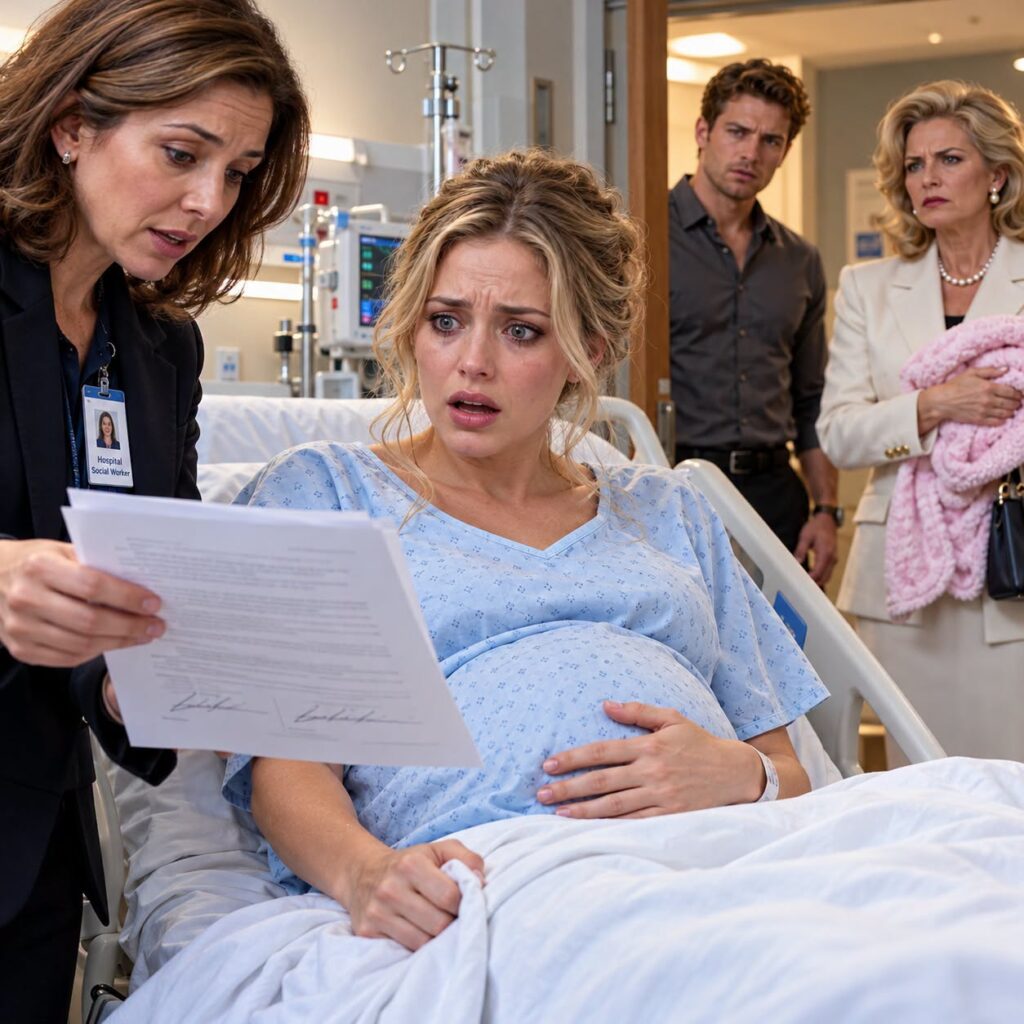
As the room filled with urgent voices, Ms. Patel returned, her expression tight.
“There’s been a report to child protective services,” she said. “Someone claims you threatened to hurt your daughter.”
The complaint had been submitted while I lay in labor.
“Who made the report?” I asked, fighting another contraction.
“We don’t have that confirmed,” Ms. Patel said. “A report is an allegation, not proof. Right now, you and your baby are our patients.”
My doctor stepped between me and the door. “You need to focus on delivery. We’re handling the rest.”
I pushed until every muscle trembled. At 3:14 a.m., my daughter arrived, furious and pink, with a cry that broke me open. They placed her on my chest. I touched her damp cheek.
“Hello, Sophie,” I whispered. “I’m your mom.”
A nurse helped me complete the birth-registration paperwork. When I wrote Sophie Grace, my hands finally stopped shaking.
By morning, my attorney, Laura Kim, was sitting beside my bed. She reviewed the forged authorization, the screenshots, and my medical records. She asked permission to speak with hospital security and the social worker. I gave it.
Tessa came in next, pale and sleepless. She showed Laura the original messages on her phone, including one Caleb had deleted from the group chat but she’d saved.
He’d written: If I get the baby to Mom’s house, she’ll have to fight us to get her back. Diane had added at 2:43 a.m.: I made the report. Keep her there.
There it was. Not concern. Not tradition. A plan to use our daughter as leverage because I wouldn’t surrender my independence.
The child-protection investigator who contacted the hospital listened to my care team, reviewed the messages I consented to share, and met with me before discharge. No one treated the allegation as a custody order. I left the hospital with Sophie beside me and Marisol carrying our bags.
Caleb did not come home with us.
Laura helped me file for divorce and request temporary parenting orders after Sophie’s birth. We also made a police report about the forged authorization. Investigators later traced the document to a computer in Richard’s office. Records from the notary showed that the seal on it had been copied without authorization.
At the hearing, Caleb’s lawyer called the plan “misguided family support.” Laura laid out the messages, the false medical claims, and the effort to take Sophie at discharge. When the judge asked Caleb why he’d used my signature, he looked down at his shoes.
The court granted me temporary primary physical custody, with Caleb’s parenting time supervised while the allegations were evaluated. The judge ordered communication through a parenting app. His parents had no permission to collect Sophie from my care.
Months later, Caleb and Diane accepted plea agreements arising from the forged paperwork. Richard faced his own charges for helping prepare it. The divorce was finalized, and a longer-term parenting order followed after further hearings. I didn’t get a magical eraser for what happened. I got documentation, boundaries, and a safe home.
On Sophie’s first birthday, I set a small cake on our kitchen table. She smashed one fist into the frosting and laughed. My mother would have laughed, too.
I had once smiled because I was too stunned to speak. Now I smiled because my daughter was free to grow into her own life.
They tried to give her a name that meant she belonged to them. I gave her a name—and a future—that belonged to her.



