 The floor was red oak, three-quarter-inch tongue-and-groove, finished in the early nineties with a polyurethane topcoat that had long since yellowed into the dull, sticky amber of an old cider jug. It had no give. Even in the dead of summer, when the humidity off Lake Erie turned the air thick enough to chew, those planks stayed cold to the touch. In late November, with an arctic front dragging across the northern counties and spitting gray sleet against the storm windows, the timber felt like quarry slate pulled fresh from a ditch.
At 9:47 p.m., the two sleeping bags struck it.
They did not land with a soft, downy rustle. They were surplus Coleman bags from the summer of 1988—heavy, canvas-shelled, lined with a slick, patterned flannel that smelled of damp crawl space, dried rodent pellets, and three decades of dry-rot. The brass zippers hit the floorboards first: clack-crack. A sound sharp enough to startle a dog two streets over.
“Your sister’s family gets the guest room,” my mother, Eleanor, said. She did not look at me while she spoke. She was already brushing the coarse dust of the closet floor off her cardigan sleeves with brisk, downward strokes of her manicured fingers. “You and the kids can take the den.”
The den was not a bedroom. It had never been a bedroom, even in the tax appraisals Eleanor contested every three years down at the county courthouse. It was a dog-leg alcove grafted between the back of the kitchen pantry and the mudroom door, originally intended by the builder as a sewing nook or an indoor potting station. It had no heating register; the main duct ran straight beneath the hallway floor toward the front parlor, leaving this corner suspended over an uninsulated corner of the crawl space where the frost gathered on the block foundation by mid-October. It had no interior door. To reach the half-bath downstairs, one had to walk past the foot of the den; to reach the cellar stairs, one had to cut directly across its center.
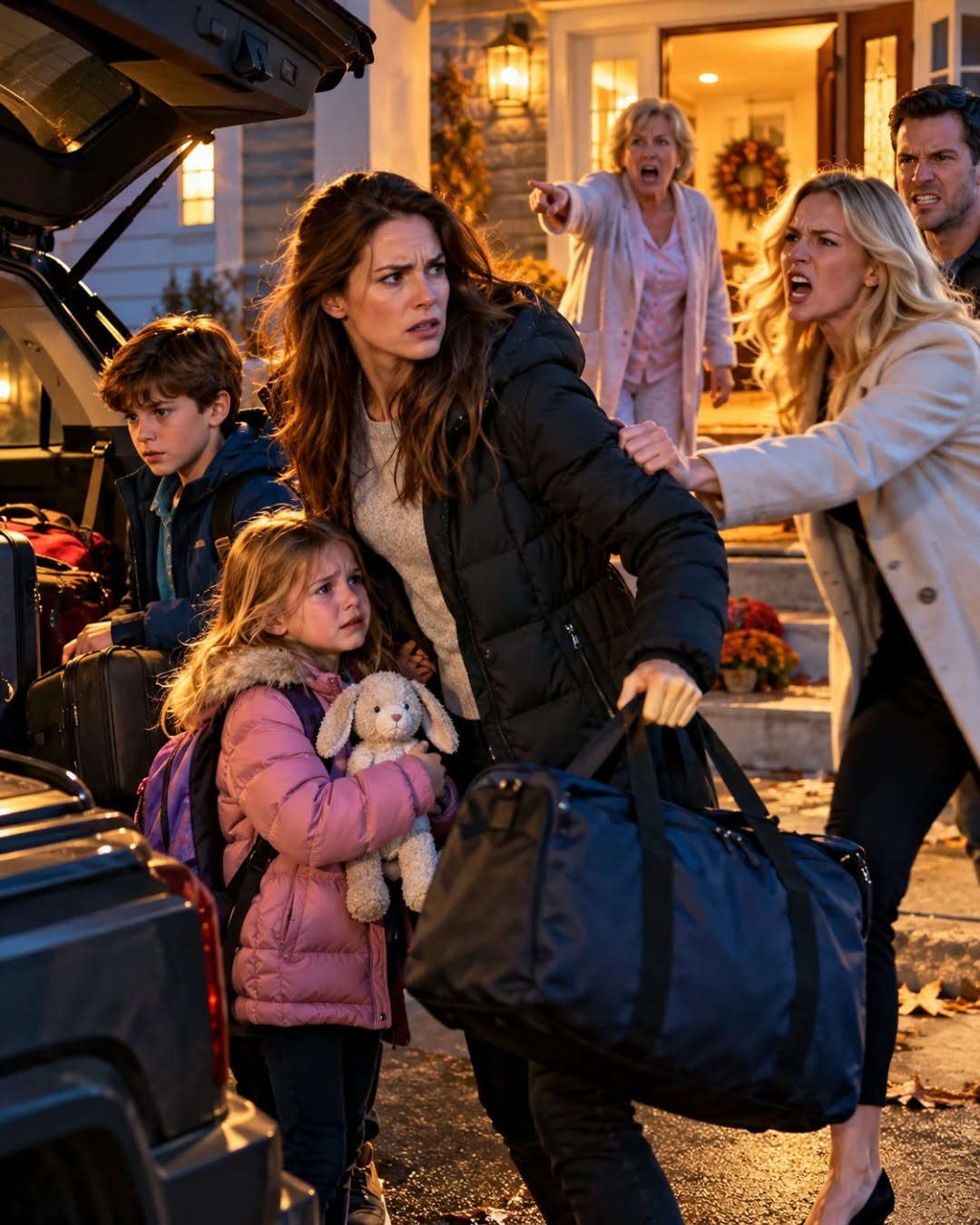
On the floor, my five-year-old daughter, Lily, knelt by the nearest cylinder of faded green canvas. Her fingers—small, red-tipped from the cold air that leaked through the car seals during the last sixty miles of our drive—hesitated over the rusted teeth of the zipper. She looked up, her forehead creased with the serious, fragile concentration of a child trying to decode an adult’s silence.
“Is it a tent, Mama?” she asked. Her voice was small, cracked around the edges from the dry forced air of my sedan’s dashboard heater. “Are we doing the campout inside like we did when the lights went out on Elm Street?”
Beside her, my nine-year-old, Noah, did not move. He stood with his thumbs hooked under the shoulder straps of his blue backpack. He had not unzipped his parka. He had not taken off his knit watch cap. He had spent seven hours in the passenger seat watching the mile markers tick down from Charlotte through the blue-black ridges of West Virginia, counting the bridge overpasses, handing his sister pretzels, asking every forty miles if we were close enough to Grandma’s to let his legs stretch. Now he simply looked at the space between my boots and the baseboard where the quarter-round molding had split and pulled away from the plaster.
He knew what the den was. Two Thanksgivings ago, when my sister Amanda’s black Labrador had developed an intestinal bug, they had quarantined the dog on an old vinyl tarp in this exact alcove.
“Eleanor,” I said. My voice was dangerously flat, stripped bare of the bright, frantic cheer I had forced into it across three hundred and eighty miles of interstate. “Three weeks ago, you called me twice in the same afternoon to confirm I was bringing the children. You said the guest room was made up. You said you’d bought the lavender sheets from the outlet mall because Lily liked the color.”
My mother turned her back to the den, reaching into the linen press on the hall landing to straighten a stack of hand towels that were already parallel to the shelf edge. Her shoulders were high, tight, set in that stubborn, angular posture she adopted whenever a bank teller questioned an endorsement.
“Well, things shift, Claire,” she said, her tone airy, indifferent, the verbal equivalent of a shrug over an overcooked chop. “Amanda has four people. She has two boys who are practically grown men. You can’t put six-foot football players on the floor; their knees will lock up. Greg has his sciatica from the drive down from Ann Arbor. You have two little ones. They’re small. They fit together. It’s an adventure for them.”



