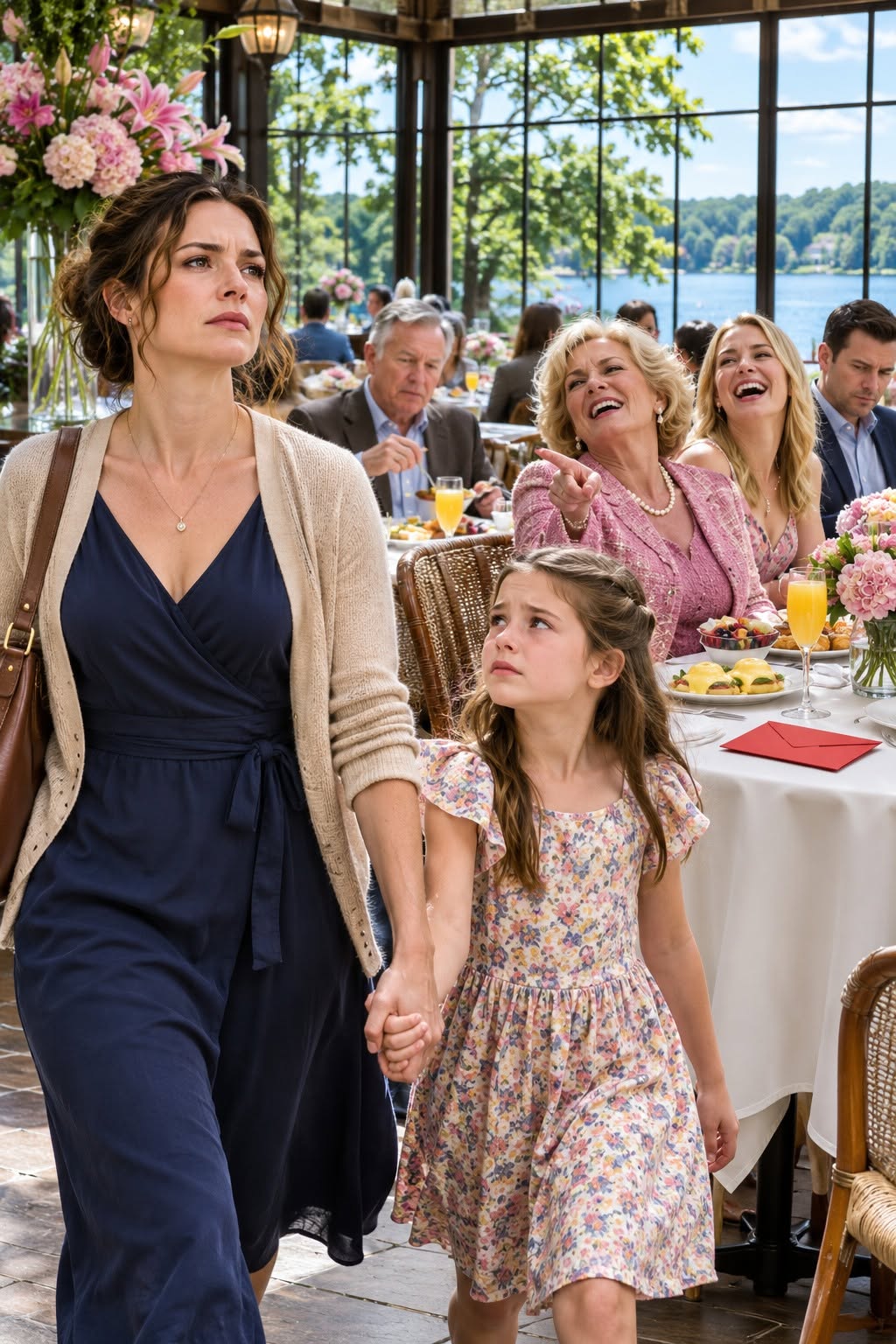
The sunlight on Reservoir Road that Sunday afternoon felt less like a warm embrace and more like an interrogation lamp. Inside the restaurant, the air smelled of expensive truffle oil, melting butter, and the quiet, suffocating arrogance of people who believed their social standing shielded them from basic human decency.
At our table, the silver cutlery clinked against fine china, a delicate soundtrack to a slow-motion public execution.
Across from me sat my mother, Beatrice Dwire, her posture rigid as a Victorian corset, her silver-streaked hair styled with the precision of a military campaign. Beside her sat my father, Arthur, his thick fingers wrapped around a coffee cup, his eyes glued permanently to his plate as if afraid that looking up might require him to take a stand. Next to him was my younger sister, April, glowing in a designer linen dress that cost more than my weekly grocery budget, her husband Zach sitting silently at her flank like an obedient shadow.
And right beside me sat nine-year-old Jill. My heart. My anchor.
We had ordered eggs Benedict for Mom because she demanded them every single year without fail, even though she invariably forgot what they were called until the waiter recited the menu. It was a tedious ritual, one of a thousand small performances I had played along with for thirty-eight years.
Then came the punchline.
“Sweetheart,” Mom had said, turning her sharp, powdered gaze toward Jill with a smile that didn’t reach her eyes, “I hope you don’t grow up to be a disappointment like your mother.”
The words didn’t land with a crash; they hissed into the air like poison gas.
April’s laughter followed—bright, melodic, and utterly devoid of hesitation. It wasn’t the chuckle of someone caught off guard by an awkward slip of the tongue. It was the sound of a predator celebrating a kill.
My father’s fork kept scraping against his plate. Zach stared harder into his eggs. And Jill… Jill stopped chewing. Her small hands, sticky with pancake syrup, froze on the edge of the table. Her brown eyes shifted up to mine, searching my face for translation, for safety, for an explanation of why Grandma was allowed to say something so cruel and why nobody at the table was telling her she was wrong.
In that fraction of a second, the fog of thirty-eight years cleared.
I didn’t yell. I didn’t cause a scene. I simply reached down, took Jill’s small, warm hand in mine, and stood up from the table. With my free hand, I unlatched my leather handbag, pulled out a heavy red envelope I had brought specifically for Mom—stuffed with a card and a cash voucher for her favorite spa—and placed it gently beside her crystal mimosa glass.
“Happy Mother’s Day,” I said, my voice eerily calm, steady as a bedrock.
Mom blinked, momentarily thrown off. “Bethany? Where are you going?”
April scoffed, waving a manicured hand. “Oh, come on. Don’t be so dramatic.”
I didn’t look back. As we walked out into the bright afternoon glare, Jill’s small fingers gripped mine so tightly her knuckles turned white.
“Mom?” she whispered once we reached the car. “Are we in trouble?”
I knelt on the pavement, looking directly into her wide, frightened eyes. “No, sweetheart. We’re leaving. That’s different.”
She studied my face. “But Grandma was mad.”
“Grandma doesn’t get to hurt people’s feelings just because she’s older.”
Jill nodded slowly. I buckled her into her booster seat, climbed into the driver’s seat, and pulled out my phone. My thumb hovered over my banking application. For sixty consecutive months, without a single missed deadline, I had wired $1,400 to April’s account with the memo Mom monthly. Sixty months of tightening my own belt, of working late-night accounting freelance gigs while Jill slept, so my mother could live comfortably without ever having to worry about utilities or property taxes.
And how had Mom repaid that loyalty? By humiliating me in front of my daughter, while April laughed and Dad chewed in silence.
I pressed Cancel.
A prompt flashed on the screen: Are you sure?
A cold, humorless laugh escaped my lips. “I’ve never been more sure.”
We drove away from Reservoir Road, leaving the brunch behind. Instead of going home, I pulled into a retro diner on Fifth Street. Jill ordered chocolate-chip pancakes piled high with whipped cream—the exact kind of breakfast my mother always sneered at as “vulgar and undisciplined.”
Halfway through her meal, Jill slid a paper placemat across the table. Written in purple crayon, shielded carefully while she worked, were the words:
Happy Mother’s Day to the best mom. You are not a disapointment.



