My parents skipped the funeral of my husband and two children because it was my sister’s birthday. When I begged them to come, my father calmly said, “Today is your sister’s birthday. We can’t come.” Six months later, one headline about me made my entire family panic when they learned I had…
21 November 2026 · bonnie
In the days before the funeral, Claire had sat at the dining table with a notepad and a trembling hand, dialing numbers she had not called in nearly two years. Her family lived less than three hours north, just across the Potomac border in Maryland, close enough for an easy morning drive down Interstate 95. Their estrangement had never been born of a single dramatic explosion, but rather a slow, calcifying accumulation of disappointments—her father Richard’s disapproval when she married a high school history teacher instead of joining the family real estate firm, her mother Evelyn’s relentless tallying of perceived slights, and the quiet, unspoken rule that affection in the Miller household was always conditional upon compliance.
Yet when the unthinkable happened, Claire had believed—naively, desperately—that death erased old ledgers. She had called her father’s office, left tear-choked messages on her mother’s voicemail, and texted the date, time, and address of the Richmond chapel to her younger sister, Melissa. Please, she had whispered into the phone the night before the service. I cannot stand there alone. I just buried my whole life. Please come.
Nobody came.
Her father’s assistant had sent a stiffly worded floral arrangement of white lilies with a printed card signed The Miller Family, as though sending condolences to a distant business associate. Her mother had sent a brief text the morning of the funeral claiming a sudden bout of vertigo made the drive impossible. Melissa had not replied at all, leaving Claire to stand beside three caskets beneath a blazing July sky with only Ethan’s elderly aunt and a handful of Lily’s schoolteachers holding umbrellas against the heat.
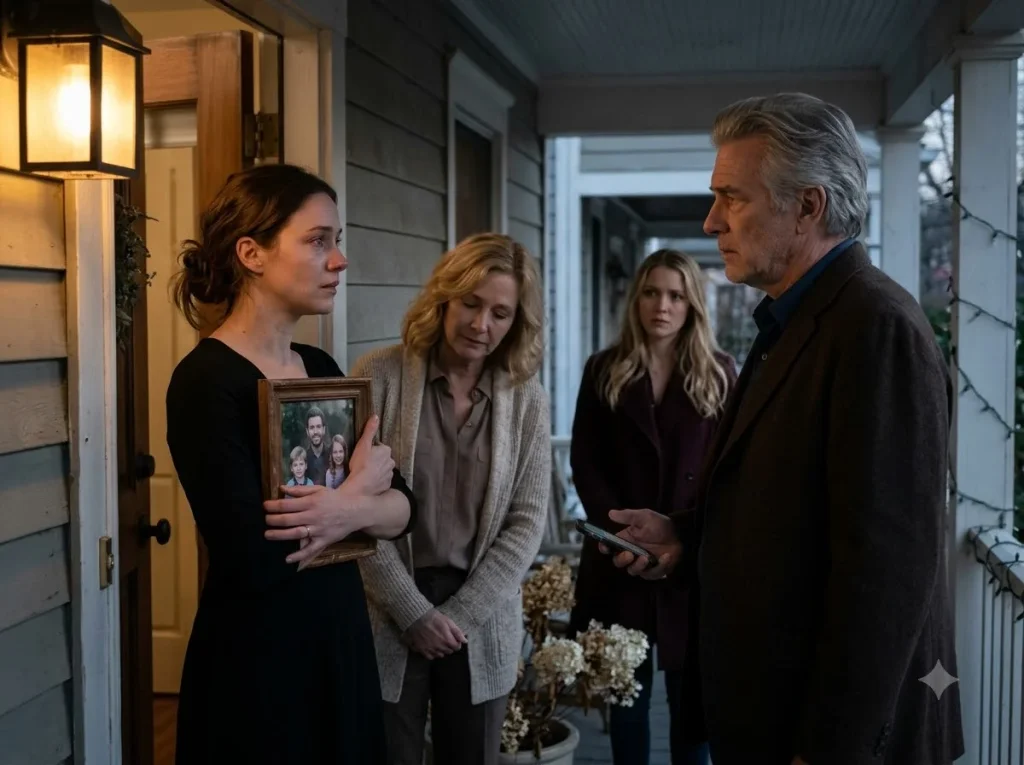
After the earth was closed over them, Claire stopped calling. Grief hollowed her out, leaving no room for anger—only a vast, numb clarity. When the wrongful death attorneys approached her in August with undeniable evidence of corporate falsification and criminal negligence, Claire had cooperated through a fog of exhaustion, answering depositions in a steady, quiet voice while holding the wood-framed photograph in her lap beneath the conference table.
She had not followed the press coverage when the case finally resolved that morning. She had not read the regional newspapers or checked the local evening broadcasts that named the figure—eight-point-four million dollars, one of the largest civil settlements in central Virginia that year. To Claire, numbers were an insult, a crude attempt by the legal system to weigh three irreplaceable souls against a ledger sheet.
Outside, the gravel stopped crunching. Car doors opened and closed in rapid, deliberate succession—first one, then a second, then a third. Heavy footsteps began climbing the wooden steps toward the porch, moving with a brisk, purposeful rhythm that had nothing to do with hesitation or sorrow.
Chapter 3 – Headlights on the Gravel
Twenty minutes earlier, inside the warm leather cabin of a dark sedan speeding south along Interstate 95 toward Richmond, Richard Miller had tapped the screen of his smartphone one last time before locking it. Even with the display dimmed, the headline from the Richmond Times-Dispatch seemed burned into the backs of his eyelids: Widow Reaches Historic $8.4M Settlement in Multi-Fatality Negligence Suit.
At sixty-five, Richard carried himself like a man accustomed to rooms rearranging themselves when he entered. His silver hair was swept neatly back from a broad forehead, and he wore a tailored brown wool jacket over a crisp dark blue button-down shirt—clothes chosen deliberately for the drive south, projecting quiet authority rather than ostentation. For the past year, his commercial development firm had been quietly hemorrhaging liquidity after two suburban office parks stalled in permitting. A seven-figure bridge loan was due at the end of the quarter, and until noon today, he had been weighing which properties to liquidate at a loss.
“Keep your tone measured when she opens the door, Evelyn,” Richard said, keeping his eyes on the darkening ribbon of highway ahead. “She’s been through an ordeal. She’s isolated out here. What she needs right now is family structure—people who actually understand how to manage this kind of sudden capital before lawyers and financial vultures pick her clean.”
Beside him in the passenger seat, Evelyn smoothed the front of her oatmeal cardigan over her taupe blouse with restless, manicured fingers. At sixty-two, her shoulder-length blonde waves were freshly styled, though tight lines bracketed her mouth. All afternoon she had oscillated between defensive justification and rehearsed tenderness, trying to bridge the six-month chasm without ever speaking the word sorry.
“She knows I wasn’t well in July,” Evelyn murmured, staring out at the passing pine trees. “And she never called again after the service. Pride runs both ways, Richard. A mother shouldn’t have to beg to be welcomed into her own daughter’s house.”
BO
bonnie
Content published under this byline is prepared by our editorial team, drawing on a mix of original reporting, research, and AI-assisted drafting, with each piece reviewed before publication. Our focus is on delivering clear, accurate, and engaging coverage across the topics our readers care about most.