She notified the recording office of the alleged fraud and began preparing a lawsuit to void the deed, along with a request for emergency court relief. A police report alone wouldn’t erase a public record.
Then my grandmother’s former accountant called.
Grandma hadn’t just left me the house. She’d established an education trust for Sophie. Mom was its successor trustee, required to provide annual statements. I had asked for the latest accounting the week before the attack. That was the paper Mom wanted me to waive.
The accountant sent bank records. Eighty-four thousand dollars was missing. Transfers went from Sophie’s trust to Vanessa’s failing home-renovation business, with my mother’s authorization on every one.
My stomach turned. The fight hadn’t started because Vanessa was jealous of my house. Mom needed me to sign away my right to challenge what she’d done with my daughter’s money.
And if she could sell my home, she could replace the stolen funds before anyone investigated.
Dana was still reading the statements when Detective Harris called back.
“Rachel, there was another 911 recording from that afternoon,” he said. “It came from Sophie’s watch. Your mother didn’t know the line was open.”
He paused.
“We can hear her tell Vanessa exactly what to do to you.”
“Play it,” I told Detective Harris.
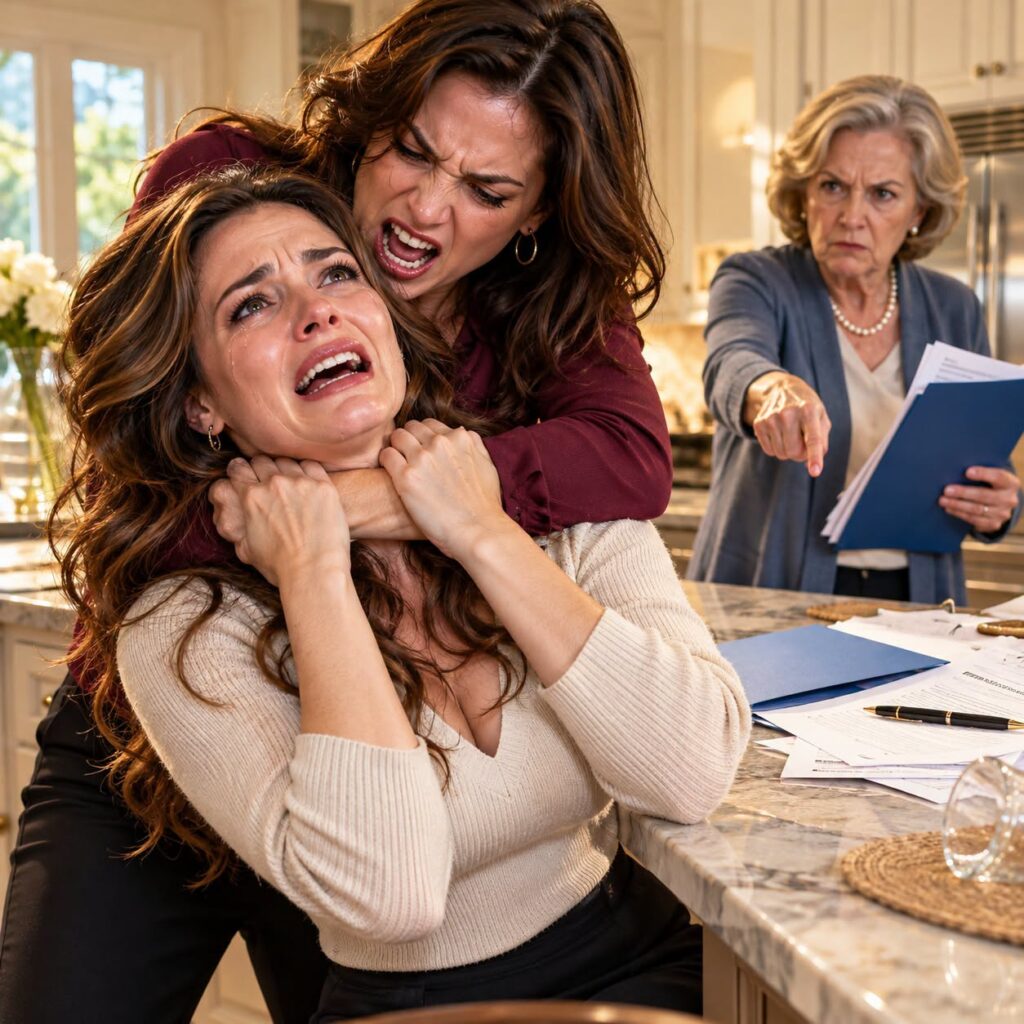
He wouldn’t send me the emergency recording while investigators were securing the evidence, but he read me the transcript. In Sophie’s tiny, trembling voice, the dispatcher heard, “My aunt is hurting Mommy.” Then my mother said, clearly enough to identify every word, “Keep her there until she signs.”
It wasn’t proof of an accident. It was a command.
Sophie had activated the emergency-call feature on her watch while Vanessa was choking me. The phone in her hand had been a distraction. My brave little girl had managed both.
The next morning, Dana filed the civil action challenging the forged deed and asked the court to block any transfer while the case proceeded. She notified the real estate agent of the lawsuit. He canceled the listing before a buyer could be deceived.
Meanwhile, Detective Harris obtained the notary’s records. The notary was a longtime friend of Vanessa’s who had certified that I’d appeared in person. Hospital timestamps, security footage, and my medical chart placed me miles away at that exact hour. Confronted by investigators, the notary admitted she’d been paid to stamp documents without witnessing my signature.
The bank records told the rest. Mom had approved transfers from Sophie’s trust for almost a year, claiming they covered educational expenses. In reality, she’d financed Vanessa’s business debts. A forensic accountant traced the payments to overdue contractors and a luxury SUV.
Mom had taught Vanessa to see my refusal as the only obstacle. She’d handed her the blue folder and sent her into my kitchen expecting intimidation to work. When it didn’t, she went ahead with the forged deed.
The prosecutors charged Vanessa with assault by strangulation and forgery-related offenses. My mother faced charges tied to the trust theft, the fraudulent conveyance, and her role in the attack. Both also faced consequences for violating the protection orders. The notary faced a separate criminal case and professional discipline.
Months later, I sat in the courthouse while my mother finally looked directly at me.
“We were going to put the money back,” she whispered.
“You stole from Sophie,” I answered. “And when I asked questions, you let Vanessa nearly kill me.”
She started crying. For the first time in my life, I didn’t rush to comfort her.
Vanessa accepted a plea agreement that included incarceration and a no-contact condition. Mom pleaded guilty to financial offenses and received a sentence that included jail time, probation, and restitution obligations. The court invalidated the fraudulent deed, and a civil judgment ordered the missing trust funds repaid. Collection would take time, but the recovered assets were placed under an independent trustee.
I kept the protective orders in place. I never gave either woman another key.
One Saturday, Sophie and I planted lavender beside the front steps. She pressed soil around the roots and glanced at the door.
“Can they come in now?” she asked.
“No,” I said. “Not without our permission.”
She smiled and went back to planting. Our house had never felt so much like home.
My mother once taught me that family meant opening the door no matter how badly someone hurt you. I taught my daughter something better: love should never require you to unlock the door for the people who taught you fear.



