I scanned the header: The Last Will and Testament of Arthur James Vance.
My breath hitched.
I flipped to the second page, where the distribution of assets was detailed. My eyes raced across the legal jargon until I hit a paragraph highlighted in bright yellow highlighter:
…And whereas my primary residential property located at 414 Elm Street, along with the portfolio of municipal bonds currently held in Trust Account #8892-B at First National Bank valued at four hundred and fifty thousand dollars ($450,000), shall be held in trust for the sole benefit and education of my children, Liam Vance and Kendra Vance, to be distributed equally upon their respective thirtieth birthdays, provided that…
I stopped reading. My pulse thundered in my ears.
Four hundred and fifty thousand dollars in municipal bonds? A residential property? My father hadn’t died with a modest insurance policy and a reverse mortgage. He had left nearly half a million dollars in liquid assets designed to secure our futures.
So where was it?
I flipped to the final page, looking for the executor’s signature and the probate stamp. That’s when I saw the second document attached to the will: an affidavit of trust distribution, signed and notarized in July 2021—three months after my father’s funeral.
The signature at the bottom wasn’t just my mother’s. It was accompanied by a secondary document: a full waiver of inheritance, purportedly signed by me, relinquishing all rights to my fifty-percent share of the trust in favor of my mother and sister, “for the purpose of familial consolidation and support.”
I stared at the signature line at the bottom of the waiver.
There was my name: Liam A. Vance.
Written in a smooth, practiced, looping script that looked nothing—absolutely nothing—like my messy, hurried signature.
Someone had forged my name.
Chapter 8 – The Signature Expert
The kitchen was dead silent except for the hum of the refrigerator.
Leah leaned over the island, her finger tracing the forged signature on the parchment paper. “Liam… this isn’t yours. Even I can tell, and I’ve only known you for three years. The ‘V’ is completely wrong, and you always cross your ‘t’s with a loop.”
“It’s a forgery,” I whispered, the cold reality settling over my bones like lead. “A complete, federal-level forgery.”
“Your mother?”
“Who else?” I snarled, slamming my palm down onto the countertop. “She was the executor. She had access to all my old tax documents, college transcripts, and loan applications from when I was in school. She had samples of my handwriting for years!”
“Four hundred and fifty thousand dollars,” Leah murmured, her eyes wide. “Plus the house. That means Kendra didn’t just feel entitled to a seventy-two-thousand-dollar condo because she’s spoiled—she felt entitled to it because she’s been sitting on a half-million-dollar inheritance that my mother illegally transferred to her entirely!”
The puzzle pieces snapped together with terrifying clarity.
Kendra wasn’t just living off Mom’s allowances; she was living off my inheritance. Mom had systematically looted the trust, forging my signature on waiver documents during the chaotic weeks following my father’s death when I was grieving, overwhelmed, and trusting. She had funneled the bond payouts into private accounts under Kendra’s name, treating my legal share as a slush fund for luxury cars, shopping sprees, and downtown apartments.
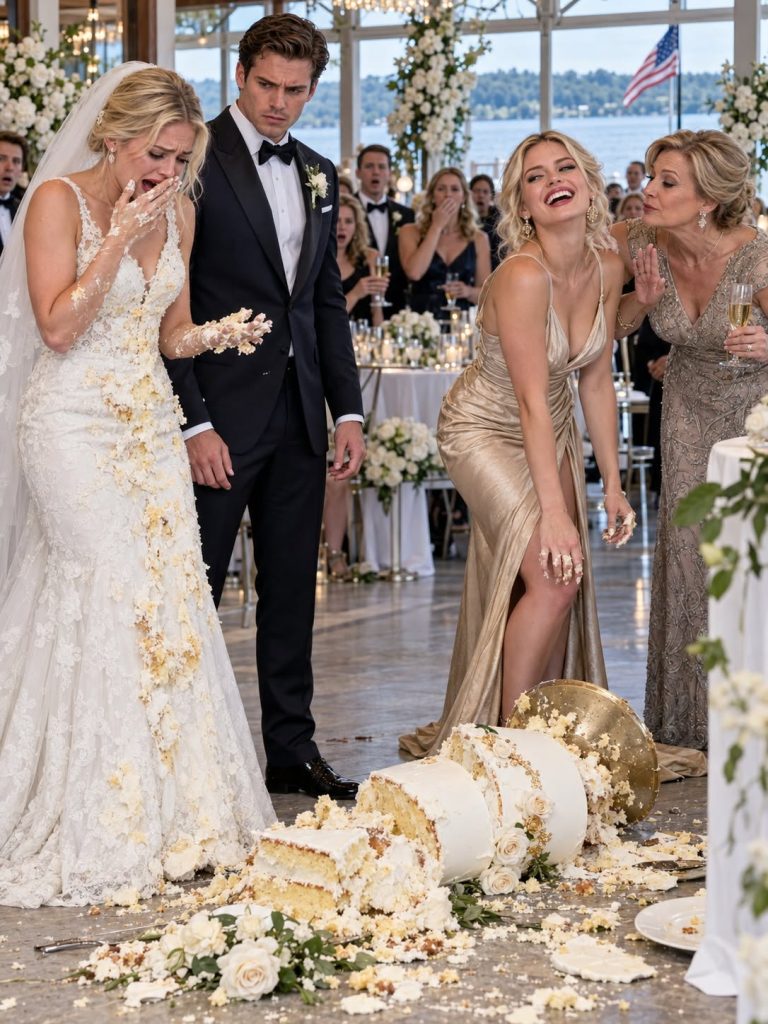
And now, because I had cut off the twelve-thousand-dollar moving fund and voided the lease guarantee, Kendra was running out of cash. The well was dry. She couldn’t afford her lifestyle anymore without my recurring subsidies, so Mom had panicked—pushing Kendra to demand the condo immediately, leading to the wedding cake disaster, and ultimately trying to intimidate me with police visits.
“We need to call Marcus right now,” Leah said, grabbing her phone. “This isn’t a civil dispute anymore. This is grand larceny, mail fraud, and forgery.”
“Forget Marcus,” I said, grabbing my car keys from the hook by the door. “We’re not calling. We’re driving over to Mom’s house right now. And we’re bringing these papers with us.”
“Liam, wait—is that wise? She’s unhinged. If you confront her without police or a lawyer present—”
“I don’t care,” I interrupted, my voice dropping into a cold, dangerous register. “She forged my name. She stole my father’s dying wish and handed it to a parasite who just tried to ruin our wedding. We are going over there now.”
Leah didn’t argue. She grabbed her jacket, locked her phone, and followed me out to the car.
The drive across town took fifteen minutes. Every red light felt like an insult, every slow driver a personal obstacle. By the time I pulled my car up to the curb of my childhood home—a modest, white-columned suburban house where I had grown up—my knuckles were white on the steering wheel.
The driveway was empty. Mom’s sedan wasn’t there.



