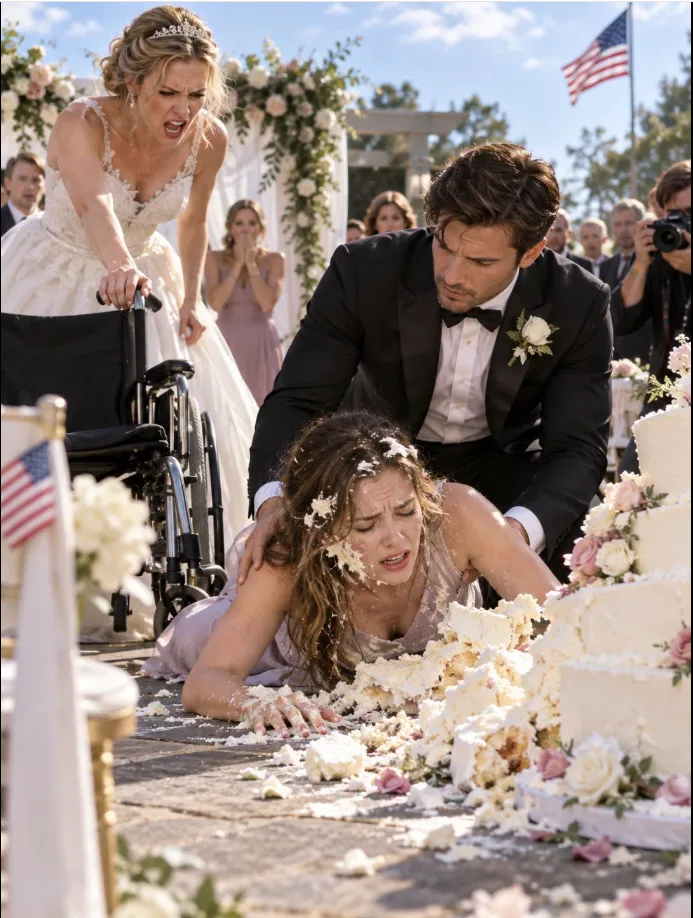
He reached into his pocket and pulled out a small, folded piece of paper—an envelope with yellowed edges, postmarked two years ago, addressed to me in bold, masculine handwriting.
“I found it yesterday morning,” Callum whispered, “tucked inside Sloan’s vanity drawer, used as a bookmark for a jewelry catalog. She didn’t just steal your money, Mave. She stole my gratitude. She read the words I wrote to the woman who gave her spine to save my life, and she used them to figure out what kind of man I was so she could manipulate me into falling for her.”
A heavy, aching sob ripped from my chest. All the years of isolation, the endless gray afternoons sitting by the window of that damp cottage, watching Sloan drive away in new convertibles while I counted pennies to buy compression socks—it had all been an orchestrated, calculated theft of my entire identity.
“Why didn’t you stop the wedding earlier?” I asked, my voice cracking under the weight of the realization. “If you found out yesterday… why did you go through with the ceremony?”
Callum looked toward the small rear window of the ambulance, where the flashing lights of the police cruiser following us illuminated the dusk.
“Because in this state,” Callum said grimly, “breach of fiduciary duty is a civil dispute. But fraud committed in the process of an active financial union, coupled with public physical assault, gives the state attorney general immediate jurisdiction to freeze every asset they possess without bail.”
He looked back at me, his eyes softening into something infinitely tender.
“I needed the trap to spring in front of every witness in this valley, Mave. I needed Marcus’s cameras rolling. I needed the whole world to see who Sloan Vance really was—so she could never, ever hide behind her family’s name again.”
Chapter 7 – Under the Emergency Lights
The ambulance backed into the trauma bay of St. Helena Regional Medical Center with a hiss of pneumatic brakes.
The rear doors flew open, revealing a flurry of activity. Four nurses and an emergency physician in light blue scrubs swarmed the gurney, moving with the rapid, synchronized efficiency of a seasoned trauma unit.
“Twenty-eight-year-old female, blunt force trauma to thoracic cage and cervical-spine region, preexisting T-10 complete paraplegia,” the lead paramedic barked as they unlatched the gurney and slid it smoothly out onto the concrete bay floor.
“Bring her straight to Trauma One,” Dr. Chen, the attending physician, ordered, shining a penlight into my pupils. “Pupils equal and reactive. Let’s get an immediate portable chest X-ray and clear her for a full spine CT. Where’s the orthopedic surgeon on call?”
“Dr. Patel is scrubbing in,” a nurse responded, wheeling the gurney through the double automatic doors into the brightly lit emergency wing.
Callum walked directly behind them, never falling more than an arm’s length away.
“Sir, you need to wait in the family lobby,” an orderly said, stepping into Callum’s path with hands raised. “Only immediate family is permitted in the trauma resuscitation suite.”
Callum didn’t stop. He pulled his military identification and a laminated medical durable power of attorney card from his breast pocket, flashing it with an authority that brooked no argument.
“I am Captain Callum Reed, designated emergency healthcare surrogate filed under her military record,” Callum said without breaking stride. “I am remaining with the patient.”
The orderly hesitated, looked at Dr. Chen, who gave a quick, approving nod, and stepped aside.
Inside Trauma One, the transition from the backboard to the hospital bed was agonizing. Even with the nurses executing a careful four-person log roll, the torque on my right shoulder sent a blinding wave of nausea through my stomach. I cried out, my hands clutching the bed rail as cold sweat broke across my forehead.
“Easy, Mave,” Callum’s voice was right by my ear, his hand firm on my left arm. “Breathe through it. Four seconds in, four seconds out. Just like the bird. You’re safe.”
“Pain scale, Mave?” Dr. Chen asked, cutting away the ruined, frosting-soaked fabric of my silk blouse with trauma shears. “One to ten?”
“Eight,” I gasped, staring up at the acoustic ceiling tiles. “In the right collarbone. Lower back is… dull pressure. Numb. Normal for me.”
Dr. Patel, a tall woman with silver-streaked hair, entered the room, snapping on latex gloves. She immediately began palpating the dorsal spine, her fingers pressing into the familiar scar tissue that marked the titanium rods holding my vertebrae together.
“Hardware feels intact,” Dr. Patel noted, her touch clinical and precise. “No palpable step-off or obvious deformity along the thoracic fusion. But the clavicle has a visible displacement. Let’s get that CT scan done immediately.”
As the team prepped the bed for transport to the radiology suite, two county sheriff’s deputies entered the trauma bay, followed by a woman in a sharp gray pantsuit carrying a legal briefcase.



