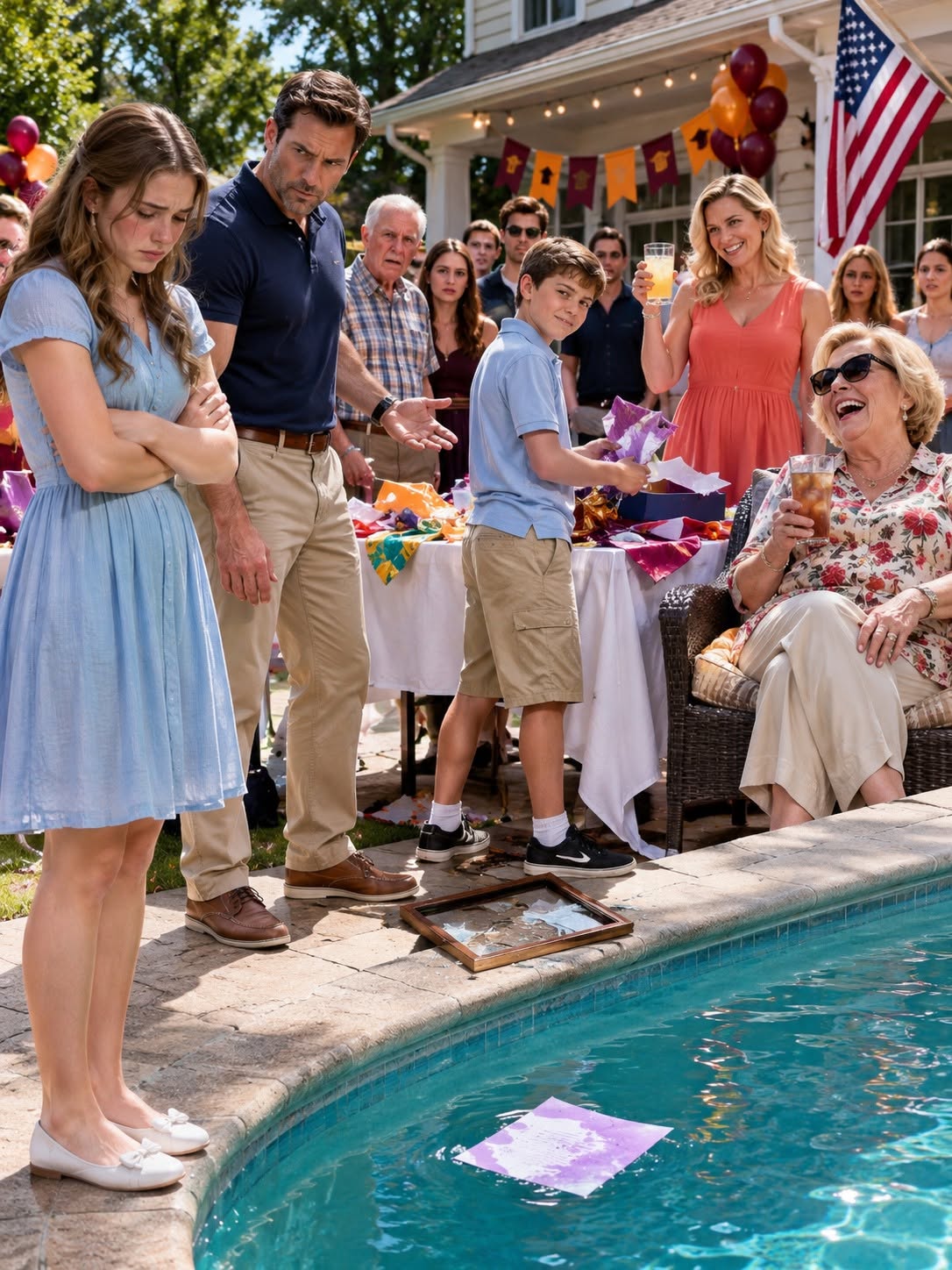
The purple ink didn’t disperse immediately. It held its shape for two seconds in the chlorine, a bruised cloud spelling out *Office of Undergraduate Admissions*, before the pool skimmer pulled it apart.
I stood ten feet away by the offset smoker, a pair of stainless-steel tongs gripped in my right hand. The hickory smoke from twelve pounds of beef brisket hung heavy in the humid June air of our suburban Maryland backyard. Around me, thirty people—neighbors, high school teachers, folks from the church choir, and my old bowling league—went dead silent. The sound of silverware clinking against paper plates vanished. Even the cicadas in the silver maples seemed to cut out.
My eleven-year-old nephew, Connor, stood at the coping of the deep end. His hands were empty now, his chest heaving under a polo shirt that still had the department-store crease down the front. Beside his sneakers lay the smashed remains of an eight-by-ten walnut frame. The glass had shattered across the flagstone, milky and sharp in the bright two-o’clock sun.
My daughter, Norah, took a half-step forward. She was wearing the white sundress she’d ironed herself that morning and the maroon Virginia Tech lanyard I’d bought her the day the fat envelope arrived in March. Her knuckles were white where she gripped the hem of her dress.
“Connor?” she whispered. The word barely carried over the hum of the pool pump. “Why would you do that?”
Connor didn’t look at her. He didn’t look at me, either. His gaze flicked over my shoulder toward the shaded patio, where my sister, Trish, sat cross-legged on an outdoor sectional with a chilled glass of pinot grigio balanced on her knee. Trish offered him a tiny, almost imperceptible nod—a sharp chin-dip that looked like an umpire calling a runner safe.
Connor spun back toward the gift table.
It was an ordinary folding table draped in a cheap maroon cloth, piled with cards, wrapped boxes, a leather-bound journal from her calculus teacher, and a personalized leather toolset my buddy Marcus had brought for her engineering labs. Connor lunged at it. His small fingers, sticky with barbecue sauce, tore straight into a package wrapped in silver foil.
“Those aren’t yours,” I said. My voice wasn’t loud, but the heat in it felt like a draft from a blast furnace. I dropped the tongs onto the prep board and crossed the flagstone in four strides. I dropped to one knee, putting myself between him and the table, catching his wrist before he could rip into the ribbon of another card. “You need to stop right now. Look at me, Connor. Stop.”
The boy went rigid. His eyes were wide, glassy with the defiance of a kid who had never heard the word *no* without a bribe attached to it. He pulled back, his sneakers squeaking on the wet stone. “Mom said I could open them! She said it was boring here!”
Before I could answer, a hand clamped down on my forearm. Trish’s nails—acrylic, French-tipped, freshly done on my credit card three days ago—dug into my skin.
“Relax, Blake,” she said smoothly, smelling of expensive floral perfume and white wine. “He’s bored out of his mind. You didn’t set up cornhole, you didn’t hire a DJ, there’s literally nothing here for children. He’s just helping her. What’s the big deal?”
“He threw her acceptance letter into the pool, Trish.” I looked down at her hand on my arm until she let go. “He shattered the frame. That wasn’t an accident.”
Trish took a slow sip of her wine. “She can print another one. It’s a piece of paper, Blake. Honestly, stop being so dramatic. You’ve been acting like she cured cancer just because she got into state school.”
That was when the laugh came.
It didn’t come from Trish. It came from five feet behind her, under the motorized awning. My mother, Donna Whitfield, sat in the prime lounger—the one with the memory foam cushion I’d carried out from the sunroom so her lower back wouldn’t ache. She was wearing oversized Jackie O sunglasses and clutching an insulated tumbler of sweet tea. Her mouth was curved into a cruel, satisfied crescent.
“Oh, let the boy have his fun,” Donna said, her voice carrying clear across the lawn to where Mrs. Gable from down the street stood frozen with a bowl of potato salad. “I told him he could knock her down a peg. Lord knows somebody needed to. Little Miss College Girl walks around with her nose in the air like she’s too good for the people who put shoes on her feet.”
Trish didn’t flinch. She raised her wine glass in Donna’s direction, tapping the rim in a silent toast.



