Michelle called the clinic with me beside her. The office manager confirmed they had issued no such assessment and asked us to send a copy to their compliance department.
Hannah stared at the floor.
“Did you know the medical letter was fake?” I asked.
She shook her head. Brenda appeared behind her in the doorway.
“She’s forgetting things,” Brenda announced. “We’re protecting the family.”
“From what?” I asked.
Nobody answered.
That afternoon, Michelle contacted the lender identified on the envelope. With my written authorization as the property owner, we learned that Tyler had submitted an inquiry about a $180,000 loan secured by the house. The application could not proceed because he didn’t own it and had no valid authority to pledge it.
Then came the twist that actually hurt worse than the towel.
Michelle asked Hannah to show us her messages with Tyler. After a long silence, Hannah unlocked her phone. One message was dated two weeks earlier.
If Mom won’t transfer the deed, we need someone appointed who can act for her. Brenda says the judge will listen if there’s video.
My daughter hadn’t merely stood aside. She’d helped design the trap.
When I confronted her, she started crying. Tyler’s failed construction business owed suppliers and back taxes. Hannah had guaranteed some of its debt. Brenda had convinced them guardianship would unlock enough of my equity to save them.
“Do you understand what you tried to do?” I asked.
Hannah nodded, but Brenda interrupted. “You’ll never prove anything.”
Then Michelle’s phone rang. The clinic’s compliance officer had checked the forged assessment. The signature belonged to a real employee.
But that employee had been on medical leave for eleven weeks.
The clinic was preparing a report to law enforcement.
Michelle looked from her phone to Brenda. “I’d strongly suggest nobody destroy a document or delete a message.”
For the first time, Brenda stopped smiling.
We didn’t have to guess how the medical letter had appeared. The clinic confirmed that the letter used an obsolete template. The signature was scanned. Brenda had once worked in the clinic’s billing office. Michelle submitted the evidence and asked the court to deny the emergency request.
I supplied my own evidence: my doctor’s recent examination notes, bank records showing I managed my accounts, and the complete video from the kitchen security camera I’d installed after a break-in. Tyler had apparently forgotten it covered the entire table.
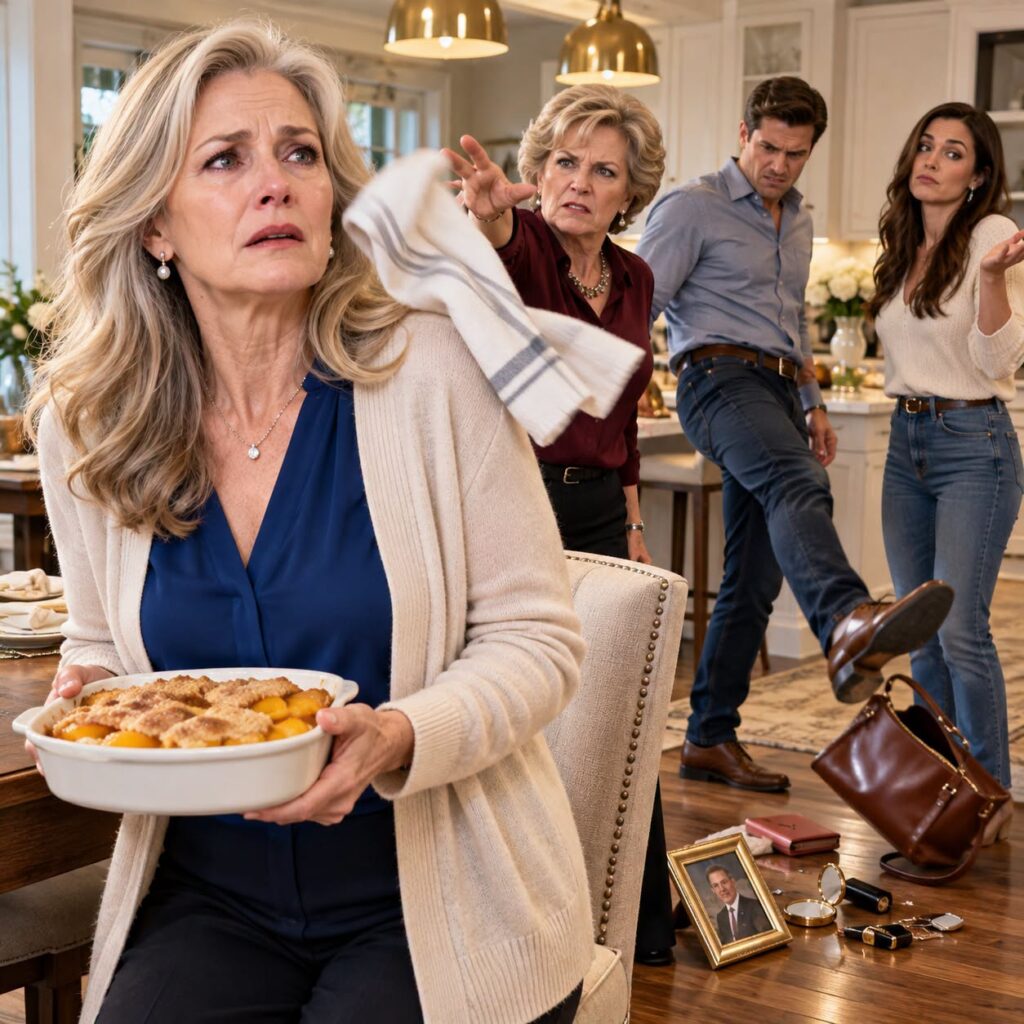
The unedited footage showed Brenda throwing the towel, Tyler kicking my purse, and Hannah watching in silence. It also showed me calmly asking about the loan.
At the hearing the following week, I sat beside Michelle in my husband’s favorite navy coat.
Hannah sat across the aisle. Tyler stared straight ahead. Brenda whispered something to their attorney, who shifted uncomfortably as Michelle presented the records.
The judge asked Hannah whether she still stood by the statement she’d signed.
My daughter looked at me, then at her father’s photograph on the screen.
“No,” she said, her voice breaking. “Parts of it were false. I knew the video had been cut.”
Tyler grabbed her elbow. She pulled away.
The judge denied the emergency guardianship request. The disputed medical letter and supporting materials were referred for investigation. There were no dramatic arrests. But the lender closed Tyler’s application, and their attorney warned them to preserve every record.
Afterward, Hannah followed me into the hallway.
“I was scared we’d lose everything,” she whispered.
“You were willing to take everything from me first.”
She reached for my hand. I wasn’t ready to give it.
The house remained listed for sale. Michelle delivered the proper written notice ending the month-to-month tenancy, with the legally required time to move. I didn’t change the locks, cut the power, or pretend a FOR SALE sign meant they had to disappear overnight.
A month later, Hannah and Tyler moved out. Brenda left with them, dragging the upholstered chair she’d insisted was hers. Their debts remained theirs. The investigation into the forged letter continued.
Hannah later separated from Tyler and began paying back money she’d borrowed from me for his business. We started meeting for coffee once a month. I told her forgiveness would require honesty over time, not another apology.
The house sold that spring. I used part of the proceeds to buy a smaller place with a sunny kitchen and a blue front door. Above the table, I hung the photograph Tyler had knocked to the floor.
I still make peach cobbler on Sundays. Sometimes Hannah helps slice the fruit. She always asks before bringing anyone else.
I bought my daughter a house because I wanted her to feel safe. When she helped turn it into a weapon against me, I finally understood what safety meant for myself.
I didn’t lose my family when I put up that sign. I stopped losing myself to keep it.