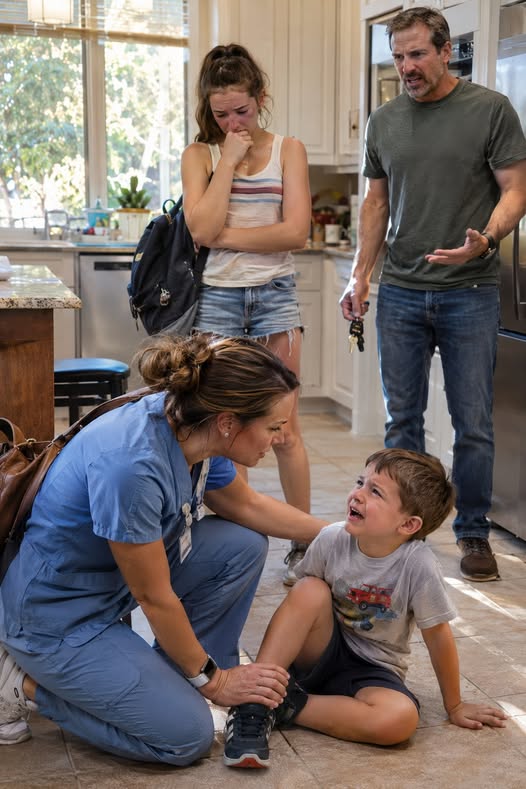
 The kitchen was so quiet I could hear the rhythmic hum of the compressor beneath the stainless-steel refrigerator. On the linoleum floor, between the breakfast bar and the pantry door, lay a plastic toy dinosaur, its neon-green tail snapped clean off where Owen had landed on it.
Owen was still clinging to the collar of my scrubs, his hot tears soaking into the faded turquoise fabric. His small body shuddered with every hiccup. My hand never stopped smoothing the curve of his back, checking his shoulder blades, feeling for the rapid, frantic flutter of his four-year-old heartbeat.
“Ben,” I said again, my voice flat, stripped of the exhaustion I usually brought home from a twelve-hour shift in the trauma ward. “Look at me. Who is watching our son tomorrow morning?”
My husband kept his back turned for three full seconds. He set his key ring down on the granite counter with a sharp, deliberate *clack*. When he turned around, he had arranged his face into that practiced expression of beleaguered patience—the one he used whenever I questioned why the lawn hadn’t been mowed or why the joint savings account had dipped below our agreed threshold.
“Rachel, you’re exhausted,” he said, taking a slow step toward me, arms opening slightly as if to envelop us both in an embrace of manufactured calm. “You just walked in from the hospital. You saw an ugly moment between the kids, and your adrenaline is spiked. Let me handle Sophie. I’ll tuck Owen in, I’ll put some arnica on his elbow, and we’ll figure out the schedule over coffee.”
“Do not talk down to me,” I whispered. Owen flinched against my chest, and I immediately modulated my tone, pressing a kiss into his damp curls. “Sophie didn’t pull that hour out of thin air. She said seven o’clock. You leave for the architectural firm at seven fifteen every single weekday. Owen’s preschool doesn’t open until eight. Who has been taking him?”
Ben’s jaw tightened. A muscle jumped just below his ear. “I drop him off at the early drop-off center at Saint Jude’s. I’ve told you this three times this month.”
“Saint Jude’s discontinued before-care in January, Ben. The director sent an email to every parent.”
The kitchen fell dead silent again.
Upstairs, the heavy thump of a duffel bag hitting floorboards reverberated through the ceiling. Sophie was packing. Not throwing a tantrum, not slamming doors the way she had when she turned twelve and discovered door locks. This was methodical. Quiet.
Owen pulled his face away from my shoulder. His eyelashes were spiked with tears, his lower lip trembling. “Mommy?”
“Yes, baby?”
“Sophie didn’t mean to.”
My heart gave a hard, sudden twist. I looked down into his wide, hazel eyes. “What did you say, sweetheart?”
“She was trying to grab the red paper,” Owen sniffled, his tiny fingers picking at the button of my badge reel. “Daddy told her to burn it in the sink, but I wanted to draw on it. She grabbed me fast so I wouldn’t touch the stove.”
I froze.
My gaze snapped from Owen’s innocent, tear-stained face directly to Ben.
Ben’s complexion had drained completely, turning the color of wet sidewalk chalk. The confident, patronizing posture he wore like an expensive suit collapsed instantly. His fingers twitched toward his pocket, then stopped.
“Owen,” Ben said, his voice dropping into a register that made my maternal instincts scream in warning. “You’re confused, buddy. You hit your head a little on the tile, remember?”
“He didn’t hit his head,” I said, rising from the kitchen stool. I held Owen tighter, backing half a step away from my husband. “I examined him the second I walked through that door. His elbow hit the floor. His head never touched the tile. What red paper, Ben?”
“Nothing. A delinquent notice for a magazine subscription. Rachel, please, this is absurd.”
“Then why did you order a thirteen-year-old girl to burn it in the kitchen sink?”
Ben didn’t answer. He couldn’t. His eyes darted toward the stairs, toward the sound of Sophie’s footsteps moving across her bedroom.
Without another word, I carried Owen past him. Ben reached out to catch my arm—his grip was firmer than it should have been, his fingers digging slightly into the muscle near my tricep.
“Let go of me,” I said, not loudly, but with every ounce of authority I possessed from a decade of managing combative patients in triage.
Ben released me as if burned. “Rachel, think about how you’re acting right now. You’re turning a sibling squabble into a federal case.”
I didn’t dignify that with a response. I walked straight down the hallway, carrying my son up the carpeted stairs.



