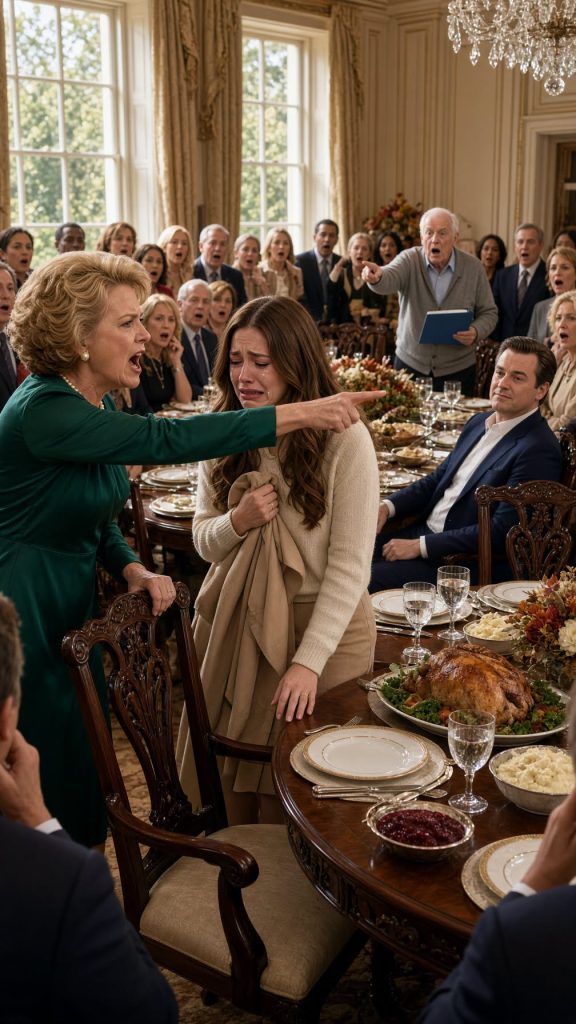
My wealthy mother-in-law dragged my chair away from the Thanksgiving table in front of twenty relatives. “The help eats in the kitchen,” she announced. My husband smiled and told me not to embarrass him. I reached for my coat, but his grandfather suddenly stood up and asked why nobody had told him I was coming.
The chair scraped across the hardwood so violently that twenty relatives turned from their Thanksgiving plates.
Patricia Whitmore had hooked her manicured hand around the back of my chair and dragged it three feet from the table.
“The help eats back there,” my mother-in-law announced, pointing toward the kitchen.
For a moment, I thought I had misheard her. My wedding ring was on my finger. My husband, Grant, sat less than an arm’s length away.
He smiled.
“Claire, don’t embarrass me,” he said quietly. “Just do what Mom asks.”
Aunt Denise lowered her fork. Someone near the windows laughed, then stopped when I looked over.
I had spent the morning arranging serving trays because Patricia said the caterers were short-staffed. I wasn’t an employee. I was her son’s wife, and the director of a neighborhood food pantry where people could eat without being judged. But in this room, neither fact seemed to matter.
“I came as family,” I said.
Patricia straightened the pearl necklace I’d once helped Grant choose for her birthday. “Family knows its place.”
I stared at Grant, waiting for him to stand.
He cut into his turkey.
The humiliation was sharp enough to make my eyes burn, but I refused to cry in front of them. I reached for my coat hanging on the chair by the doorway.
“Claire?”
The voice came from the far end of the table.
Arthur Whitmore, Grant’s eighty-two-year-old grandfather, was pushing himself upright. Everyone had told me he disliked visitors after his wife Ruth died. Grant had even claimed Arthur refused to meet me when we married ten months earlier.
Now the old man was staring at me as though he’d seen a ghost.
“Why wasn’t I told you were coming?” he asked.
Patricia moved quickly toward him. “Dad, please sit. You’re confused.”
“I know exactly who she is.”
His hand shook against the table, but his voice did not.
“Claire Bennett,” he said, using my maiden name. “You ran Ruth’s pantry. You were with her on the night she died.”
I went still. I had known Ruth as a kind volunteer who never mentioned her family fortune. Arthur had visited the pantry twice before his wife became ill.
“Mr. Whitmore?”
Arthur turned to Grant. “You told me your wife had never met Ruth.”
Grant’s fork clattered onto his plate.
Arthur reached beneath the table and lifted a blue folder.
“Then someone explain this,” he said. “Why does the agreement selling Ruth’s pantry building carry Claire’s signature?”
I stepped closer. I had never seen that agreement in my life.
The signature was almost perfect. Even the loop in the C looked right.
The date beneath it was October 14.
I remembered October 14. A newspaper photographer had caught me unloading food with thirty student volunteers that afternoon.
“I didn’t sign this,” I said.
Grant shoved back his chair. “It’s only an administrative release. Don’t make it something ugly.”
“An administrative release of what?”
Arthur answered before he could. “A thirty-year lease. Ruth arranged for the family foundation to purchase that building and let Second Table Pantry use it without rent. Your signature would release the lease so they can sell the property.”
Three weeks earlier, a lawyer had ordered the pantry to vacate by January. Grant had called it routine redevelopment. I believed him.
Patricia thrust out her hand. “Give me that folder, Arthur.”
He held it away.
“There was also a six-hundred-thousand-dollar grant,” he continued, looking at me. “The foundation’s annual report says you received it.”
My mouth went dry. Our pantry had received eighteen thousand dollars that year, barely enough for a new freezer.
“We never got six hundred thousand,” I whispered.
Grant walked toward me. For the first time that afternoon, he looked frightened.
“Claire, we can discuss this at home.”
“You mean the home where you keep telling me not to ask about the foundation?”
He caught my wrist. Not hard enough to bruise, but hard enough to stop me reaching for the folder.
“Let go,” I said.
Arthur slammed his cane against the floor. Grant released me.
“Ruth left instructions that the pantry remain open,” Arthur said. “I asked Patricia for proof the grant had been paid. She showed me a receipt with Claire’s name on it. I asked to speak to Claire personally. Three times.”
“I never heard from you,” I said.
“I know that now.”
Patricia stepped between us. “She took the money, Dad. Of course she’ll deny it.”
Then she opened her purse and produced a second document: a photocopy of a bank transfer bearing my printed name beside an account labeled Second Table Outreach LLC.
I scanned the numbers.
“That isn’t our account,” I said. “And that isn’t our organization’s legal name.”



