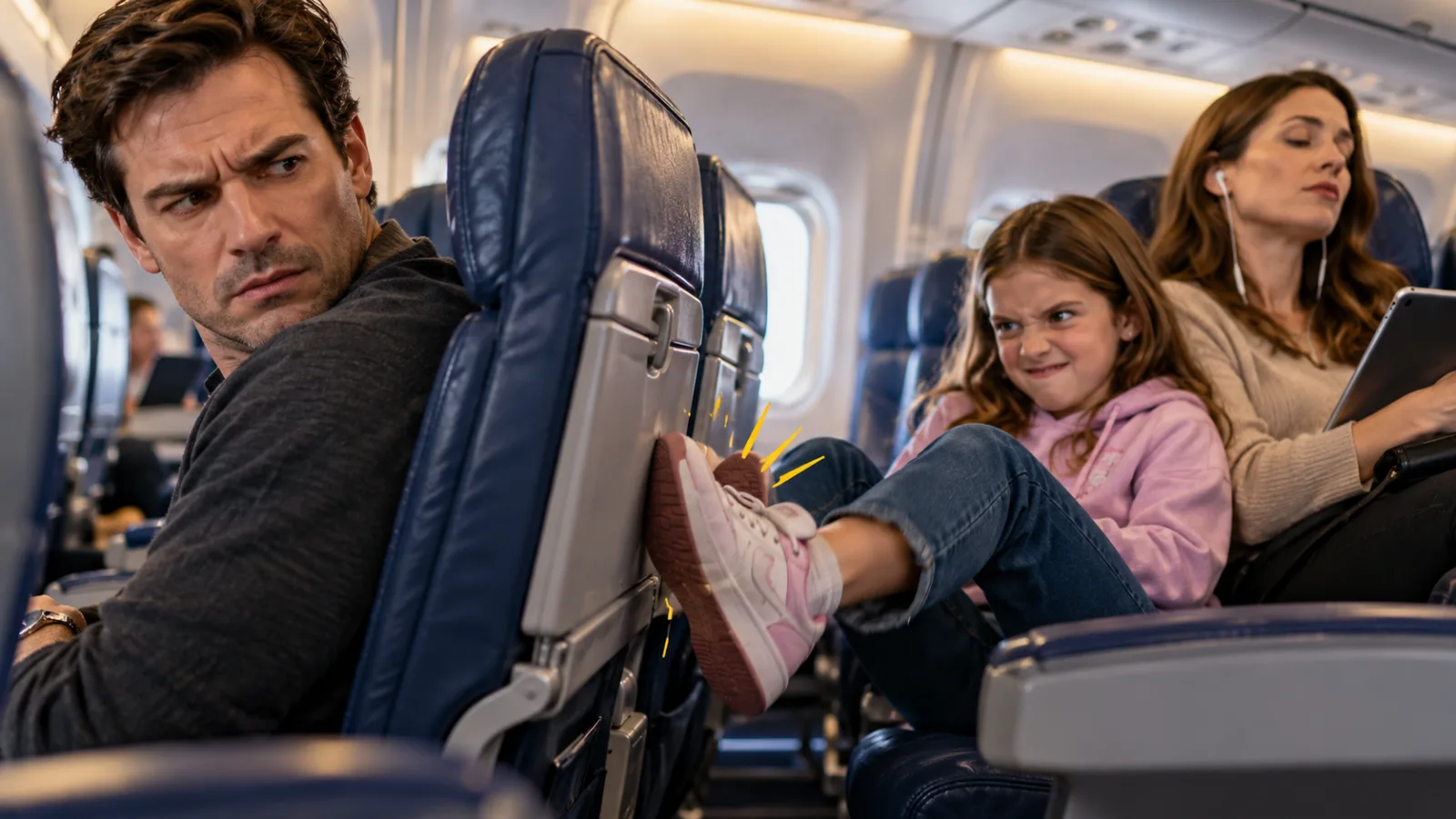
 The first kick came before the plane reached cruising altitude.
It landed between my shoulder blades with the sharp precision of a hammer striking a wall.
I looked at the flight map, told myself it was turbulence, and closed my eyes.
Then it happened again.
My name is Adrian Cole, and I had spent the previous six days speaking at a cardiology conference in Tokyo.
I was forty-three, a cardiac surgeon in Chicago, a husband to a patient woman named Elena, and the father of two boys who still believed I could fix almost anything.
I had been awake for nineteen hours.
All I wanted was to sleep until the cabin lights came on over the Pacific.
The third kick pushed my tray table against my ribs.
The airport in Tokyo had been unusually quiet when I arrived before dawn.
I had bought two miniature train sets for my boys and a small silk scarf for Elena, then checked my messages while the boarding agent made her announcements.
There was a voice mail from my youngest, who wanted to know if surgeons were allowed to eat candy in operating rooms.
I had recorded an answer explaining that candy was a poor substitute for sleep, even if his father occasionally wished otherwise.
The memory embarrassed me now, because I had been thinking almost exclusively about my own comfort since boarding.
I was not wrong to want sleep.
I was simply discovering how quickly reasonable needs can become blinders.
A man in the row ahead adjusted his neck pillow and immediately drifted off.
I envied him with a force disproportionate to the offense.
The cabin smelled of coffee and the faint chemical sweetness of cleaning products.
Overhead bins creaked as the aircraft climbed.
A baby cried somewhere near the rear galley, and another passenger whispered reassurance in a language I couldn’t identify.
Nobody complained about the baby.
There was a difference between an unavoidable sound and a deliberate impact against someone’s seat, and I held tightly to that distinction.
When Sophie kicked again, I could feel the little plastic hinge of my tray table rattle.
It made me think absurdly of the monitor alarms in the operating room, those tones the brain learns to identify even in sleep.
At work, I was the person everyone expected to remain controlled.
On the plane, I was a tired passenger struggling to remain civilized.
I did not know that both roles would matter before we landed.
I counted to ten.
I turned around.
A girl in a bright yellow sweatshirt sat directly behind me with one sneaker pressed against my seat.
She looked about ten.
Her mother wore oversized sunglasses indoors and watched a television drama on her tablet.
“Could you ask her to stop kicking?” I said.
The mother barely moved her head.
“She’s a child. Deal with it.”
I waited for the punch line that never came.
At the conference, my final presentation had been about the importance of distinguishing a warning sign from background noise.
A slide showed a line of heartbeat tracings that appeared nearly identical until one was examined more closely.
I had told an auditorium full of doctors that confidence was useful only after careful observation.
On the plane I was not applying my own lesson.
I had labeled the girl disrespectful, her mother impossible, and the next twelve hours ruined.
I hadn’t yet considered that a child could behave badly for reasons she didn’t understand herself.
In fairness, the first signs offered no reason to imagine anything complicated.
The mother had dismissed a simple request with contempt.
The girl had smiled.
Any passenger in my position would have been irritated.
What troubles me when I remember those minutes is not the irritation.
It is the certainty with which I believed the irritation explained everything.
“I’m asking politely.”
“And I’m answering politely.”
The girl smiled and kicked again.
I turned forward because I knew how easily anger could make a bad moment worse.
At the hospital, I had watched frightened families say terrible things to people who were trying to help.
I did not assume a rude sentence defined an entire person.
But the kicks became a rhythm, each one arriving just as my body began to relax.
Across the aisle, an elderly passenger lifted his eyes from a paperback.
Before boarding, I had talked to Elena for four minutes beside a vending machine.
She asked about the presentation, and I said it had gone well despite a microphone that failed at the worst possible moment.
She reminded me to drink water and promised the boys would be asleep by the time I crossed the ocean.
I promised to send a message when the aircraft landed.



