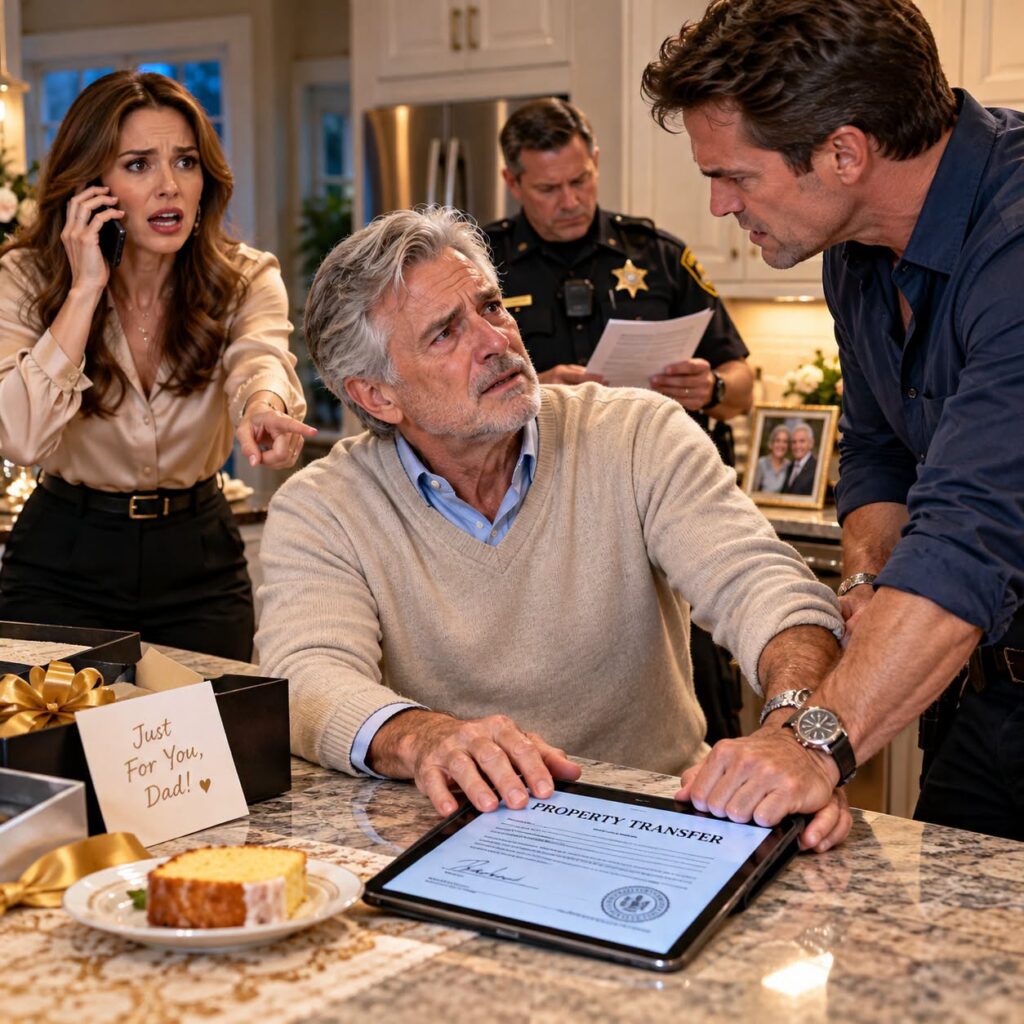
Judith had reported it stolen to the Ohio Secretary of State and filed a police report.
“I didn’t know whose name was on those papers,” she said. “Until I opened that ridiculous family folder.”
Brooke had forgotten the tablet was still signed into her own shared storage account. Judith found a draft deed, an unsigned loan application, and a spreadsheet named AFTER CLOSING.
The last file listed the same plan in three lines:
TRANSFER HOUSE.
BORROW $480,000.
PLACE WALTER IN ASSISTED LIVING.
My stomach went cold.
Then Judith told me the part that hurt worse.
“I heard Mason tell Brooke what to do. He’s the one who copied your signature from those old insurance forms. Brooke was supposed to handle the paperwork.”
For twenty-nine years, I’d investigated people who believed a forged signature could turn a lie into money.
My own son had learned the lesson from watching me work.
The deputy checked the county recorder’s public index. The deed had already been recorded at 3:18. The new owner was an LLC registered to Mason.
Brooke started crying. “He said Dad agreed!”
Mason snapped, “Shut up.”
My attorney called back just as the deputy was requesting a fraud investigator.
He’d reached the private lender named in Judith’s files.
“The deed is only step one,” he said. “They’re using the house as collateral.”
I asked when the money would go out.
“Nine tomorrow morning.”
And then he told me the lender’s file contained a second forgery: my signed statement that I’d gifted Mason the house voluntarily.
“Then we’re going to give them a reason not to send a dime,” I told my attorney.
He didn’t tell me to confront Mason. He told me to preserve everything.
I emailed him the photographs, Judith’s messages, the original gift receipt, and the camera clip showing exactly when she came and went. The deputy gave me a case number. Judith sent over her stolen-stamp report and the copy of her notary journal showing no entry for my deed.
Before midnight, my attorney sent a written fraud notice to the lender and its title company. I spoke to the lender’s fraud department myself. I explained that my signature was forged, the notarial act never happened, and the supposed medical assessment was fraudulent.
The lender put the wire on hold pending investigation.
At eight the next morning, I was sitting beside my attorney, not hiding in my bedroom like Mason had planned.
He filed suit to cancel the fraudulent deed and clear my title, along with an emergency request to prevent any further transfer or lien. We also notified the county recorder and asked for a property-record alert.
None of it erased the deed overnight. Real justice rarely moves that fast.
But it stopped Mason from turning my home into cash.
The investigation uncovered more than I’d seen on the tablet. Mason owed money after diverting payments from customers at his struggling contracting company. The lender’s file contained my forged driver’s-license acknowledgment and a medical letter from a doctor whose office confirmed he hadn’t examined me.
Brooke had submitted the deed through a recording service using Judith’s stolen seal. She’d also written the assisted-living plan, complete with a monthly budget for a facility three counties away.
When detectives interviewed Judith, she handed them the text Brooke had sent after the tablet went missing from her control:
IF MOM SAW THOSE FILES, WE’RE FINISHED.
Judith cried when she gave them her phone.
“She is my daughter,” she said. “But you’re somebody’s father.”
Mason pleaded with me to call it a misunderstanding. He said he’d planned to pay everything back.
“You didn’t borrow from me,” I said. “You forged me out of my own life.”
Months passed. My title was restored through the civil case. The loan never funded. Mason ultimately pleaded guilty to felony charges related to the forged deed and attempted fraud. He received a prison sentence and was ordered to pay restitution. Brooke accepted a separate plea agreement that included probation, restitution, and community service.
I didn’t celebrate either sentence.
My granddaughter, Hazel, was eleven. With the court’s involvement, she stayed with Judith while her parents’ cases worked their way through the system. I saw her every Sunday. We made pancakes, and I never asked her to carry our anger.
On my next birthday, she handed me a homemade card.
It showed our little brick house beneath a bright yellow sun.
“I drew the door open,” she said, “because you always open it for me.”
I taped it beside the kitchen window, exactly where Mason had pinned my wrist.
They tried to steal the house my wife and I built, but the thing they truly lost was the right to call it home.



