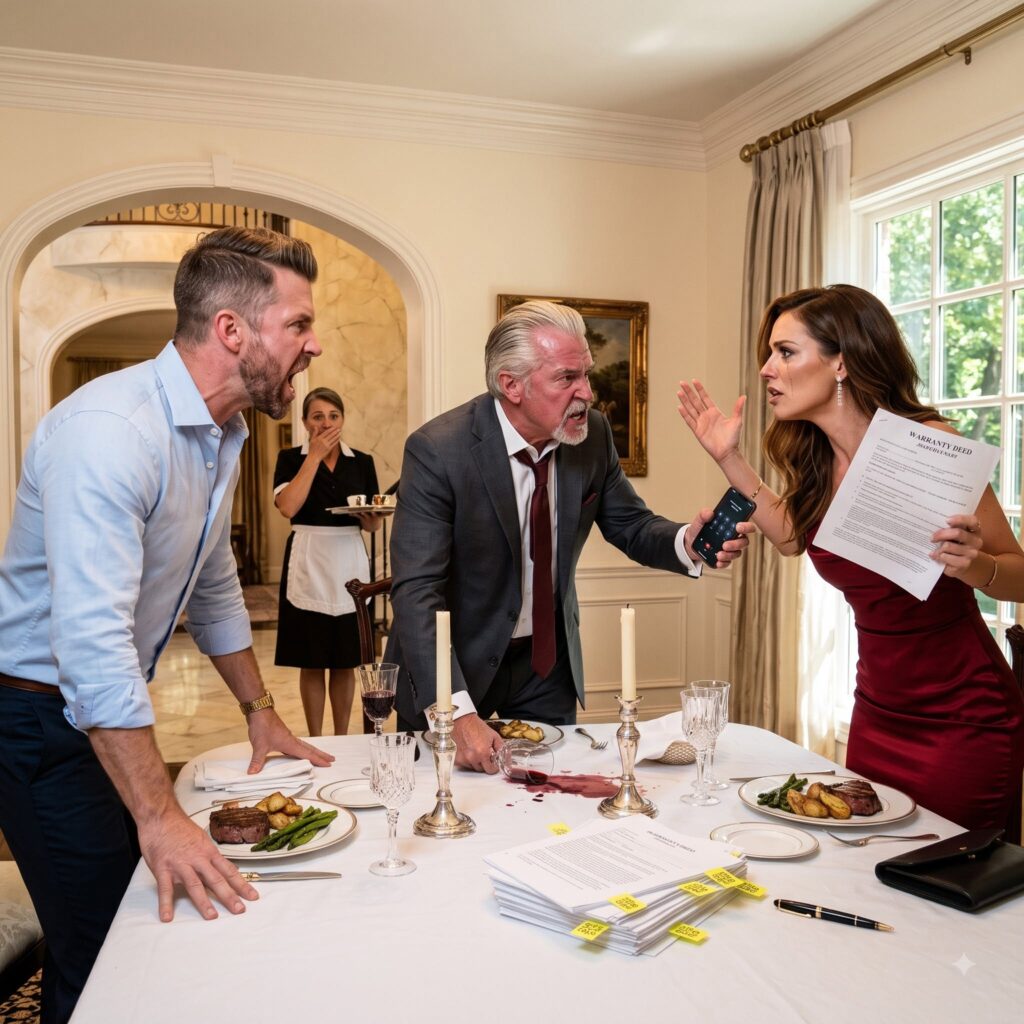
Richard stood, his voice low and cold. “You’ll sign that house back by Monday. If you don’t, I’ll tell a judge you manipulated a grieving widower into giving you his home. Who do you think Harris County believes, a Whitmore or a school counselor?”
“Let’s find out,” I said.
I turned my phone face up on the table. A call was active, four minutes and thirty-eight seconds, on speaker.
A woman’s voice came through, calm and crisp.
“Mr. Whitmore, my name is Dana Ruiz. I represent the forty families of Cypress Creek. I’ve heard everything. I think you and I need to talk.”
Richard lunged for the phone. I pulled it back.
“Texas is a one-party consent state, Richard,” I said. “I’m a party to this conversation. It’s legal.”
“Mr. Whitmore,” Dana said through the speaker, “I’d strongly advise you to call your attorney tonight. You’ll be hearing from me in the morning.”
The call ended.
Richard sank back into his chair. For the first time in nine years, the most powerful man I knew looked small, old, and afraid.
Grant just stared at the cold steak on his plate.
I stood up, smoothed my dress, and walked upstairs to my bedroom. I locked the door, and for the first time that night, I let myself shake.
It had started three months earlier with an iPad.
Grant left it on the kitchen counter, still logged in, and a message lit up the screen. It was from Kayleigh: Can’t wait till she’s gone. Your dad says the house will be ours by summer.
I scrolled up. There were months of messages. Then I found a thread between Grant and his father. One line from Richard stuck in my head: Make sure the QCD is buried in the settlement papers. She won’t read it.
I didn’t know what a QCD was. I looked it up in the school parking lot the next morning. It meant quitclaim deed.
That afternoon, I hired a divorce attorney named Monica Feld. She pulled the Harris County property records and called me back an hour later.
“Hannah,” she said, “do you know you own the house you live in?”
I remembered the day in 2019. Richard had called me into his office downtown, all smiles. He said it was “estate planning,” “boring tax stuff,” and “trust me, sweetheart.” I signed where he pointed. He took me to lunch at Brennan’s afterward. I thought it meant he was finally accepting me into the family.
Monica found the date of the deed. Then she searched the court records and found Cypress Creek. She found Richard’s sworn deposition, dated sixteen days after he signed his house over to me, saying he owned no real estate.
I didn’t sleep that night. I kept thinking about that little girl’s cracked bedroom floor.
So I found Dana Ruiz, the families’ attorney. She listened to everything and said, “A deed proves he moved the house. But a judge will want to know why. If he ever admits it out loud, call me.”
So for six Sundays, I carried that deed in my purse to dinner, waiting for the night they finally made their move. Every week, before I walked in, I called Dana and left the line open.
On the seventh Sunday, Grant cut into his steak.
Everything collapsed quickly after that.
Dana filed a motion to reopen the Cypress Creek settlement for fraud, with the gift deed, the IRS gift tax return, Richard’s deposition, and four minutes and thirty-eight seconds of his own voice. Richard’s lawyers took one look and told him to settle.
He agreed to a personal judgment of $7.2 million for the forty families. Whitmore Homes filed for bankruptcy. His lake house, his boat, and his collection of vintage Porsches were all sold. The Harris County District Attorney’s office charged him with aggravated perjury. At sixty-eight, he pleaded guilty and got ten years of probation. He’ll never build another house in Texas.
Grant’s divorce was final sixty-one days after that dinner. Because the house was my separate property, his lawyer told him he had no claim to it at all. He walked away with his truck, his golf clubs, and half of a joint savings account that turned out to be much smaller than he remembered.
Kayleigh left him three weeks after Richard’s accounts were frozen.
Last month, Grant sent me a text at two in the morning: I’m sorry. I was a coward. You deserved better.
I read it. I didn’t answer. Some apologies are meant to be received, not returned.
Here’s the part nobody expected, including me.
I didn’t keep the house.
Legally, it was mine. Monica said I’d earned every inch of it. But every time I walked through those marble halls, I thought about cracked foundations in Cypress Creek and a family that had been lied to so a rich man could keep his home.



