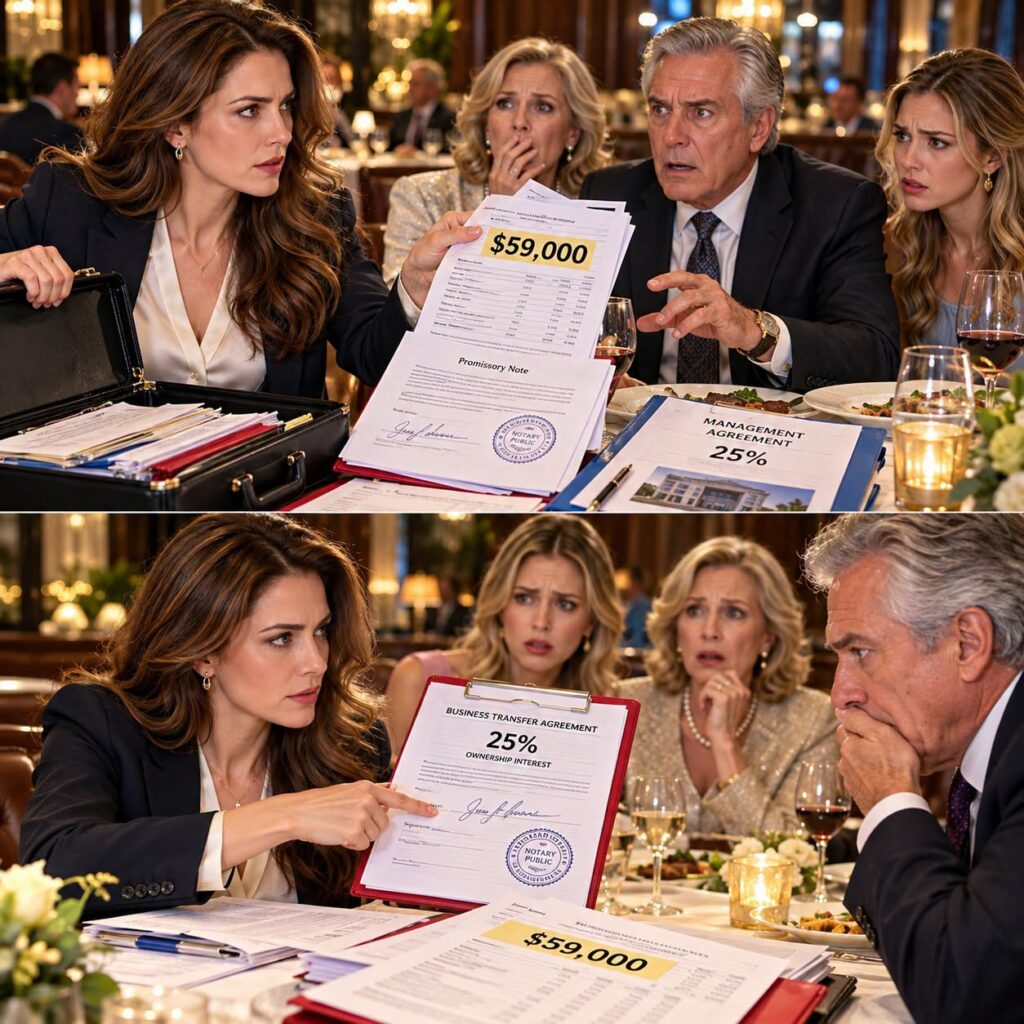
She had spotted something I had missed. The packet referenced a proposed $180,000 business credit line secured by clinic receivables.
My father had not simply tried to install my sister.
He had tried to create paperwork making it appear that he had authority to restructure my company, then use that supposed restructuring to support a loan application.
I called the bank’s fraud department.
The loan had not funded, but an application existed.
My name was on it.
So was Lauren’s.
When I returned to the table, Dad was standing. “We’re leaving.”
“No,” Lauren said.
It was the first time all night she sounded certain.
She turned to me and told me Dad had called her three weeks earlier claiming I was exhausted, planning to reduce my hours, and wanted her to join the clinic. He said the twenty-five percent was my idea.
I stared at him.
He had lied to both of us.
Then Lauren pulled out her phone.
“There’s more.”
She showed me an email Dad had sent her. Attached was a PDF labeled MEMBER CONSENT FINAL.
The date on it was six days earlier.
I had been in Boston that day at a medical conference.
The document claimed I had signed it in Charlotte in front of a notary.
Melissa called me back while I was still staring at the screen.
“Rachel,” she said, “I checked the notary registration.”
My father went completely still.
“The commission number on that seal,” she continued, “belongs to someone whose commission expired last year.”
Dad grabbed his coat.
And for the first time, I understood why he had been so desperate to make me sign something at dinner.
I stood between my father and the restaurant exit.
“You’re not taking those documents.”
He looked furious, but he also looked scared.
Mom asked him one question. “How much trouble are we in?”
That broke him.
The truth came out in pieces.
Dad’s consulting business had been failing for almost a year. He had hidden tax debt, maxed out two business credit cards, and refinanced their house. The $59,000 he owed me had not disappeared. He had been using every spare dollar to keep creditors away.
Then he decided my clinic could solve everything.
He knew I would never borrow money for him, so he created a story in which Lauren was joining the business, I was supposedly stepping back, and he was “helping” reorganize operations. The forged papers were meant to make his involvement look legitimate long enough for the bank to approve the credit line.
He said he intended to repay it before I noticed.
That sentence ended whatever sympathy I had left.
The next morning, Melissa and I met with the bank’s fraud investigator. Lauren came too. She signed a statement confirming she had never authorized the loan application or agreed to the documents Dad submitted in her name.
Melissa sent formal notices revoking any authority Dad might claim over my business. We changed passwords, added security codes to financial accounts, notified my accountant, and reviewed every filing connected to Harborview Dermatology.
There was no secret transfer of ownership. No valid twenty-five-percent interest. No funded loan.
But there was enough forged paperwork that Dad had to hire his own attorney.
My parents wanted me to “handle it privately.” I agreed to only one private matter: the money they actually owed me.
Through their attorney, they signed a repayment agreement for the full $59,000. Dad sold his fishing boat, cashed out a small brokerage account, and paid me $41,000 within a month. The remaining $18,000 came over the next six months.
The bank handled the suspected fraud separately. I gave them every document I had and stopped protecting Dad from the consequences of his choices.
Lauren and I took longer to repair things.
She admitted she had been tempted by the clinic because she was embarrassed about her business failing. But she also showed me every message Dad had sent and apologized for believing him without calling me first.
We eventually had coffee, just the two of us.
“I never wanted your clinic,” she said. “I wanted to stop feeling like the family disappointment.”
I understood that more than she realized.
I helped her find a small-business mentor, but I did not give her a job.
Six months later, Harborview had its best quarter ever.
My parents were no longer involved in my finances, my business, or my decisions. Family dinners became rare. Nobody brought contracts.
I kept the enlarged forged signature in my office safe.
Not because I wanted to stay angry, but because it reminded me of the night I stopped confusing family pressure with family loyalty.
Dad had brought legal papers to dinner expecting me to surrender twenty-five percent of what I built.



