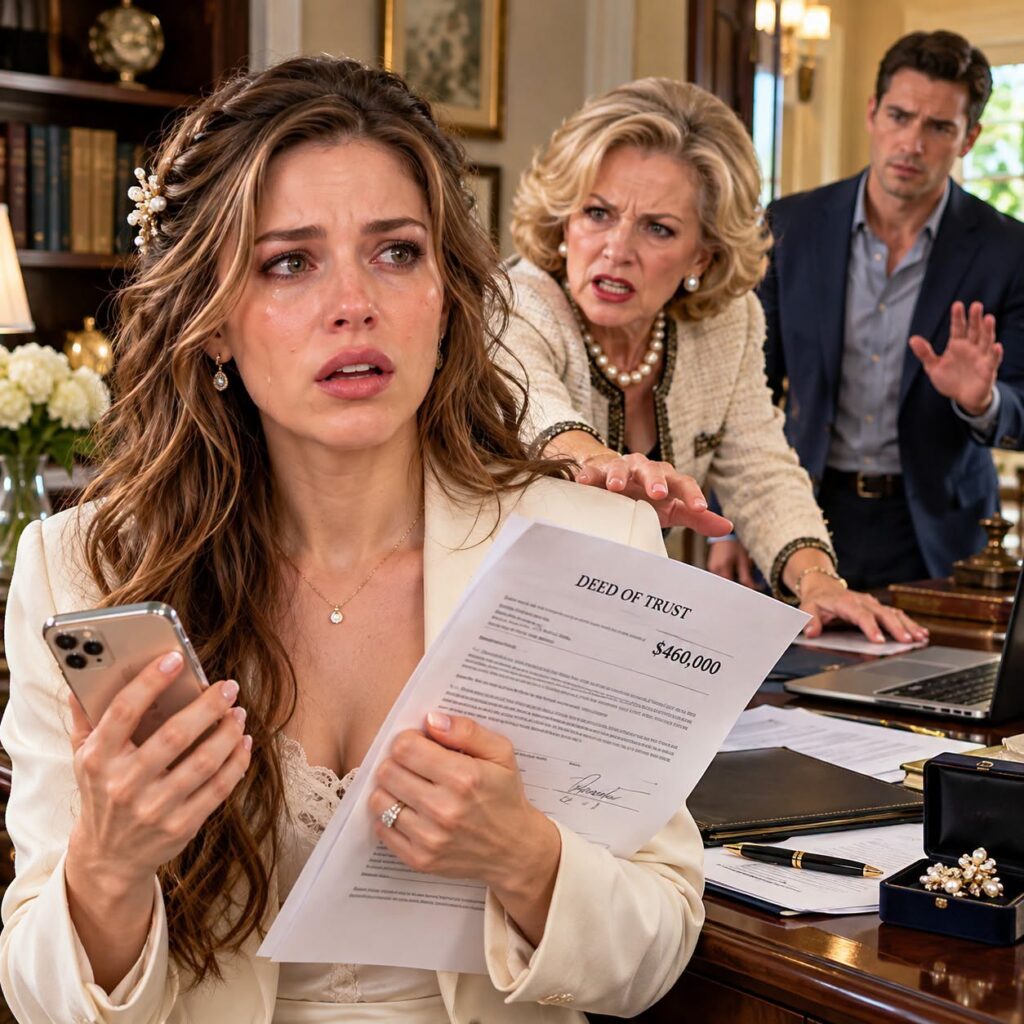
I thought Evan and I had met by chance at a charity auction two years earlier. Leah shook her head. He’d found my home’s value in public records and paid her to arrange our “accidental” meeting.
She’d taken the money. She wouldn’t look at me while admitting it, which somehow hurt worse than seeing the check.
The room seemed to tilt.
“Our entire relationship?” I asked.
“He said he’d fallen in love with you for real.”
I laughed once, a horrible sound.
Leah admitted she’d notarized the deed after Judith claimed I’d signed it. She hadn’t witnessed anything. She hadn’t even called me.
“But there’s more,” she said.
She played a voicemail she’d saved after she began fearing Judith would blame everything on her.
Evan’s voice came through the speaker.
“The wedding keeps her distracted. Once the wire clears, Mom and I can pay the investors and get out. Claire won’t realize what happened until the first payment notice.”
I went cold.
Evan hadn’t wanted a wife. He’d wanted an address with equity.
My phone rang. Denise.
“Claire, the lender just confirmed something,” she said. “They received a draw authorization an hour ago.”
“But I never signed one.”
“I know. They’re investigating. And the wire was released forty minutes ago.”
I stared at Leah’s check and the recording on her screen.
Then Denise told me where the money had gone.
“Into an account bearing your name.”
“That isn’t my account,” I told Denise.
“I believe you. But we need proof quickly.”
I gave her the last four digits of my accounts. None matched. I called my bank’s fraud line, placed credit alerts, and filed an identity-theft report while she contacted the receiving bank.
Leah handed over the check, voicemail, and Judith’s messages. She admitted in writing she’d stamped the deed without me.
I didn’t forgive her. I needed the truth more than another apology.
At the police station, a detective compared the forged draw authorization with the signature on my driver’s license. The handwriting wasn’t even close. The fraudulent account had been opened online using copies of my identification Evan had kept from our honeymoon booking.
When the detective asked about my documents, I remembered Evan “organizing” our travel folder.
I had thanked him.
By evening, the receiving bank had frozen what remained of the transfer. Evan and Judith had already moved part of it to pay overdue debts tied to his failing construction business. Investigators began tracing those payments; the lender suspended further advances.
Denise filed an emergency civil action challenging the lien and seeking to prevent any foreclosure or additional transfer. The paperwork couldn’t undo the betrayal, but it gave me a way to defend the house through a court instead of a shouting match.
The next morning, the hour I should have been getting my hair done, Evan appeared on my porch.
He was carrying my wedding bouquet.
“Claire, please. Mom pushed me into this. We can fix it together.”
I left the chain on the door.
“You had months to tell me.”
He held out the flowers like they were evidence of love.
“I meant the vows.”
“You meant the wire.”
His face hardened. “You’re really going to destroy my family?”
“No,” I said. “I’m going to tell the truth about what your family did.”
I closed the door and gave the doorbell recording to the detective.
The wedding never happened. I returned what gifts I could, lost money on nonrefundable deposits, and endured weeks of well-meaning relatives asking whether a misunderstanding could be repaired.
I stopped answering that question.
Over the following months, investigators assembled bank records, Leah’s messages, and the forged documents. Leah surrendered her notary commission, pleaded guilty to a lesser charge, and received probation after cooperating. Evan pleaded guilty to fraud and forgery and received a prison sentence. Judith also pleaded guilty and received a shorter prison sentence. She avoided my eyes in court.
The lender ultimately agreed to release its claim after examining the evidence, and the fraudulent deed of trust was formally cleared from my property records. Not every dollar was recovered, but the house remained mine.
On the second anniversary of the wedding that wasn’t, I took Judith’s pearl hairpin out of a drawer and placed it in an envelope for my attorney to return.
Then I opened every window in my mother’s house.
Fresh air swept through the rooms Evan had tried to turn into collateral.
They had forged my name because they thought my love made me powerless.
They learned too late that they could counterfeit my signature, but they could never counterfeit my consent.



