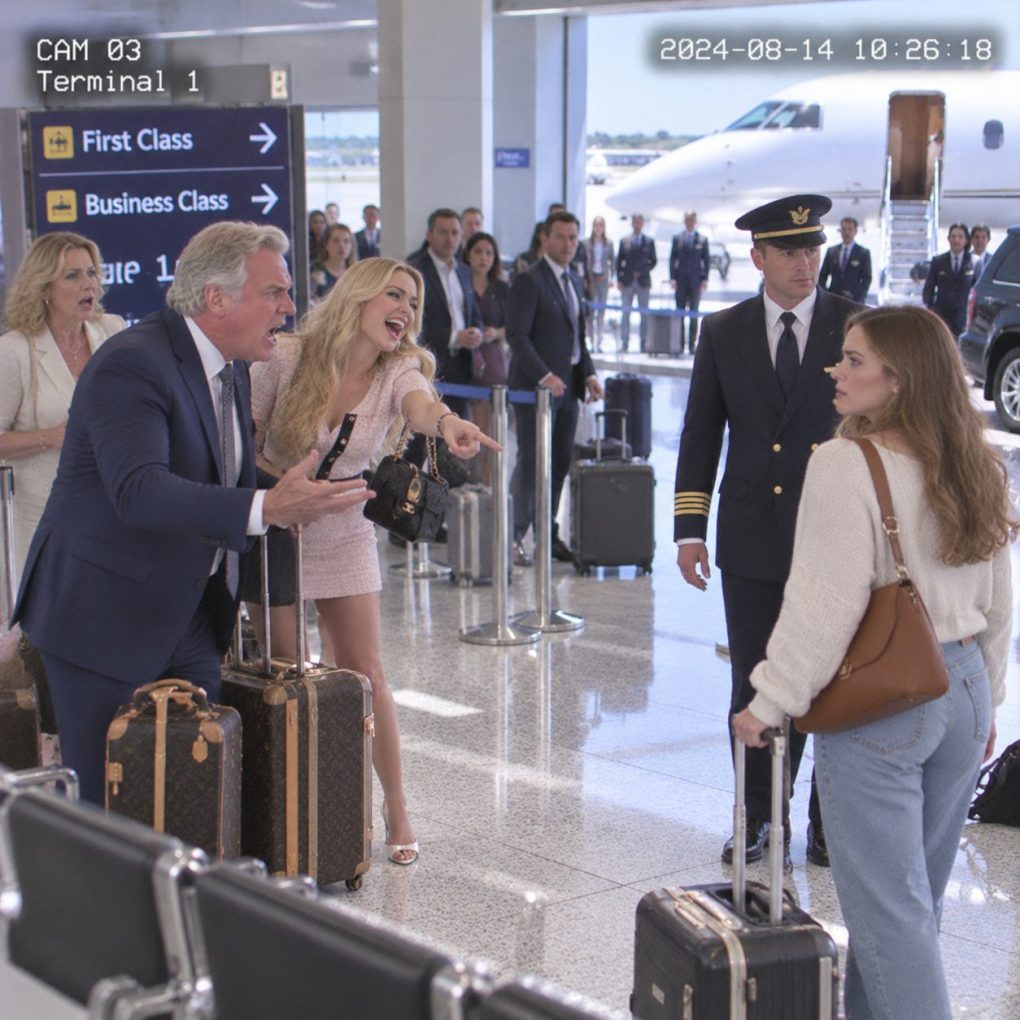
Dad said it loudly enough for the first-class lounge attendant to hear. “Don’t worry about Claire. She can’t even afford economy.” My stepsister Savannah laughed, adjusting the silk scarf around her neck while her fiancé wheeled two designer suitcases toward the priority boarding lane. “Maybe she can ask for a seat near the bathroom,” she said. My stepmother covered her smile with a coffee cup. I stood beside my carry-on and said nothing.
We were at Dulles, all supposedly traveling to San Francisco for Dad’s retirement celebration. At least, that was what he had told me when he invited me three weeks earlier. What he neglected to mention was that he had purchased first-class tickets for himself, my stepmother, Savannah, and Savannah’s fiancé, Grant. He assumed I would buy my own. When I asked for the itinerary, Dad texted back, You’re thirty-four. Figure it out. So I did. I simply never told him how.
For most of my adult life, my family believed I worked in “shipping.” Dad used that word because it sounded appropriately unimpressive beside Savannah’s career in luxury real estate. The truth was that I had spent twelve years building Meridian Aero Logistics, a company that moved critical medical equipment, semiconductor components, and emergency cargo across the country. We started with one leased turboprop and five employees. Six months earlier, a private-equity investment valued the company at just over $190 million. I still owned the largest individual stake.
Dad knew none of that because he had stopped asking meaningful questions about my life years ago. When I told him I had become CEO, he said, “That’s nice.” When Meridian opened offices in Dallas and Seattle, Mom’s old friends congratulated me online before my own father noticed. Meanwhile, every minor promotion Savannah received earned a family dinner.
The gate agent announced first-class boarding. Savannah hugged Dad. “Best retirement trip ever.” Then she looked at me. “Seriously, Claire, what flight are you taking?” I checked my watch. “Mine leaves in about twenty minutes.” Grant smirked. “Spirit?” Dad laughed. “If she’s lucky.”
That was when a man in a navy flight uniform approached from behind me. Captain David Lawson had flown Meridian’s executive aircraft for almost three years. He nodded politely toward my family, then addressed me. “Ms. Bennett, your jet is fueled. We can depart whenever you’re ready.”
Nobody moved.
Savannah’s smile vanished first.
Dad stared at the captain, then at me. “Your what?”
Through the terminal windows, across the service road toward the private aviation ramp, a black SUV was already waiting to transfer me to a Gulfstream G500 carrying Meridian’s silver insignia near the tail.
I picked up my bag.
Dad grabbed my arm—not hard, but fast. “Claire, whose plane is that?”
“Meridian’s.”
“You mean your company lets you use that?”
I looked at him.
“My company owns it.”
Grant’s expression changed instantly. Unlike my family, he knew exactly what Meridian Aero Logistics was.
And that was when I noticed something even stranger.
He looked frightened.
“Claire Bennett?” he repeated.
“Yes.”
Grant slowly lowered his phone.
Dad frowned. “What’s wrong with you?”
Grant ignored him and stared at me.
“Meridian Aero?”
“Yes.”
His face went pale.
Then he whispered, “You’re the Claire Bennett reviewing the Pacific Crest contract?”
I stopped.
Pacific Crest was the logistics contract Meridian’s board would vote on the following morning.
A contract worth nearly $38 million over five years.
And the company bidding for it belonged to Grant’s family.
Nobody had ever told me Savannah’s fiancé was connected to it.
Before I could answer, my phone buzzed.
My general counsel.
Urgent: We found undisclosed related-party payments in Pacific Crest’s proposal. Do not discuss the bid with anyone connected to the applicant.
I read the message twice.
Then looked up at Grant.
Dad was still smiling proudly at Savannah, completely unaware that the “poor daughter who couldn’t afford economy” was about to board the aircraft carrying the person who could expose the deal his golden child had been bragging about for months.
I did not discuss the Pacific Crest bid at the airport. In fact, I told Grant immediately that because of my newly discovered family connection, I could no longer speak with him about the proposal outside formal channels. Then I boarded Meridian’s plane and asked our general counsel, Monica Reyes, to document the conflict.
The family arrived in San Francisco almost two hours after I did. By then, Monica had already briefed me. Pacific Crest Freight Systems was seeking to become one of Meridian’s preferred domestic ground carriers. The bid was not glamorous, but it was valuable: roughly $38 million in expected revenue over five years if service targets were met.



