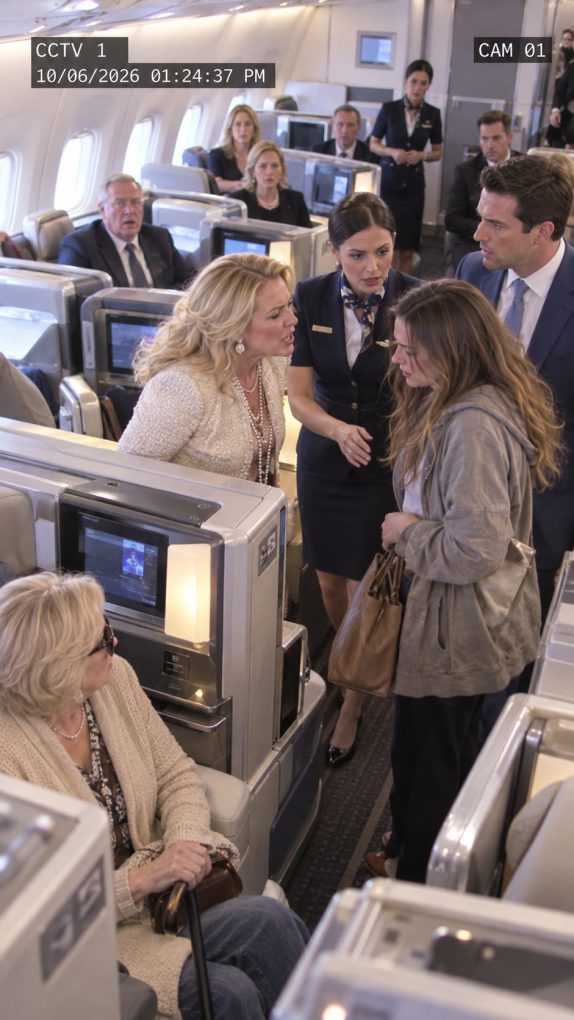
\
The flight attendant did not ask to see my boarding pass before deciding I did not belong in first class
She looked at my faded gray coat, the scuffed sneakers I had bought at a drugstore that morning, and the canvas tote bag resting beneath Seat 2A. Then she leaned toward the senior attendant and said loudly enough for half the cabin to hear, “Get this poor woman off the plane. Right now. She’s contaminating the air in first class.”
A few passengers laughed.
I did not.
Twenty-four hours earlier, a storm had flooded part of my hometown outside Des Moines. I had spent the night helping my eighty-year-old aunt move boxes from her basement, ruined my shoes in muddy water, and missed the car service that was supposed to take me to the airport. I had changed in a gas-station restroom, bought the cheapest sneakers I could find, and boarded Flight 417 looking nothing like the woman whose photograph appeared in annual reports.
That suited me perfectly.
I was Eleanor Hayes, chairwoman of Hayes Meridian Capital.
Six months earlier, my firm had acquired 61 percent of NorthStar Atlantic Airways after leading its restructuring.
I did not run cabin service. I did not schedule crews. I did not personally hire flight attendants.
But I did own the controlling stake in the company whose employee was now trying to remove me from a seat I had purchased.
“I’m assigned to 2A,” I said.
The attendant, Monica, glanced at my phone without really reading it.
“There’s been a seating error.”
“No, there hasn’t.”
Her expression hardened.
A man across the aisle chuckled. “She probably wandered up from economy.”
Monica smiled at him.
Then she turned back to me.
“Ma’am, don’t make this difficult.”
I could have ended the scene immediately by giving my name.
I chose not to.
“Why exactly am I being removed?”
Monica lowered her voice, but not enough.
“We have standards in this cabin.”
That sentence mattered more than the insult.
The captain had not requested my removal. I was not intoxicated, disruptive, threatening, or improperly ticketed. Nobody had shown me a policy violation because none existed.
So I opened the voice recorder on my phone.
“Please explain the standard.”
Monica finally called a gate supervisor.
Five minutes later, a man named Trevor boarded, glanced at me, then at Monica, and said, “Let’s just relocate her so we can close the door.”
“Relocate me where?”
“Economy. We’ll refund the difference.”
I looked at his badge.
Then I asked one question.
“Are you documenting the reason?”
Trevor froze.
Before he could answer, another man stepped onto the aircraft carrying a tablet.
He wore a NorthStar executive badge.
I recognized him.
Chief Operating Officer Daniel Reeves.
He had come to inspect the departure after a morning operations meeting.
Daniel looked toward Seat 2A.
Then stopped.
“Ms. Hayes?”
The cabin went silent.
Monica looked between us.
Trevor’s face drained.
Daniel walked closer.
“I didn’t know you were flying today.”
“I know.”
Then I turned my phone toward him.
“Apparently neither did they.”
Monica whispered, “Who is she?”
Daniel answered without taking his eyes off me.
“The woman whose firm owns controlling interest in this airline.”
Nobody laughed after that.
But I did not ask for anyone to be fired.
I simply said, “Delay the door closure five minutes.”
Then I handed Daniel my phone.
“Listen to the recording.”
Daniel listened to the recording in the jet bridge while I remained seated. He did not shout at Monica or Trevor, and he did not stage a public firing for the passengers. He called corporate compliance and told the gate to preserve the boarding records, seat map, internal messages, and any available terminal video before the flight departed.
The important question was not whether Monica had insulted the controlling shareholder. It was whether she and Trevor had treated an ordinary passenger improperly. My ownership could not become the reason the conduct suddenly mattered. If the same words would have been acceptable toward someone without power, then the airline had a deeper problem.
The flight eventually departed with me still in 2A. Monica was replaced before pushback because Daniel believed continuing the service interaction could compromise both safety and the internal review. Another qualified crew member covered the position. Trevor was removed from that departure process pending review.
I spent the three-hour flight reading NorthStar’s customer-service policy. Appearance was not a basis for denying a purchased cabin assignment. Employees could intervene for safety, intoxication, disruptive behavior, hygiene concerns that met specific operational thresholds, or ticketing problems. “Looks poor” appeared nowhere.



