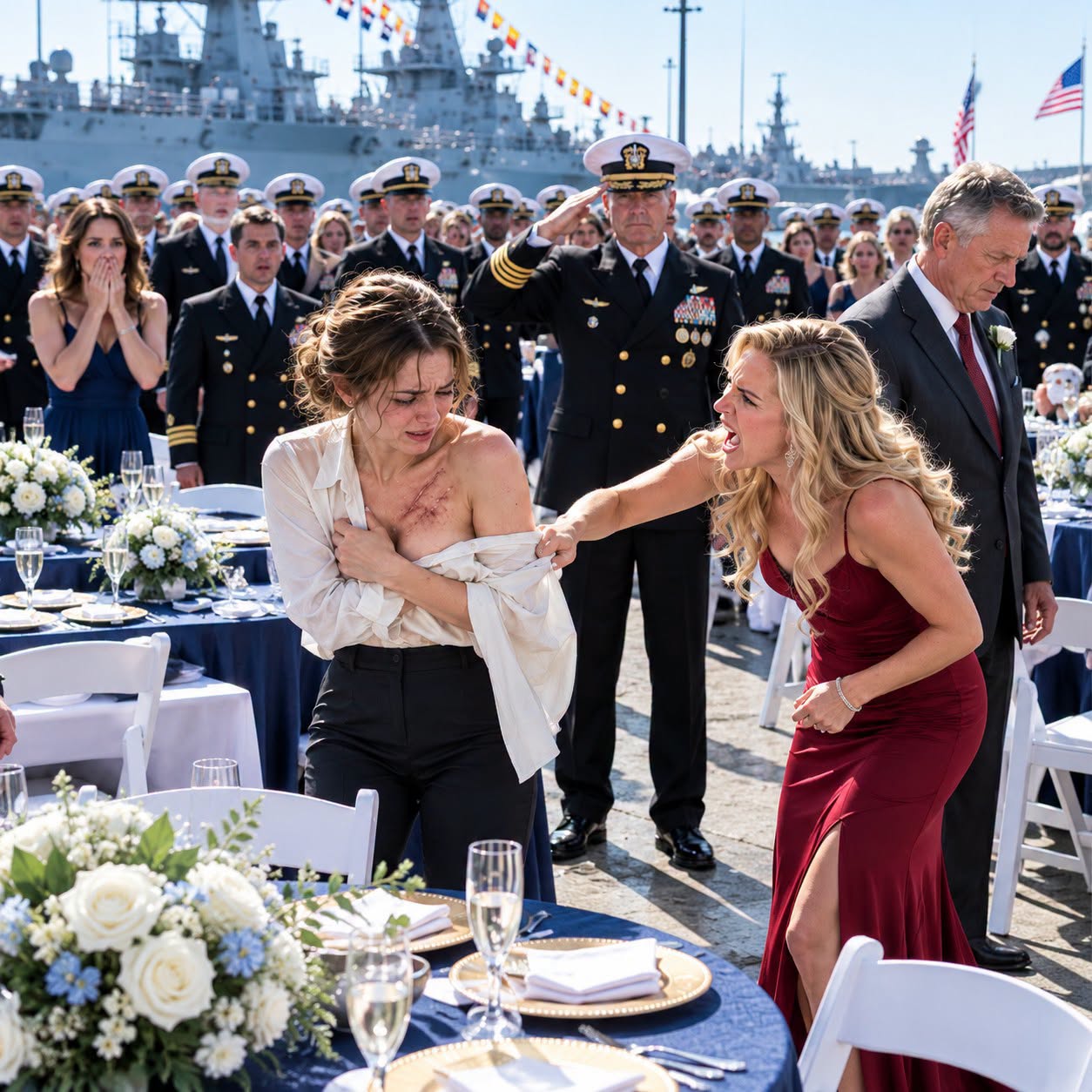
The ballroom of the Norfolk Waterside Marriott smelled of polished brass, prime rib, and old sea salt masked by lavender wax. It was a scent Captain Hugh Alden, USN (Ret.), wore like an ancestral shroud. For fifty years, our family name had belonged to Norfolk’s blue-and-gold aristocracy. In my father’s mind, there were only two kinds of people who walked the earth: those who served with spotless records until retirement, and those who brought dishonor upon the wardroom.
For five years, I had occupied a third, unspoken category: the ghost.
I wore high-collared navy silk, tailored with structured shoulders and an opaque back that rose cleanly to the nape of my neck. Underneath the fabric, the skin was not skin at all, but a tapestry of meshed allografts, rigid fibrous bands, and keloid ridges that pulled hard whenever I reached across a table. To the casual eye, I looked like an executive who had stepped away from the service to pursue private enterprise—a choice my father considered an act of quiet cowardice, but one he tolerated in public as long as I kept my chin up and my mouth shut.
“Stand straight, Maya,” my father muttered, barely parting his lips as Commander Douglas Vance strolled past with a tumbler of bourbon. “Your slouch makes your jacket pull. You look like a junior lieutenant waiting for mast.”
“I’m standing straight, Dad,” I said quietly, keeping my hands lightly clasped over my clutch.
“You look tense. People will think you regret leaving.” He took a crisp sip of his seltzer and lime. He had stopped drinking liquor after his third bypass, but his tone retained the bite of ninety-proof bourbon. “Try to smile. Marin’s husband is trying to close a contract with NAVSEA tonight. The least you can do is not look like a dark cloud hovering over their table.”
Across the crowded parquet floor, my younger sister Marin was radiant. She wore a sleeveless backless gown of champagne satin, her blonde hair pinned in a crown of effortless curls that caught the chandelier light. Beside her stood Gregory, her husband of three years, an executive vice president at Titan Marine Logistics. Gregory had never served a day in uniform, but he possessed the aggressive, toothy smile of a man who sold auxiliary diesel gaskets to procurement boards at four hundred percent markup.
Marin caught my eye, waved a manicured hand, and excused herself from a circle of junior officers. She drifted toward us, her silk train whispering against the carpet.
“Look at you, Maya,” Marin purred, stepping between me and our father. She reached out and touched my high neckline, her fingernail grazing the stiffened collar. “Still dressing like a church librarian in August? It’s seventy-two degrees in here. You must be suffocating.”
“I’m fine, Marin,” I said evenly.
“Well, you don’t look fine. You look like you’re hiding.” She turned her dazzling smile onto Dad. “Doesn’t she, Daddy? We brought her out of that drafty little apartment in Portsmouth so she could socialize with normal human beings, and she’s standing by the potted ficus like an escort.”
My father let out a dry, dismissive breath. “Leave your sister alone, Marin. Just make sure Gregory doesn’t corner Admiral Harris until after dinner. Harris hates business talk before the salad course.”
“Oh, Gregory doesn’t need Harris,” Marin said smoothly. Her eyes flickered back to me, sharpening with a predator’s focus. “Actually, Maya, that reminds me. Gregory needs an introduction to Captain Miller over at SUPSHIP. Miller was your old skipper on the Vanguard, wasn’t he?”
My chest tightened beneath the silk. “Miller was my commanding officer five years ago, yes.”
“Great. Titan Marine just released a new line of rapid-seal thermal cut-off valves for auxiliary engine rooms. Gregory needs Miller to sign off on an accelerated field evaluation. Take him over there and give Gregory your personal recommendation.”
I looked across the room at Captain Miller, now grey-haired and thick-waisted, speaking with a pair of supply corps commanders. Then I looked at Marin. “Has the valve completed independent shock-and-vibe testing at NAVSSES?”
Marin blinked, annoyed. “What does that matter? It passed the preliminary factory bench run. Gregory says it’s fine.”
“Factory bench runs don’t simulate a ruptured high-pressure steam line or a secondary electrical fire in sea state five,” I replied, keeping my voice low and level. “If the valve hasn’t cleared Naval Surface Warfare Center certification, I won’t ask Miller to bypass protocol. I won’t put my name behind it.”
Marin’s jaw stiffened. A delicate flush crept up her neck, clashing with the champagne silk. “You won’t put your name behind it? What name, Maya? What name do you actually have left in this room?”
“Marin,” I warned softly.



