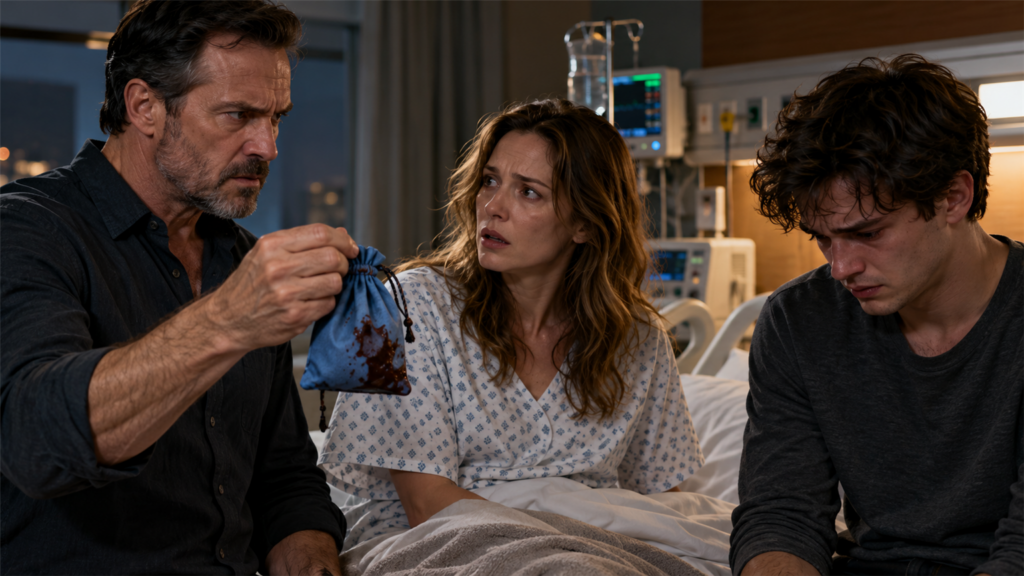
Jason’s jaw tightened.
Mom reached for my blanket.
“Stop asking questions that will ruin your brother’s future.”
I pulled the blanket away.
My father appeared in the doorway just as she spoke.
For several seconds, nobody moved.
Then Dad asked Jason to tell him exactly what had happened.
Jason stared at the floor.
Mom said, “It was harmless.”
Dad looked at her.
“You keep saying that. Why?”
Two days later, investigators arranged for us to review a relevant portion of the elevator-area security footage as part of the ongoing investigation.
I sat beside Dad in a small conference room. Mom and Jason attended voluntarily.
The investigator started the recording.
At 8:43 p.m., Jason appeared beside the elevators.
He glanced around, opened my purse, and removed the blue pouch.
Dad leaned forward.
“Pause it.”
The investigator stopped the video.
Dad wasn’t looking at Jason anymore.
He was staring at my mother, visible near the elevator doors.
Because the next frame showed her reaching toward Jason’s hand.
“Play it,” Dad said.
His voice sounded different. Not louder. Just tired.
The investigator resumed the recording.
I watched Jason pull my blue medication pouch from my purse. Mom reached for it, examined the white initials Grandma had sewn onto the front, and handed it back to him.
Then she smiled.
Jason tucked it inside his jacket.
Thirty seconds later, he gave me the brownie.
My father sat perfectly still.
“You saw him take it?” he asked Mom.
She pressed her lips together.
“I thought he was teasing her.”
“You knew what was in that pouch.”
“I didn’t think anything would happen.”
On the screen, I accepted the brownie. Jason watched me eat while leaning against the elevator.
Less than two minutes later, I reached for my purse.
The recording showed me searching frantically, then looking directly at Jason.
He laughed.
When my knees began to buckle, Mom remained beside him.
Only after I collapsed did she step forward.
Dad pushed his chair back.
“Turn it off.”
Nobody moved.
He looked at Mom.
“You watched our daughter fall to the floor, and you told the nurse she was pretending?”
Mom’s eyes filled.
“I didn’t know it was that serious.”
I remembered being eight, waking in a hospital bed while Dad sat beside me with a stuffed rabbit he’d bought from the gift shop. Mom had been there too. She’d spent that entire night listening as the doctor explained the danger of another severe allergic reaction.
She knew.
Maybe she’d convinced herself Jason was harmless. Maybe admitting the truth meant admitting she’d spent years excusing his cruelty.
But she’d watched him take my emergency medication.
That wasn’t something she could explain away.
The investigator clarified that the video established what happened in the hallway, not precisely what the brownie contained. Further testing and interviews would determine that.
Jason eventually admitted he’d deliberately brought a brownie containing peanuts, knowing about my allergy. He claimed he expected me to notice before swallowing it and that hiding my medication was supposed to frighten me.
His own words made the situation worse.
I’d trusted him when he said the brownie was safe.
And he’d been counting on that trust.
Investigators documented his admissions, the footage, my medical records, and witness statements. Jason was charged in connection with the incident. Months later, he accepted a plea agreement that included probation, counseling, community service, and restitution for some of my expenses.
The outcome didn’t erase the emergency room, the fear, or the weeks I spent checking my purse repeatedly whenever I left home.
My mother wasn’t charged. Investigators found that she had known about the missing pouch but hadn’t established that she’d planned the food exposure.
That distinction mattered legally.
It didn’t change what I’d watched her do.
Dad moved into a small apartment several weeks later. He told Mom he needed time to decide what their marriage would look like after this.
He began visiting me on Saturday mornings, bringing coffee and sitting at my kitchen table without insisting that I forgive anyone.
Sometimes we spoke about Grandpa. Sometimes we didn’t speak at all.
One morning, Dad noticed Grandma’s blue pouch lying beside my keys.
“Still carrying that old thing?” he asked.
I nodded.
The white stitching had faded, and one corner was beginning to fray.
“Grandma made it,” I said.
He picked it up carefully.
“She stayed up half the night sewing those letters. Remember?”
I smiled.
“She made the E backward the first time.”
Dad laughed softly, then wiped his eyes.
A few months later, my mother wrote me a letter.
She didn’t ask me to forgive Jason.
For the first time, she didn’t call the incident a prank.
She wrote that she’d protected his feelings at the expense of my safety, and that she’d understood what the medication was for.



