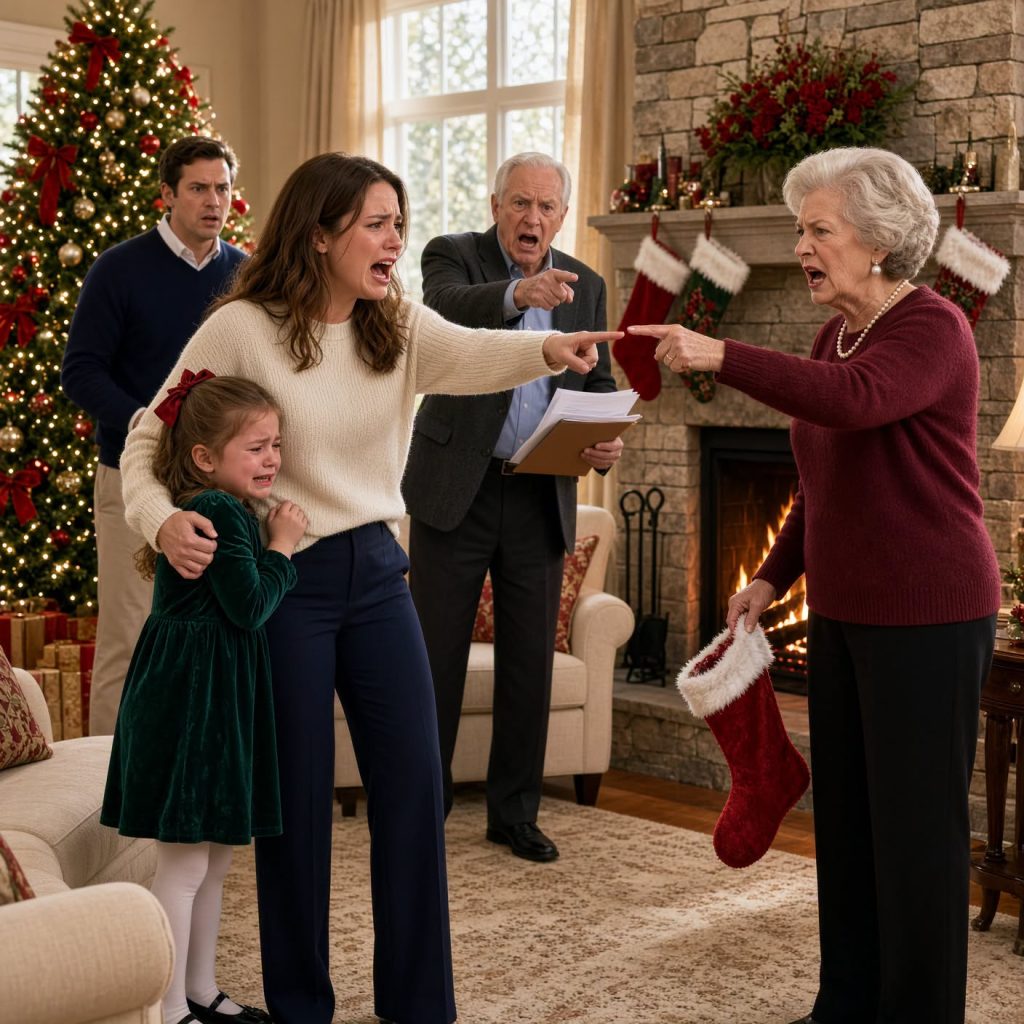
The accusation hung in the air like a slap. Across the room, Vanessa’s eyes widened, her gaze flicking toward me with sudden calculation.
“That’s a lie,” I said, my voice ringing clear in the quiet room. “I never asked you for a dime. We haven’t even spoken on the phone since Thanksgiving.”
“Don’t raise your voice in my home,” Patricia retorted, color rising in her cheeks. “You’re always so quick to play the victim, Claire, whenever anyone points out the truth.”
“I’m not playing anything, Patricia. You’re lying to your husband in front of our children.”
Robert didn’t argue with either of us. He turned, crossed the Persian rug to the mahogany sideboard, and reached into the inside pocket of his wool overcoat hanging on the brass hall tree. When he turned back, he was holding a crisp manila envelope.
“That’s strange,” Robert said, walking slowly back toward the center of the room. “Because I received a letter at my post office box last week saying almost exactly that.”
He slid a single typed page from the envelope and held it out toward me. I took one step forward, keeping my arm wrapped tightly around Grace’s shoulders, and looked down at the sheet.
It was dated November fourteenth. The text was brief, polite, and entirely fabricated: Dear Robert, thank you so much for your generosity toward the children this holiday season. Because Grace already has more toys than she needs, Daniel and I have decided it would be best if Patricia gave us Grace’s three-thousand-dollar gift allocation directly in cash so we can put it toward household expenses. Warmly, Claire.
At the bottom was my name, signed in sweeping, looping cursive that looked vaguely like mine at a glance—except I never looped the top of my capital C, and I always dotted my i with a firm slash rather than a circle.
“This isn’t my signature,” I said, holding the paper up so Daniel could see it. “Look at the C. Look at the slant. Somebody traced this off a birthday card or a check.”
Before I could speak another word, Daniel reached out and took the paper from my fingers. His eyes scanned the typed lines, dropped to the signature, and then lingered on the faint crease where a second sheet had been paper-clipped behind it. His face changed—the warmth draining out of his skin until he looked pale beneath the warm glow of the Christmas tree lights.
“Mom,” Daniel whispered, his voice barely audible over the crackle of the fire, “why is my signature on the second page?”
Patricia’s hand flew to her throat. “Daniel, don’t be ridiculous. Let me see that—”
Robert didn’t let her take it. He pulled the second sheet from the envelope and turned it toward his son, holding it steady so every person in the room could see the letterhead of Arthur Vance, the estate attorney who had managed the Miller family trusts for twenty years.
“Because someone asked my attorney to remove Grace from the family education fund,” Robert said, his voice dropping into a register so cold it made the hair on my arms stand up. “And that someone claimed to be you.”
Chapter 2 – The Paper Trail
For three full seconds, nobody breathed.
Then Vanessa let out a sharp, involuntary gasp, clapping a hand over her mouth as she stared at the letterhead in Robert’s hand. Beside the tree, Mason finally dropped the silver-foil box onto the carpet with a dull thud.
“Dad, what is that?” Daniel asked, his voice tight as he stared at the document. He reached out with his free hand, and Robert surrendered the second page.
I leaned in beside my husband, keeping Grace pressed securely against my side, and read the text under Arthur Vance’s law firm header. It was an Irrevocable Beneficiary Waiver and Amendment Request, dated November eighteenth—four days after the fake letter bearing my name.
The document stated that Daniel Miller, as adoptive father and legal guardian of minor child Grace Miller, formally declined Grace’s inclusion in the Miller Grandchildren’s Educational Trust, citing “sufficient alternative financial provisions” and requesting that Grace’s designated one-third share of the trust’s annual distributions be reallocated equally between the two biological grandchildren, Mason Miller and Ella Miller.
At the bottom, above the line reading Daniel R. Miller, was a signature in blue ink. Underneath it was a witness signature line, signed in neat, cramped handwriting: Vanessa Miller-Hollis.
Daniel’s head snapped up, his eyes locking onto his sister across the room. “Vanessa? You witnessed this?”



