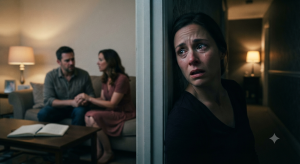
My father was explaining how he intended to steal my three-million-dollar Boston apartment when I heard my mother calmly suggest changing the locks before my plane landed in Paris.
I stood outside the sunroom of my parents’ sprawling suburban estate, holding a stack of old family photographs against my chest, while the three people who were supposed to love me discussed how quickly they could erase me from my own home.
“Three weeks is more than enough time to take possession of Clara’s apartment,” my father, Richard, said.
His voice carried the effortless authority he used whenever he believed he was entitled to make decisions for everyone else.
“She’ll throw a tantrum for a few days, then she’ll give in.”
My mother, Eleanor, answered without hesitation.
“We wait until her flight takes off, get the locksmith inside, and have her belongings removed before she knows what’s happening.”
I felt the edges of the photographs press into my fingers.
Beyond the partially open sunroom door, I could see my father’s reflection in the polished glass of a cabinet.
He was leaning comfortably in his favorite leather chair, holding a cup of coffee as though he were discussing a routine household repair.
My mother sat opposite him with her planner open across her knees.
Between them sat my younger sister, Chloe, looking at something on her phone.
None of them sounded worried.
None of them sounded ashamed.
And none of them had any idea I was listening.
“The realtor needs access immediately,” my mother continued.
My father nodded.
“The Boston market is strong, and that place could solve Chloe’s problems in one transaction.”
I pressed my back against the hallway wall.
My apartment.
The historic Back Bay property my grandfather Arthur had legally left to me before he died.
The home where I had spent countless afternoons listening to him play his magnificent Steinway piano.
The place where he had taught me chess, patience, and the importance of recognizing a person’s intentions before trusting their words.
The only property in my life that nobody had ever made me feel guilty for owning.
My father continued speaking.
“Clara has always been practical, so she’ll eventually understand that Chloe needs it more.”
There it was.
The sentence that had shaped my childhood and followed me into adulthood like a shadow.
Chloe needs it more.
I had heard those words when my parents used money intended for my college expenses to help Chloe attend an expensive summer program.
I heard them again when Chloe abandoned her master’s degree in London after one semester and my parents paid the resulting bills.
I heard them when she needed a luxury wellness retreat in Sedona because she felt emotionally exhausted.
I heard them when she decided her apartment in Cambridge needed expensive furniture to match the image she wanted to project.
And I heard them when her technology startup collapsed after she spent more time celebrating its launch than building an actual business.
Every crisis ended the same way.
Chloe cried.
My mother reassured her.
My father reached for his checkbook.
And eventually, someone suggested that I should contribute because I was responsible, financially stable, and supposedly less interested in expensive things.
I had spent years trying to explain that responsibility didn’t make my money communal property.
My parents always responded as though I had revealed a terrible character flaw.
They called me selfish.
They accused me of lacking compassion.
They reminded me that family members were supposed to support one another.
Yet family support always seemed to move in one direction.
Toward Chloe.
Never toward me.
I listened as my sister finally spoke.
“Are you sure the apartment will sell quickly?”
Her voice sounded bright with anticipation.
My stomach turned.
She wasn’t objecting to the plan.
She wasn’t asking whether I would consent.
She was wondering when she could spend the proceeds.
Dad gave a confident laugh.
“Back Bay properties like Clara’s don’t sit around waiting for buyers.”
Mom turned a page in her planner.
“We’ll have everything arranged before she comes home.”
Chloe sighed.
“Good, because I can’t keep dealing with these people.”
I didn’t know the exact size of her latest debts.
I only knew that my parents had been unusually tense whenever her finances came up.
Chloe had stopped mentioning the startup that was supposed to make her wealthy before thirty.
Her social media accounts still displayed designer restaurants, expensive vacations, and carefully photographed outfits.
But behind that polished image, another financial disaster had apparently grown large enough for my parents to consider stealing a home.
My home.
Grandpa Arthur’s home.
I looked down at the photographs in my hands.
The picture on top showed my grandfather sitting beside me at his piano when I was twelve.



