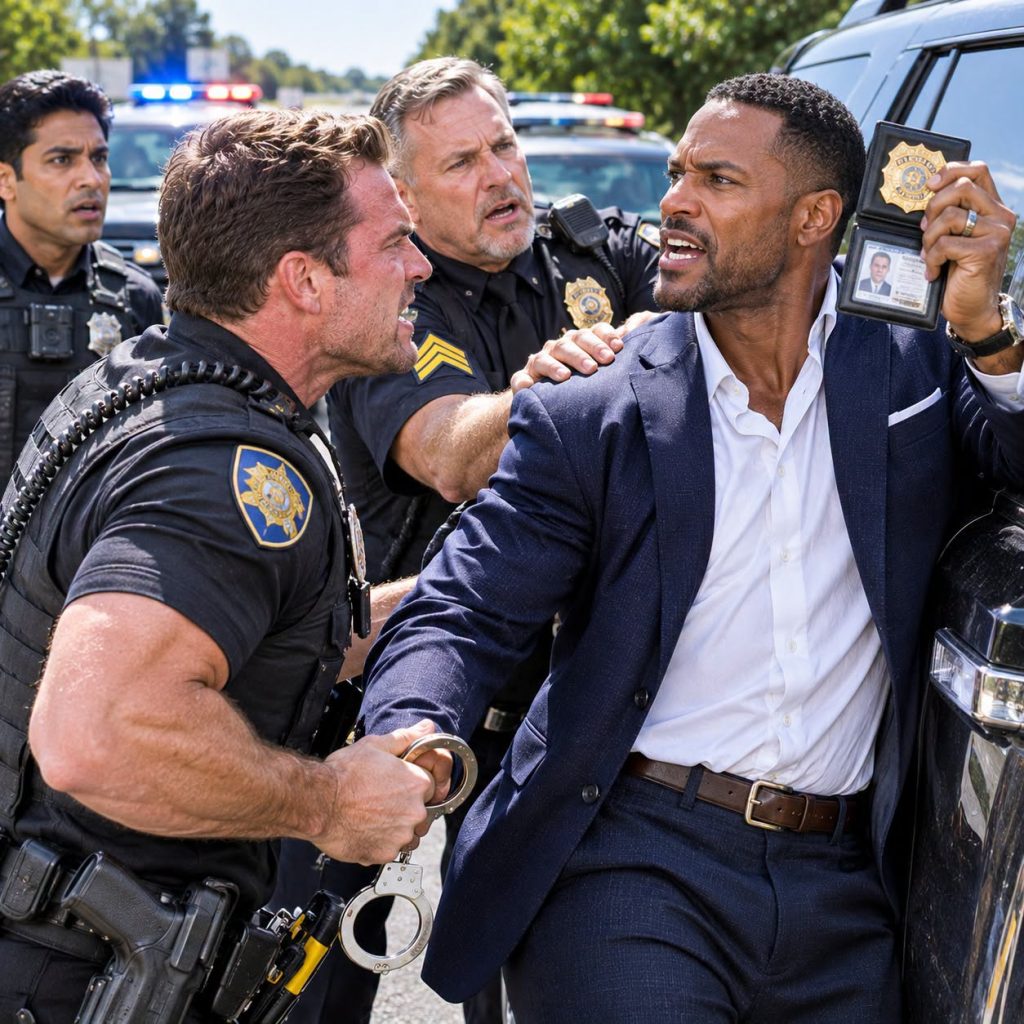
Nobody moved. Sarah looked at her own name glowing on the screen. “That isn’t me.” Reigns folded his arms. “Convenient.” I pointed to the door. “Lock the building down.” Voss scoffed. “You don’t have the authority while you’re under investigation.” “I became commanding officer at 4:00. It’s 4:19. I absolutely do.” I looked at the Internal Affairs lieutenant. “Nobody leaves.” Reigns stepped toward me. “You think that badge saves you?” “No,” I said. “The evidence does.” Sarah suddenly grabbed my arm. “The evidence server.” She pulled me toward the technical room. Reigns tried to follow, but one of the IA officers blocked him. We entered the server room and found a civilian IT contractor crouched beside an open terminal. He bolted. I caught him at the hallway door. We slammed against the wall, and a flash drive fell from his hand. “Who sent you?” I demanded. “I don’t know what you’re talking about!” Sarah picked up the drive using a glove. “His name is Raymond Cole,” she said. I recognized the face immediately. “The tow-truck driver.”
Cole broke within twenty minutes. Voss had paid him to use an old administrator backdoor that should have been removed months earlier. Reigns identified drivers likely to have cash, expensive vehicles, immigration concerns, old warrants, or reasons to avoid police contact. He demanded roadside payments. Anyone who refused could be searched, cited, or towed. Westbridge Towing collected the vehicles and inflated storage charges. Voss buried complaints and arranged convenient body-camera “failures.” In return, the towing company routed money through a consulting firm registered to Voss’s wife. But the biggest surprise came from the system they had tried to use against me. Before taking command, headquarters had installed an enhanced evidence-control program under my credentials. Every administrative change created a hidden duplicate timestamp on an isolated server. Voss knew about the visible logs. He didn’t know about the duplicates. Sarah compared them. “Here,” she said. “Your account supposedly modified the files at 3:42.” “I was still on Highway 61.” “Exactly. And the duplicate log shows the command originated from Voss’s workstation using Cole’s maintenance token.” She looked at me. “They framed you before you even reached the precinct.”
We moved fast. Harold Jennings arrived with bank records showing a five-hundred-dollar cash withdrawal minutes before one of his stops. Robert Torres brought photographs of Reigns standing beside a Westbridge tow truck while Voss watched from his cruiser. Patel provided uninterrupted body-camera footage from the highway, including Voss ordering him to deactivate the camera. My audio recorder captured the rest: Reigns’s demand, Voss’s threat, and the whispered words—“You should’ve taken the five hundred.” By evening, state investigators had warrants. I walked into the briefing room where Reigns and Voss had been separated. Reigns stood when he saw me. “This is political.” “No,” I said. “It’s arithmetic. Fourteen complaints. Repeated camera failures. Dozens of tows. Thousands in payments. One attempted frame-up.” Voss lunged suddenly, knocking a chair sideways and reaching for the evidence folder on the table. I caught his wrist. He drove into me, but two state investigators seized him from behind. Reigns tried for the side door. Patel stepped into his path. “Don’t,” he said quietly. Reigns stopped.
I personally read the charges while investigators placed them in cuffs: extortion, official misconduct, evidence tampering, conspiracy, obstruction, and additional counts pending financial review. Voss stared at me as the cuffs clicked. “You think you fixed anything?” “Not tonight,” I said. “But tonight it stops getting worse.” Reigns looked at Patel. “You picked the wrong side.” Patel shook his head. “There were never supposed to be sides.” Weeks later, Westbridge Towing lost its municipal contracts. Victims were contacted for reimbursement proceedings. Every complaint closed by Voss was reopened under outside review. Several officers who had remained silent came forward. Others resigned. Sarah Kim was promoted to lead the department’s new integrity unit, and Officer Patel received formal recognition—not for choosing me, but for choosing the camera when his supervisor ordered darkness. On my first quiet morning as captain, I placed my scratched recorder in the top drawer of my desk. I kept it as a reminder of the strangest first day of my career. Derek Reigns had looked through the window of an expensive SUV, seen a Black man he believed he could intimidate, and decided five hundred dollars was worth the risk. He never imagined the man behind the wheel would be commanding his precinct hours later. But the real lesson wasn’t that he picked the wrong driver. It was that nobody with a badge should ever be allowed to believe there is a right driver to exploit.
What do you think of this story? Please leave a like and share your thoughts in the comments. Your support means a lot to us and inspires us to keep writing more meaningful and powerful stories. Thank you! 👍❤️



