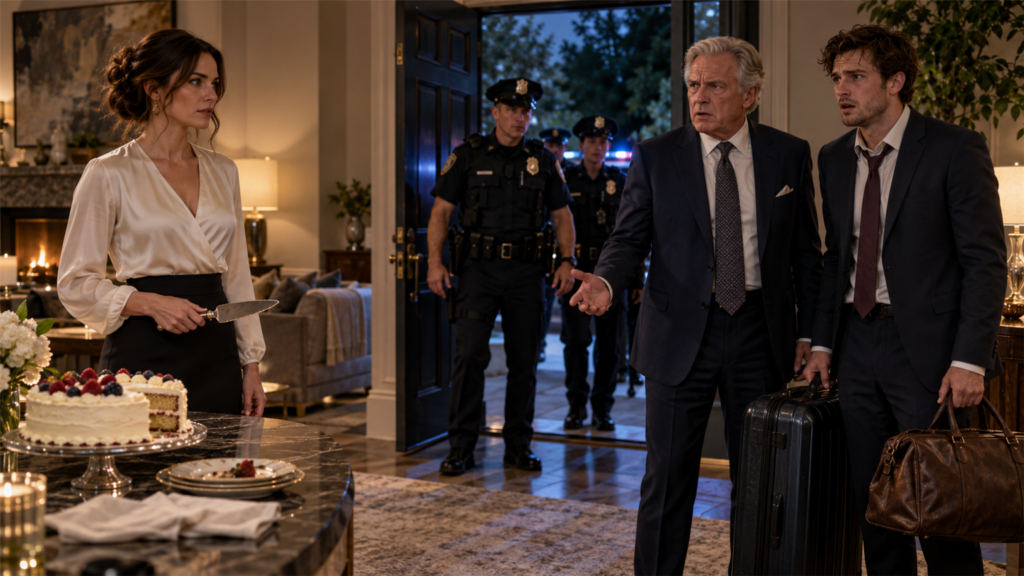
“Enough, Tyler.”
I watched my father’s thumb rub repeatedly against his wedding ring.
Mr. Collins looked at me again.
“Has your brother ever lived here?”
“No. He doesn’t have a lease, and I’ve never given him permission to move in.”
Dad’s face reddened.
“She’s making this unnecessarily complicated.”
I finally took the folded paper from my pocket.
It was a copy of the written notice I’d sent Tyler after his attempt to enter the house. It clearly stated that he had no permission to enter or occupy my property.
“I sent this three days ago,” I said. “He acknowledged receiving it.”
Tyler’s smile disappeared.
“You seriously sent me legal paperwork?”
“I sent you a boundary.”
Dad stepped toward me.
“You’re going to destroy this family over a bedroom?”
“No,” I replied. “I’m protecting my home.”
He grabbed Tyler’s smaller suitcase and pushed it across the threshold into my hallway.
“There. He’s inside. Now you can deal with it.”
I looked at the suitcase, then at my father.
“Dad, please take it back outside.”
“Make me.”
Mr. Collins raised a hand.
“Richard, stop. I did not advise you to do that.”
But my father was already reaching for his phone.
“I’ll call whoever I have to. You’re not throwing your brother onto the street.”
I heard footsteps on the porch.
Two uniformed officers appeared behind Mr. Collins.
My father turned, irritated.
“Who called the police?”
I set my birthday napkin on the table.
“I did.”
The younger officer looked from my father to the suitcase sitting in my hallway.
“Ma’am, are you the homeowner?”
“Yes,” I said. “My name is Emily Carter.”
“Did you request an officer because of a possible trespassing situation?”
“I called the non-emergency number earlier. I explained that relatives had threatened to come here and force their way into my home. The dispatcher told me to call again if they refused to leave.”
My father stared at me.
“You called the police on your own family?”
“I asked you to leave, Dad. More than once.”
Mr. Collins stepped aside.
“For the record,” he told the officers, “I was retained for a property dispute based on information that appears to have been inaccurate. I have not advised anyone to enter this residence.”
That was when my father finally stopped talking.
The officer asked to see my identification and the deed information I’d saved on my phone. After confirming the situation, he explained that my brother had no automatic right to move into my home simply because we were related.
Then he turned toward Tyler.
“Do you have permission from the homeowner to stay here?”
Tyler looked at Dad.
“I’m asking you,” the officer repeated.
“No,” Tyler muttered.
“Then you need to take your belongings and leave.”
My father stepped forward.
“You can’t just throw my son out!”
“Sir, lower your voice. We’re asking everyone to remain calm.”
Tyler bent down and grabbed his suitcase.
For the first time that afternoon, he looked less like someone collecting the keys to a new home and more like a man carrying everything he owned.
I remembered him at eleven years old, sitting on my bedroom floor after a nightmare because he was afraid to sleep alone.
For years, I’d been the person he called when something went wrong.
I’d bought groceries when he lost his first job. Paid a mechanic when his car broke down. Sent him money twice when his rent was overdue.
Somewhere along the way, helping him had become something he expected rather than appreciated.
“Emily,” he said quietly, “where am I supposed to go?”
“I offered to help you find an apartment.”
“Dad said I could stay here.”
I looked at our father.
“He didn’t have the right to promise that.”
My father swallowed.
Mr. Collins closed his briefcase.
“Richard, I suggest we leave before this becomes more serious.”
The officers did not arrest anyone. They documented the complaint, and my father and brother left with their belongings after being warned not to return without permission.
The guests slowly began collecting their coats.
Rachel stayed behind to help me clean up.
Neither of us said much as we folded the tablecloth and put the uneaten cake into containers.
When I reached for the knife, I noticed a smear of pink frosting on my sleeve.
I’d worn that blouse because my mother had given it to me for Christmas.
She died six years earlier.
She used to say that a home should be somewhere you could close the door and feel safe.
That evening, I sat at my kitchen table and finally understood why those words mattered.
Three weeks later, Tyler called.
He was staying in a rented room and had started working at a warehouse.
“I need to apologize,” he said. “I shouldn’t have brought Dad into it.”




