“She’s exaggerating,” Mom replied. “She refused to eat what I made.”
“An officer found her barefoot.”
“You have no idea what I’ve sacrificed for that girl. Now you want to play hero?”
I looked through the glass at Emma, who was carefully folding the empty paper wrapper from a cracker.
“I want her safe.”
Mom’s voice sharpened. “Then stay away. I’m her guardian.”
I ended the call and forwarded the message to the caseworker.
By afternoon I’d begun the process for an emergency kinship placement. Ben brought Sophie to my sister-in-law’s home while we completed interviews and arranged a sleeping space for Emma, should the county approve us.
That evening, the caseworker called again. Records showed that Emma received monthly survivor benefits after Natalie’s death, paid to my mother as her representative payee.
“There’s another matter,” she said. “Emma has a folded letter in her coat. It’s addressed to you.”
My mouth went dry.
“Who wrote it?”
“Your sister, Claire. And Emma says Grandma made her hide it.”
The letter was written on yellow stationery, in Natalie’s uneven handwriting.
Claire, if anything ever happens and Emma needs someone, please don’t let her think she is a burden. She likes the crust cut off her toast, but only because she wants to feed it to the birds. Tell her I loved her before she knew her own name.
At the bottom, my sister had written:
You have always been her safe place.
It wasn’t a court order. It couldn’t automatically give me custody. But it was proof of something my mother had spent three years trying to erase: Natalie trusted me, and Emma had once known that.
Emma told the caseworker she’d found the letter in a box of her mother’s belongings. Grandma took it away twice. She kept hiding it under her mattress.
The investigation unfolded slowly. School records showed repeated absences. A home visit documented little food and inadequate heating. The county also referred concerns about Emma’s survivor benefits to the agency responsible for overseeing those payments. Nobody claimed that the bank statements alone proved where every dollar had gone.
What mattered first was that Emma was safe.
After background checks and a home assessment, the court approved a temporary kinship placement with us. My mother was ordered not to contact Emma while the neglect case was pending.
When Emma arrived, Sophie had laid two quilts on her bed, unable to choose which was softer.
“You can have both,” she announced.
Emma stood in the doorway with a small plastic bag of clothes. She asked where she should put her shoes.
“Anywhere you like,” I said.
She lined them up beside the closet, toes touching, then asked if breakfast was allowed before school.
I turned toward the stove so she wouldn’t see my face.
In the weeks that followed, Emma ate dinner slowly, sometimes slipping half a roll into her pocket. Our counselor told us not to shame the habit. So I began putting an extra roll on her plate and reminding her there would be more tomorrow.
My mother eventually admitted to investigators that she’d locked Emma outside as punishment. She’d called me Emma’s mother because she was frightened of being held responsible as guardian.
The juvenile court found Emma needed continuing protection and later placed her in my guardianship after reviewing her father’s circumstances and the family’s evidence. Mom faced a neglect charge and separate scrutiny over the benefits she’d managed.
She sent a letter saying she had done her best. I didn’t read it to Emma.
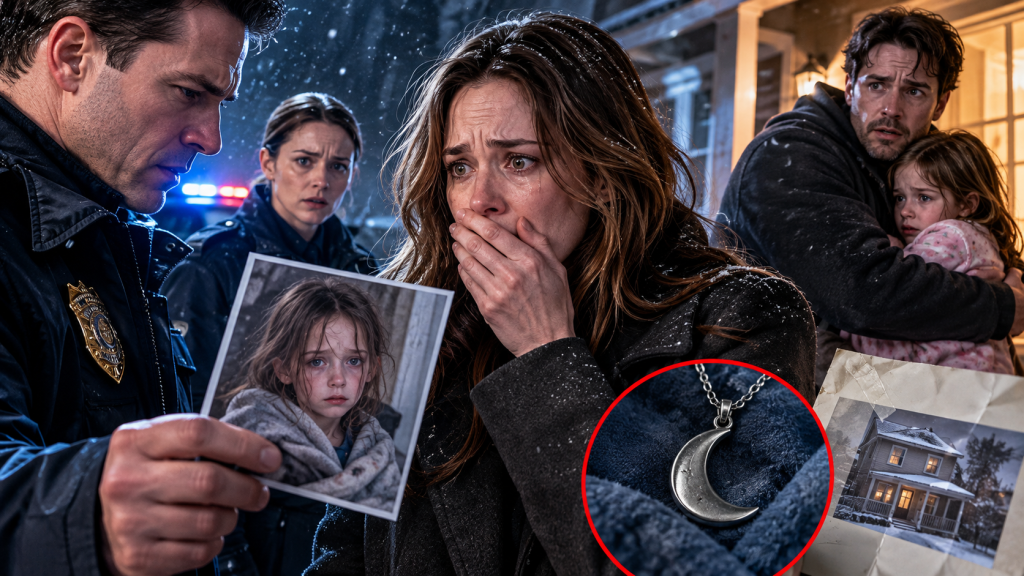
One Sunday, months later, Emma asked if she could take off the silver moon necklace. She had worn it every day, even in the bath.
“Of course,” I said.
“Will Mom be upset?”
I held out my palm so she could unclasp it herself.
“Your mom loved you with or without a necklace.”
She set it beside Natalie’s letter on her dresser. Then she went downstairs, where Sophie was waiting with a puzzle and two mugs of cocoa.
That night I found both girls asleep on the living-room rug, their socks tangled together. I carried blankets over and sat between them until the house grew quiet.
At 2:14 that first morning, a police officer had told me they’d found my daughter in the cold.
He’d been wrong about who she was.
But when Emma stirred, reached for my sleeve, and whispered, “You’re here,” I understood why she’d been so afraid to ask.
I tucked the blanket around her shoulders.
“Yes, sweetheart,” I whispered. “I’m here.”



