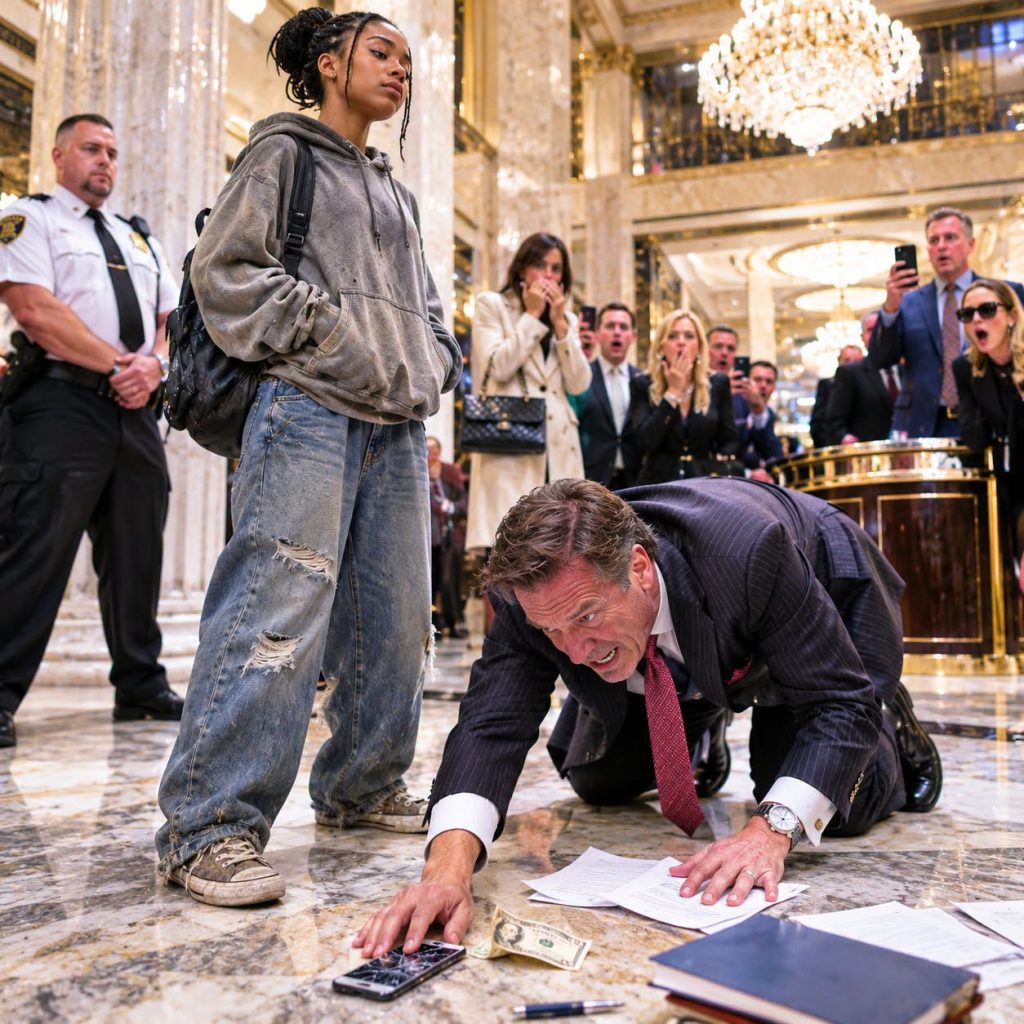
The wealthy patrons who had been laughing at me moments ago were now whispering fiercely, eyes wide with shock. Derek, the security guard, took three massive steps away from me, looking as if he had just realized he was holding a live hand grenade. Patricia, the teller, covered her mouth with both hands, staring at me in awe.
“And her father’s corporate holding accounts, which are tied to her profile?” Victoria demanded mercilessly.
“Three… three point two billion,” Crawford sobbed. Actual tears were now welling in his eyes. He looked like a man who had just been sentenced to the electric chair. “Miss Nelson… I… I didn’t know. The hoodie… the backpack…”
“You are a disgrace to this institution,” Victoria Ashford said coldly. “Gerald Crawford, you are terminated, effective immediately. Do not touch another file. Do not access another client record. You will wait for corporate security to clear out your desk.”
“Ms. Ashford, please! I’ve given twelve years to this bank!” Crawford begged, leaning over the counter toward my phone.
“You’re lucky Miss Nelson doesn’t own the building, or she’d have you thrown out the window,” Victoria snapped, before her voice softened completely. “Naomi, my deepest apologies. I will fly to New York tonight to handle this personally. How would you like to proceed?”
I stepped up to the counter, looking down at Crawford, who was trembling like a leaf. The fire in my chest had hardened into ice.
“First,” I said clearly, making sure the entire lobby could hear me, “I want my things back.”
I pointed to my notebooks, my ID, and my broken safety pins scattered across the floor. “Pick them up, Gerald.”
Crawford hesitated, looking around at the sea of phones still recording his ultimate humiliation.
“Do it,” I commanded, my voice laced with steel.
Slowly, agonizingly, the now-former branch manager in the $3,000 Tom Ford suit crawled out from behind the counter. He got down on his hands and knees on the dirty marble floor. Sniffling, he gathered my scattered papers, my ID, and my broken pins, placing them gently into my ripped backpack. He handed it to me, keeping his eyes glued to the floor.
“Thank you,” I said, snatching the bag. I looked back at the phone. “Victoria? Initiate a full withdrawal. I am pulling all forty-five million out of Sterling and Associates. And Arthur? Call my dad. Tell him we’re moving the family’s corporate accounts to a competitor by the end of the business day.”
“Consider it done, Naomi,” Arthur said smoothly.
I hung up. I didn’t look at Crawford again as I walked out through the heavy glass doors, stepping out into the bright Manhattan sunshine.
The fallout was nuclear. The videos from the lobby went viral within hours under the hashtag #Justice4Naomi. The public outrage was so intense that the Department of Justice launched a civil rights investigation into Sterling and Associates. The feds discovered that Crawford had a horrifying track record: over the past two years, he had baselessly flagged the accounts of sixteen different Black customers for “security reviews.”
Six months later, justice was fully served. A federal judge found Crawford guilty of racial discrimination, assault, and intentional infliction of emotional distress. He was permanently banned from the financial sector and hit with crippling fines. Derek lost his security license forever. As for the bank, not only did they pay out a $12 million settlement, but the PR disaster caused an exodus of major clients, costing them over $170 million in withdrawn funds.
But I didn’t just take their money and walk away.
I stood at the podium of the National Finance Conference in Chicago, adjusting the microphone. I was wearing the exact same faded gray hoodie I wore on that Tuesday in Manhattan. Looking out over a sea of executives, I officially announced the launch of the Nelson Equal Access Fund—a $10 million legal initiative dedicated to providing free representation for victims of financial discrimination.
As the crowd erupted into applause, I looked off to the side of the stage. Standing there, holding a clipboard and smiling proudly, was Patricia Holt. She had quit her job at Sterling the week after the incident, apologized to me for her silence, and was now the full-time volunteer coordinator for my foundation.
My dad was right. Money wasn’t an identity. It was a tool. And I had just learned exactly how to use it to smash the system.
What do you think of this story? Please leave a like and share your thoughts in the comments. Your support means a lot to us and inspires us to keep writing more meaningful and powerful stories. Thank you! 👍❤️



