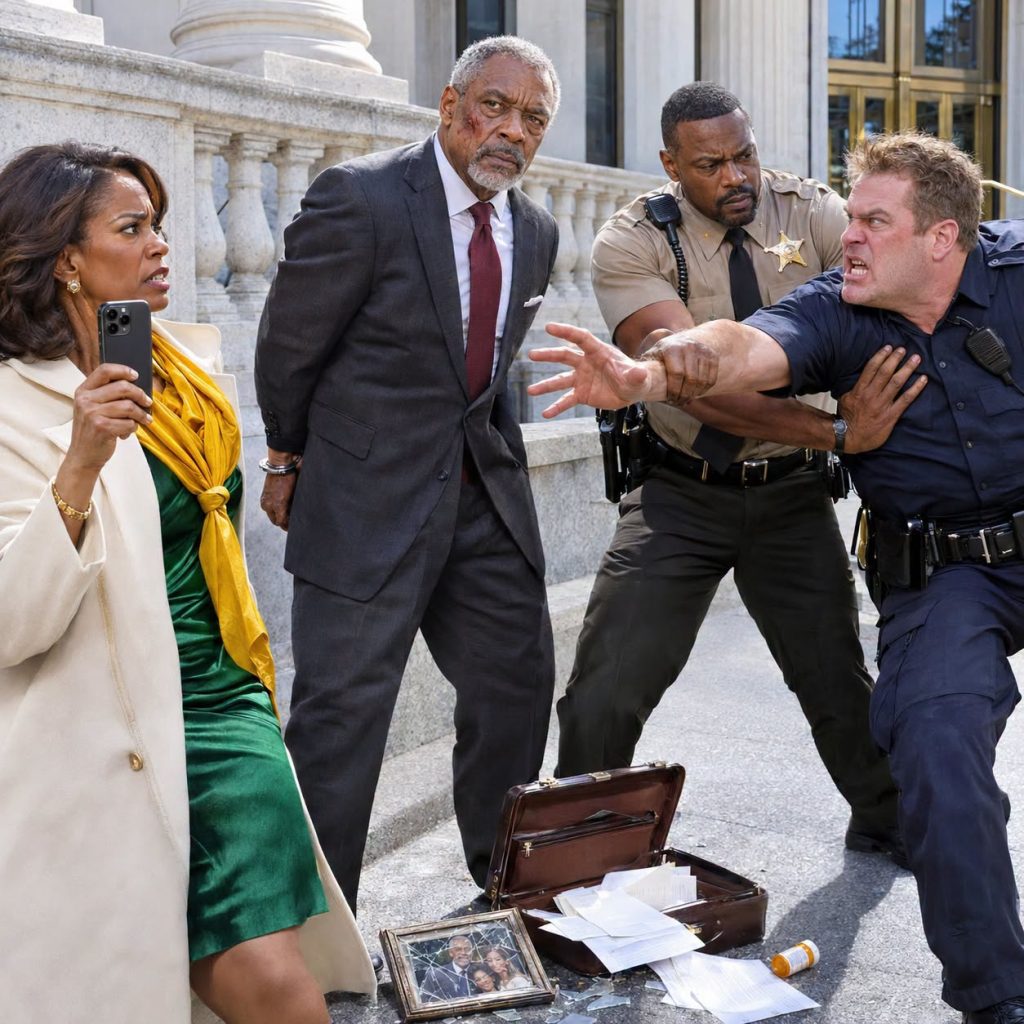
Aaron had barricaded himself in my records closet after finding the courtroom empty. He knew my hearing schedule; he hadn’t known I was in the hospital. Vance had followed him inside using his command credentials. Harris found the captain outside my chambers holding a pistol, demanding access. State officers arrived before he could force the inner door. Aaron needed stitches and treatment for a fractured wrist. When Nora interviewed him, he gave her the thing Vance had been hunting: an evidence export drive and the access logs that explained every missing entry. Copies, he told her, were already with his attorney.
The man in the maintenance uniform was a contractor who owed Vance money. Investigators later recovered messages instructing him to photograph my workstation password from a note inside a locked desk drawer. He had forced the drawer, accessed the sealed filing, and left before midnight. Vance learned that Aaron’s statement would be discussed at the sentencing hearing. He sent Dunn and Sutton to intercept my briefcase before I reached court. They knew my name, but neither recognized my face. Vance described me as an older Black courier carrying stolen police records. He promised their convictions would disappear if they recovered the file.
Weeks later, Sutton asked through his attorney to cooperate. I learned what he said from the investigators, then heard it again in court. “I recognized the case number on his papers,” he admitted. “That’s when I knew Vance had lied about the courier.” “But you continued,” the prosecutor said. “Yes.” “And the knife?” Sutton looked at the table. “Mine. I put it in the bag.” Dunn’s attorney tried to describe a confused encounter. The prosecutor played the video from the woman in the yellow scarf, Marlene Owens. There was nothing confused about Dunn placing my medication beyond my reach.
I testified before Judge Rebecca Sloan, a visiting judge assigned from another circuit. Dunn watched me approach the witness stand. For months, I had imagined the anger I would feel seeing him again. Instead, I noticed how carefully the deputy adjusted my chair so my injured shoulder would not strike it. “Did you identify yourself as a judge?” Dunn’s lawyer asked. “I gave my name and offered identification.” “But you could have ended the misunderstanding sooner?” I looked at the jury. “He had my identification in his hand. He chose not to open it.” Behind the prosecutor, Caleb Ward lowered his head and began to cry.
The evidence drive connected Vance’s orders to altered property records, payments from a towing contractor, and fabricated reports used to justify seizures. Aaron had started copying records after discovering the knife attributed to his brother had been logged into storage months before Caleb’s arrest. The conspiracy cases took time. Sutton pleaded guilty and testified. Dunn was convicted after trial. Vance’s own messages destroyed his claim that he had been protecting an investigation. Their sentences came from Judge Sloan. I sat in the gallery when she imposed them. When Dunn glanced toward me, I let him look. I had nothing left to prove to him.
Caleb’s conviction was vacated, and an independent review began reopening other cases. My father never got a law degree. He drove a city bus and carried a pocket Constitution until its staples rusted. Months later, Evelyn brought his repaired photograph to my office. A faint line still crossed one corner of the glass. “They couldn’t make it perfect,” she said. “Leave it.” I set it beside his repaired fountain pen. Downstairs, Marlene was waiting to testify in another reopened case. I went to meet her at the public entrance. She offered her hand. I took it, then held the door while she walked inside.
What do you think of this story? Please leave a like and share your thoughts in the comments. Your support means a lot to us and inspires us to keep writing more meaningful and powerful stories. Thank you! 👍❤️



