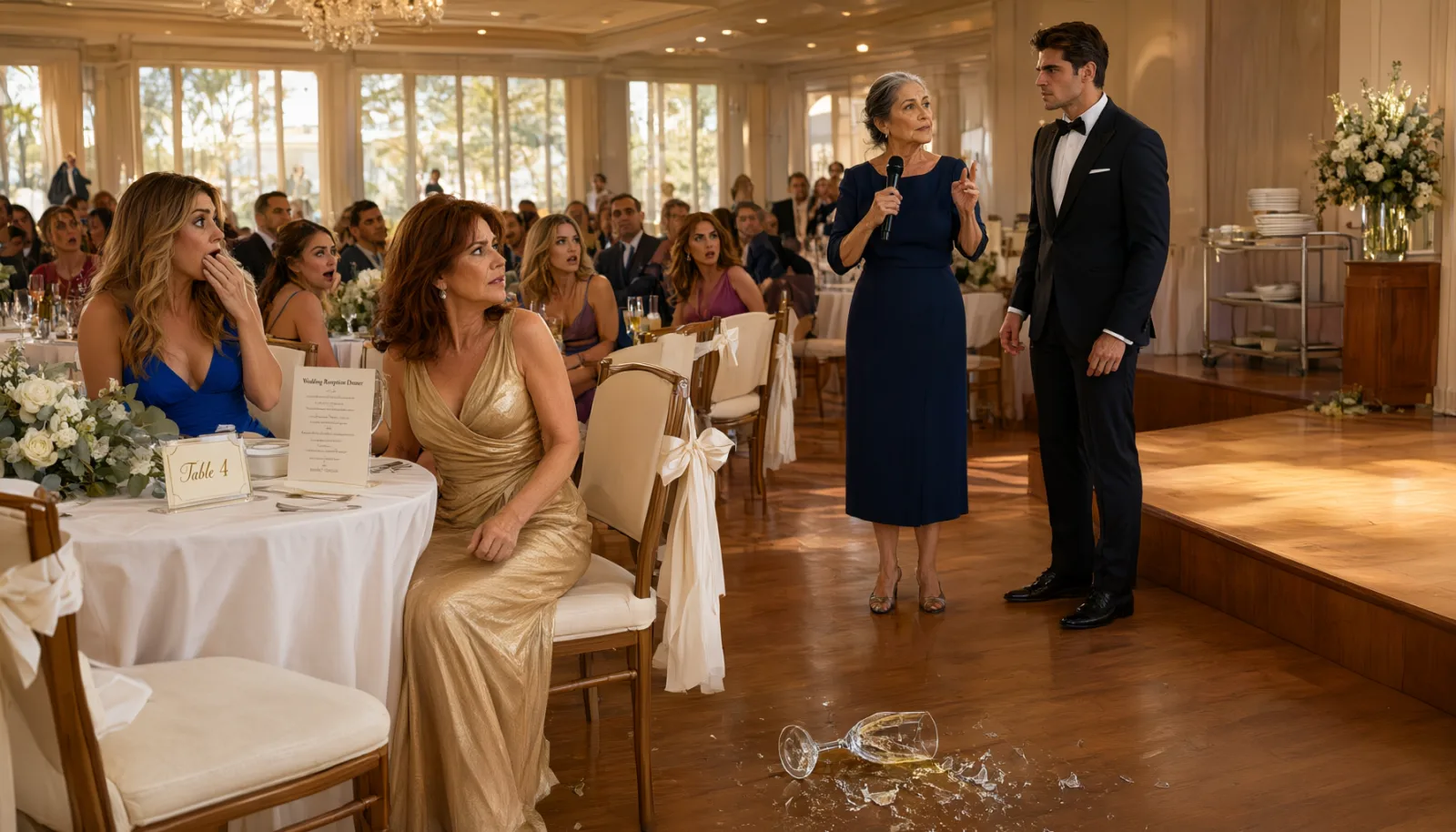
 Her palm struck my left shoulder before I could sit down.
I stumbled sideways, took two scrambling steps, and caught the back of the chair with my left hand.
For a moment, all I could think about was keeping my feet beneath me.
Then I looked at the woman who had pushed me.
“Sit over there. You don’t belong here.”
She pointed toward the far side of the wedding hall.
Her other hand held a champagne flute. Not a drop had spilled.
That detail stayed with me: the care she had taken with her drink while deciding that an older woman could be shoved out of her way.
I straightened slowly.
At sixty-five, I knew the difference between an accidental collision and a deliberate insult.
This had been both physical and personal.
“My son—” I began.
The younger woman beside her laughed.
“You look like the catering staff.”
She wore a cobalt dress and had honey-blonde hair arranged in glossy waves. Her eyes traveled over my plain navy dress before returning to my face, waiting for the remark to hurt.
It did.
I won’t pretend otherwise.
My name is Isabelle Romero, and I had dressed that morning with my son’s wedding photographs in mind.
Something simple. Something he would recognize as me.
I had chosen the earrings he gave me on my sixtieth birthday and left my more elaborate jewelry at home.
I wanted to be his mother that day.
I had no interest in making an entrance.
Around us, guests continued settling into their places. Someone at the next table had seen me stumble.
I could tell by the way she watched my hand gripping the chair.
But she looked away when the woman in gold glanced toward her.
The two women assumed the matter was settled.
The older one turned slightly, already reclaiming the conversation I had interrupted by trying to take my place.
I looked down at the chair.
There was nothing remarkable about it. Ivory upholstery, polished wood, a ribbon tied neatly around the back.
Yet I had suddenly become determined not to spend the rest of the reception in another seat, pretending this hadn’t happened.
Across the hall, my son stood near the stage in his black tuxedo, speaking with a guest.
He hadn’t seen the shove.
I was grateful for that, briefly.
Then I wondered how much people relied on moments like this passing unwitnessed.
I released the chair.
The woman in gold noticed.
“Over there,” she repeated, pointing with her right hand.
I looked directly at her.
Then at the younger woman.
Neither expression softened.
There was no uncertainty to clear up, no misunderstanding waiting for a polite explanation. They had decided what I was worth by looking at my dress.
I squared my shoulders and turned toward the stage.
The aisle was clear.
I walked it without hurrying.
Each step gave me a little more steadiness. My shoulder ached, but my hand had stopped trembling by the time I reached the platform.
I knew this hall.
I knew which doorway the servers used and where the afternoon light fell across the windows. I had approved the softer lighting above the dining tables because the original fixtures made every dinner feel like a business meeting.
I had spent years helping build a place where people could celebrate the most important days of their lives.
I had never imagined needing to prove I belonged inside it.
My son turned as I stepped onto the stage.
“Mom…”
Concern lifted his eyebrows.
I met his eyes long enough to let him know I was steady.
Then I took the microphone in my right hand.
The conversation nearest the stage faded first. Silence spread outward as guests turned in their chairs.
At the offending table, the woman in gold looked irritated.
The younger woman leaned toward her, whispering something I couldn’t hear.
I faced them.
“I’m Isabelle Romero. I own this resort.”
The words carried clearly through the hall.
My son’s expression changed as he looked past me toward the two women.
The woman in gold stopped smiling.
Her left fingers loosened around the stem of her champagne flute.
It slipped.
She reached too late.
The glass struck the clear floor beside her chair and shattered.
Several guests flinched. She stepped backward, staring down at the pieces before looking up at me.
The younger woman gasped and brought a hand to her mouth.
Then she turned toward the older woman, searching for an explanation that might make the last few minutes disappear.
My son was looking at them now.
His concern had become anger.
I could see him beginning to understand, although he still didn’t know exactly what had happened beside that chair.
I wasn’t going to make him guess.



