“Why are you working?” she asked.
“I’m not.”
I touched the photograph on its cover: a young boy leaving a rehabilitation clinic holding his mother’s hand.
“I just wanted to remember why I started.”
My criminal case moved forward. Mom and Jason were charged, while Robert entered negotiations concerning his role. After their guilty pleas, they faced sentencing.
Meanwhile, my attorney pursued a separate civil claim for the injuries and financial losses they had caused.
Their defense was that I’d exaggerated my suffering to punish the family. They even suggested my hospital had given me preferential treatment because of my charitable connections.
My attorney prepared to challenge that claim.
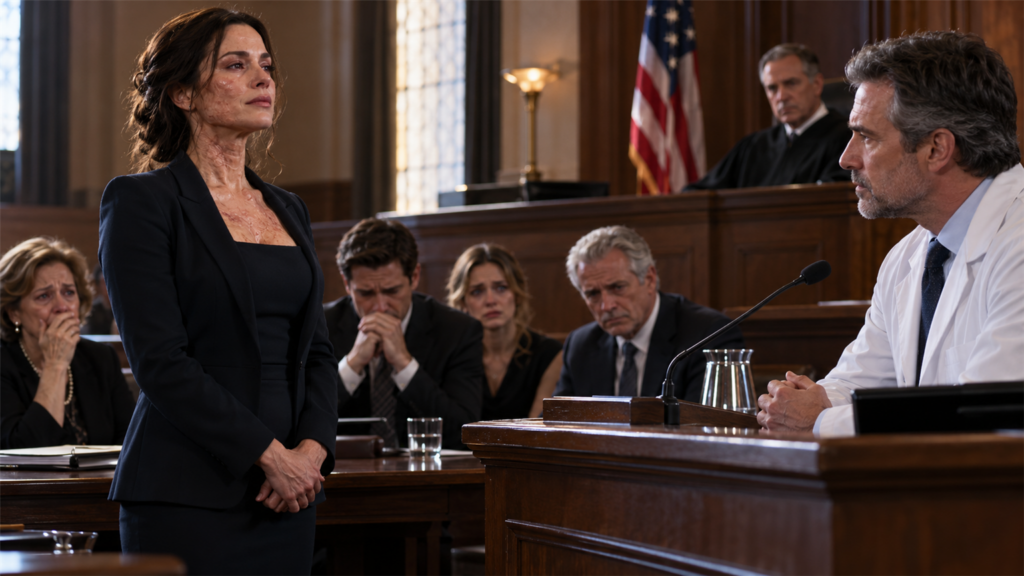
At the civil hearing, my trauma surgeon, Dr. Evelyn Brooks, took the witness stand.
The defense attorney asked whether I had received special privileges at the burn unit.
Dr. Brooks looked directly at the judge.
“Before I answer,” she said, “there’s something the court should understand about who made that unit possible.”
Dr. Brooks adjusted the microphone.
“The plaintiff created and endowed this burn unit,” she said.
My mother’s attorney stopped writing.
Dr. Brooks continued, explaining that twelve years earlier I’d founded the Mitchell Burn Recovery Foundation after volunteering with children recovering from serious injuries. Over time, our organization raised more than $6 million through grants, corporate sponsors, and individual donations.
Part of that funding had helped establish the hospital’s expanded burn unit. A separate endowment supported rehabilitation services for patients who couldn’t afford them.
I hadn’t personally contributed millions. I’d organized the people, partnerships, and funding that made the work possible.
My parents had known I ran a charity.
They simply hadn’t cared enough to find out what it did.
“The hospital treated Ms. Mitchell according to her medical needs,” Dr. Brooks explained. “Her philanthropy did not influence our diagnosis or treatment. The full-thickness burns, grafting procedures, and rehabilitation requirements are documented independently.”
The judge allowed the limited explanation concerning my relationship with the hospital, then directed the testimony back to my injuries.
Dr. Brooks described the long months of healing, the risk of contractures, and the additional procedures I might need.
My mother’s attorney asked whether some scars could eventually fade.
“Some may improve,” Dr. Brooks replied. “But full-thickness burns do not simply disappear. These injuries have permanent consequences.”
Across the courtroom, Jason stared at his hands.
Mom sat perfectly still.
I remembered those same hands fastening my winter coat when I was seven, brushing snow from my hair while telling me not to catch a cold.
I wondered how someone could spend years protecting a child from the weather and then deliberately hurt her because she refused to surrender money that wasn’t hers.
The criminal proceedings had already established the responsibility of those involved. My mother received a substantial prison sentence for the intentional assault. Jason received a shorter custodial sentence for helping restrain me, and Robert was sentenced following his guilty plea.
Dad was never charged with planning the burn itself, but his recorded threats and failure to intervene destroyed the version of events he’d tried to maintain.
In the civil case, the court entered judgment for my proven damages, including medical expenses, lost earnings, and compensation for my injuries. Recovering the full amount would take time. The judgment couldn’t give me back the skin I’d lost or the nights I’d spent afraid to sleep.
But it established that what happened wasn’t a family disagreement.
It was violence.
After the hearing, Dad approached me outside the courthouse.
He looked older. His tie hung crookedly, and his hands trembled as he held out Grandma’s recipe box.
“We found this in the kitchen,” he said. “I thought you’d want it.”
I took it carefully.
Inside were faded index cards covered in Grandma’s handwriting. On the first card was her chicken soup recipe, with a small note at the bottom.
*Always make enough for someone who needs a little extra.*
Dad cleared his throat.
“Your mother didn’t know about the hospital.”
“She knew what I did, Dad.”
He lowered his eyes.
“She just never believed it mattered.”
I looked at him.
“It mattered to the people we helped. That should have been enough.”
He didn’t ask me to forgive him.
I was grateful for that.
Six months later, I returned to the burn unit for a rehabilitation appointment. My movements were still limited, and some mornings I needed help fastening my clothes.
Hannah, the nurse who’d cared for me after surgery, met me at the entrance.
“Someone wants to say hello,” she said.
A teenage girl who’d spent weeks recovering from a house fire stood beside the nurses’ station. She wore a compression garment on one arm and held a small notebook against her chest.
“My mom told me you helped make this place,” she said.
I smiled.



