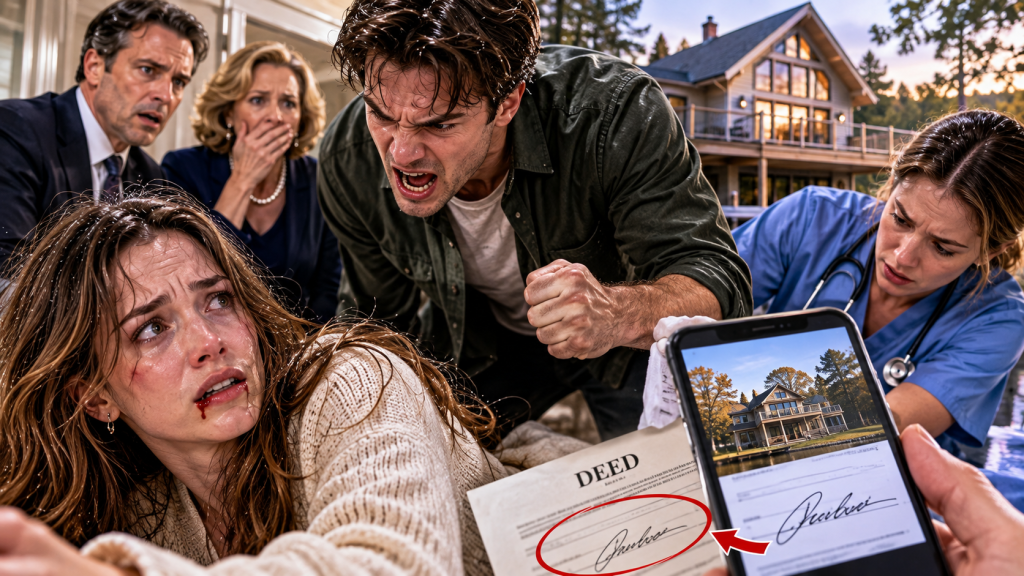
“We’ve also found the notary’s connection to Ryan,” she said. “You’ll want to hear this before the hearing.”
I tightened my grip on the phone.
“Who is she?”
“His business partner. And she just gave a statement that contradicts what Ryan told your father.”
The notary was Ryan’s business partner, Melissa. She’d helped him purchase and renovate two rental houses. When investigators asked how Grandpa had traveled from the hospital to her office, she first insisted she remembered seeing him.
Then she was shown the records.
She admitted she hadn’t seen Grandpa that afternoon. Ryan had brought her the deed already signed, she said, and persuaded her to notarize it as a favor. She claimed she hadn’t known the signature was false.
My attorney didn’t announce victory. The estate petitioned the court to invalidate the deed, and the suspected forgery was referred to law enforcement. The handwriting examination supported the family’s concerns, while the hospital documentation and Melissa’s account gave investigators evidence beyond an expert’s opinion.
Ryan’s brokerage suspended him while it investigated his conduct. The state licensing authority opened its own inquiry. His promotion to managing broker, which he’d spent months boasting about, was withdrawn.
Melissa also faced an investigation into her notarial conduct.
Dad called me the night he found out.
“He could lose his career,” he said.
I was sitting on Grandpa’s old wooden stool, the one he’d repaired with two mismatched screws.
“He could have left Grandpa alone.”
There was a long silence. Then Dad whispered, “He told me the old man wanted him to have it.”
“Did you ever ask Grandpa?”
Dad didn’t answer.
Months passed before the title case was resolved. The court set aside the deed after reviewing the evidence, leaving the house in Grandpa’s estate to pass under his will. Ryan later pleaded guilty to charges connected with the fraudulent document. The assault case was handled separately, resulting in probation and a no-contact order.
I didn’t attend every hearing. Sometimes I simply went to work, returned library books to their shelves, and reheated soup in my quiet kitchen.
When the estate finally transferred the house to me, I drove north with a box of cleaning supplies. The porch boards creaked just as they had when I was eleven. Inside, Grandpa’s yellow raincoat hung beside the door.
I slipped my fingers into its pocket and found a peppermint wrapped in faded green paper. He’d always carried them for me on long drives, even after I grew old enough to drive myself.
I sat on the kitchen floor with the peppermint in my palm.
Dad came once that spring. He’d asked permission first. We painted the porch railing without saying much. At lunch, he set down his sandwich and said, “I should’ve helped you up that day.”
I watched sunlight move across the table.
“Yes,” I said. “You should have.”
I didn’t promise him forgiveness. He didn’t ask.
By summer, I had repaired the porch, replaced a leaking window, and hung an extra raincoat beside Grandpa’s. My friend Nora visited with her daughter, who spent the afternoon trying to catch minnows in a plastic cup.
When the child came inside shivering, I handed her the yellow coat. Its sleeves swallowed her hands.
“It’s too big,” she giggled.
“That’s all right,” I told her. “You can grow into it.”
Ryan had wanted the house because he thought it would prove Grandpa loved him most. But Grandpa hadn’t left me a prize.
He’d left me somewhere I had once been safe.
And I was going to keep it that way.



