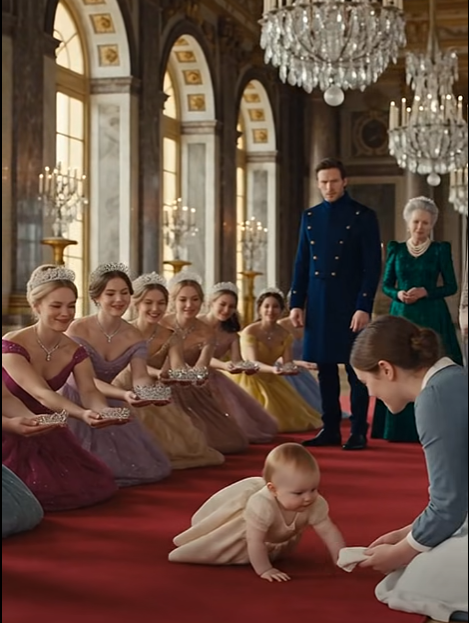
 “Where did you get that handkerchief?” Queen Victoria demanded.
Sophia had imagined many ways to lose her position at the palace. She had never imagined losing it while an eleven-month-old child clung to her apron and called her Mama.
“I was given it, Your Majesty,” she said.
“By whom?”
“Princess Eleanor.”
A gasp rippled across the ballroom. Prince Alexander reached down to lift Lily, but the baby tightened her grip on Sophia’s sleeve and began to cry. He stopped. The princesses, suddenly irrelevant, stood in a glittering row beneath the chandeliers.
“Eleanor died a year ago,” Victoria said. “You were hired only three months ago.”
“I know.” Sophia swallowed. “I met her before I worked here.”
Alexander studied her face. “Where?”
“At St. Agnes Community Clinic. I worked nights cleaning the examination rooms. Your wife came there under another name.”
The queen’s expression hardened. “That is an extraordinary claim.”
“I have proof. But not here.”
A woman in a silver gown stepped forward. Princess Charlotte had been the favorite to win the strange contest. “Your Highness, surely we’re not entertaining a servant’s fairy tale?”
“Enough,” Alexander said. He turned to the gathering. “The ceremony is over. My daughter is not a prize, and neither is marriage. I should never have agreed to this.”
His mother opened her mouth, then closed it. A palace steward began ushering guests toward the doors.
Sophia tried to step away, but Lily cried harder. Alexander, looking exhausted, said, “Would you carry her to the nursery?”
Sophia nodded. It was a kindness that might cost her everything.
In the nursery, Lily settled against her shoulder. Sophia hummed the tune she always hummed while folding linens, an old lullaby about a moonlit garden. Alexander stopped in the doorway.
“Where did you learn that song?”
“My mother sang it.”
“Eleanor sang it to Lily before she was born.”
Sophia looked at the child’s sleeping face. “Eleanor taught me the second verse.”
He crossed the room so quickly that Sophia flinched. Then he stopped himself. “Tell me what you know.”
“She came to the clinic frightened. Not of the pregnancy. Of someone in the palace. She said records were being changed and that if anything happened to her, the baby must be protected.”
Alexander stared at her. “Why didn’t you come to me?”
“I tried. Twice. Both letters came back unopened.”
“Who returned them?”
“I don’t know. But the second envelope had the royal secretary’s seal.”
Outside the nursery, a floorboard creaked. Alexander opened the door. The hallway was empty, except for a fresh white rose lying on the carpet.
Sophia recognized it immediately. Someone had left the same flower outside her rented room the night she received the palace job offer.
Alexander ordered the nursery doors guarded, but Sophia refused to be treated as a prisoner. “If I am in danger,” she said, “your daughter may be too. You need to know what Eleanor found.”
At dawn, Alexander brought her to a private study overlooking the winter gardens. He had not slept. A framed photograph of Eleanor stood beside the fireplace, her smile warm and unguarded.
Sophia told him about the clinic. Eleanor had arrived wearing a plain coat and calling herself Ellie Moore. She volunteered there on Tuesdays, helping young mothers find transportation, food, and legal advice. Sophia had first mistaken her for an ordinary donor. One evening Eleanor stayed late, trembling as she copied figures from a folder.
“She said a charity bearing Lily’s future name was being used to move money,” Sophia recalled. “She believed somebody was taking funds meant for children and paying shell companies.”
Alexander shook his head. “The Lily Foundation wasn’t established until after her death.”
“Then somebody planned it before you knew.”
He opened a cabinet and removed a photograph of the foundation’s dedication. Queen Victoria stood beside the royal secretary, Edmund Price, and a businessman named Victor Hale. Hale had been Alexander’s father’s closest adviser and was now chairman of the family’s property trust.
Sophia pointed to Hale. “He visited the clinic once. Eleanor hid in the supply room until he left.”
Alexander called his security director, Mara Finch, a former federal investigator known for telling powerful people things they did not want to hear. Mara listened without interrupting.
“Do not accuse anyone yet,” she warned. “Preserve the letters, identify the people who handled them, and get independent records. If there was financial misconduct, we need evidence, not palace gossip.”
Sophia admitted she had kept copies of Eleanor’s notes in a sealed tin at her aunt’s apartment. She had hidden them after a stranger followed her home. Mara arranged a discreet visit.
At the apartment, Sophia found the door ajar. Her aunt Ruth sat unharmed at the kitchen table, but the tin was gone. A vase of white roses stood by the sink.
“I didn’t let anyone in,” Ruth said. “The landlord said the lock had to be replaced. A man came with a work order.”
Mara photographed the damage and called the police. Alexander knelt to collect papers scattered beneath a cabinet. One page had slipped behind the baseboard: a handwritten verse of the lullaby, with certain words circled.
Sophia read them aloud. “Under the moon, beyond the gate, the quiet river learns to wait.”
Alexander frowned. “Eleanor wrote that verse in her garden journal.”
“Which garden?”
“The old estate at Ashbourne. We haven’t opened it since she died.”



