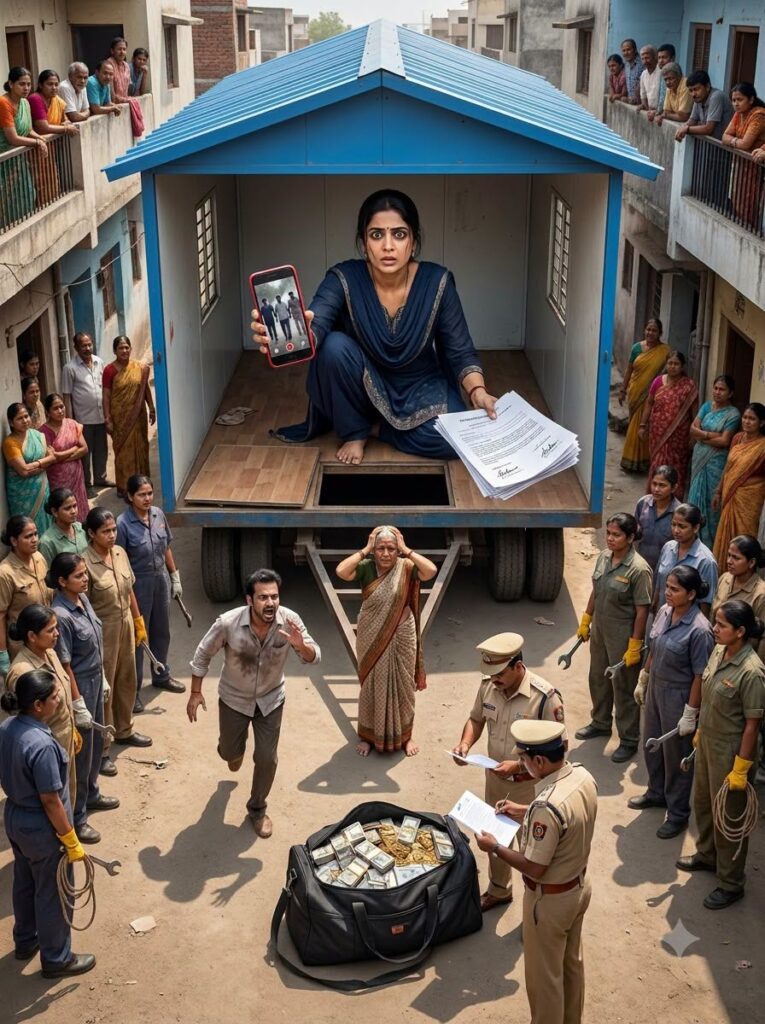
Neha wiped her face.
“I will give a statement.”
“You took money!” he shouted.
“No.”
“You helped arrange the payment!”
“I carried Papa’s envelope because he had just left the hospital. I never knew what was inside until later.”
The older officer looked at the cash bundles in the duffel bag.
“Can your father identify the source of the money?”
“Yes.”
Rohan laughed desperately.
“After seven years? This proves nothing.”
Neha reached into her handbag and removed a folded photocopy.
“I kept the bank withdrawal slip.”
Rohan stopped laughing.
The slip showed that my father had withdrawn ₹9.6 lakh two days before the video was recorded.
On the back, in his handwriting, were four words:
**For Priya’s new home.**
I sat on the edge of the trailer.
For seven years, my father had watched me struggle while carrying his own secret shame.
For seven years, my sister had hugged me with the truth locked behind her teeth.
For seven years, Rohan and his mother had lived beneath a roof paid for by two people they intended to destroy.
The older officer sealed the red phone inside an evidence bag.
Then he ordered Rohan and Sushma Devi into the police vehicle.
Sushma began screaming.
“This is Priya’s fault! She brought these women! She broke this family!”
I climbed down from the trailer.
“No, Maaji. I only moved the house. Your secrets were already underneath it.”
Rohan twisted toward me as the officer held his arm.
“You will regret this.”
“I already regret you.”
His face changed.
For the first time, I saw fear.
Not anger.
Not arrogance.
Fear.
The kind he had forced me to live with for years.
The police took him away in the same vehicle he had summoned to stop me.
Nisha was arrested two days later while attempting to withdraw money from an account opened under one of the false identities found in the bag.
Her father claimed the mental-health certificate was only a draft.
Investigators discovered six more certificates bearing the names of women connected to fraudulent property transfers.
The new plot purchased by Rohan and Nisha was frozen.
The bank suspended the loan application carrying my forged signature.
The cash was taken for investigation.
And the handwritten plan to accuse me of theft became the most important piece of evidence against them.
But none of those things repaired what happened between Neha and me.
For three weeks, I did not answer her calls.
She sent messages every morning.
**I am sorry.**
**I should have told you.**
**I thought I was protecting Papa.**
**I understand if you never forgive me.**
My father came to my new plot one evening.
The little house stood on fresh concrete supports beneath the same blue roof. The veranda had not yet been reassembled, so we sat on two plastic chairs surrounded by boxes.
He looked older than I remembered.
“I failed you,” he said.
“You taught me to own something nobody could take away.”
“And then I allowed fear to take seven years from you.”
“Why did you pay them?”
“Rohan said the marriage would be cancelled. He said everyone would blame you. I thought I was protecting your future.”
“You were buying silence.”
“Yes.”
“And your silence nearly destroyed me.”
He lowered his head.
“I know.”
I wanted to shout.
Instead, I cried.
Not quietly.
Not politely.
I cried for the bride who entered that house believing she was loved.
I cried for the wife who moved plants, changed curtains, and swallowed questions.
I cried for the daughter whose father believed scandal was more dangerous than deceit.
My father sat beside me without defending himself.
When my tears finally stopped, he said, “I cannot ask you to forgive me.”
“No.”
“But I can tell the truth now.”
“You should have told it then.”
“Yes.”
That was the beginning—not of forgiveness, but of honesty.
Neha came a week later carrying the final section of my veranda railing.
She did not ask to come inside.
She placed it near the door and turned to leave.
“Wait,” I said.
She stopped.
“I am still angry.”
“You should be.”
“I may be angry for a long time.”
“I understand.”
“But you recorded them.”
“Yes.”
“And you kept the withdrawal slip.”
“Yes.”
“You helped move the house.”
Her mouth trembled.
“Yes.”
I opened the door.
“That does not erase what you hid.”
“I know.”
“But it means you can help me rebuild.”
She covered her face and began sobbing.
I did not tell her everything was all right.
It was not.
I simply held her while she cried, because healing does not always begin with forgiveness.
Sometimes it begins with refusing to carry pain alone.
Six months later, the divorce was final.
Rohan attempted to negotiate from custody through his lawyer.



