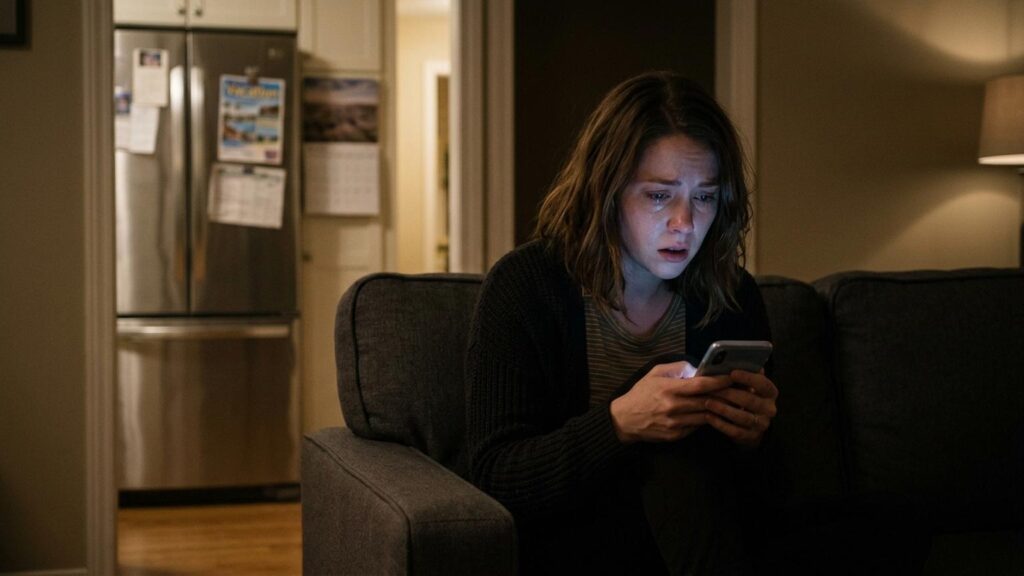
I named it Family Communications.
Every screenshot went inside.
Lauren’s texts. My father’s dismissive responses. The voicemail where Mom told me to stop frightening everyone.
I wasn’t collecting evidence because they’d gone on vacation.
I was collecting it because Lauren had tried to undermine my professional reputation with claims she had no basis to make.
Two days later, my father finally called.
“Emily, your sister says you’ve been contacting people at work about her.”
“Because she contacted my employer first.”
“She was worried about you.”
“She told my medical director I was unstable.”
Dad exhaled sharply.
“She’s a respected physician. Think carefully before you damage her career.”
I stared at the little yellow sticky note beside my laptop. It held the date of my first oncology treatment-planning appointment.
“Dad, I’m trying to survive cancer.”
“Then focus on that instead of starting a family war.”
He hung up.
The following morning, I submitted a formal complaint to Lauren’s hospital’s medical staff office, attaching the relevant communications. I also filed a complaint with the Florida Board of Medicine, describing her misuse of professional authority and asking that the allegations be reviewed.
I knew the distinction mattered. Being an absent sister wasn’t a licensing violation. Making misleading professional claims about someone’s fitness to practice was a different matter.
Three weeks later, Lauren returned from vacation.
She came straight to my apartment, furious.
“You reported me?”
I stood in the doorway, one hand resting against the wall.
“Yes.”
She stepped closer.
“Do you have any idea what you’ve done?”
I looked at the woman who once braided my hair before school, who had promised our dying grandmother she’d always look after me.
For a moment, I almost apologized.
Then she said, “Tell them you misunderstood everything.”
I reached for the printed email on the hallway table.
“Lauren, there’s something you need to read.”
Lauren snatched the paper from my hand.
It was a copy of the email Dr. Harris had sent to Human Resources after our conversation.
He had documented that Lauren contacted him without my authorization, described me as emotionally unstable, and urged him to reconsider my clinical responsibilities.
More importantly, he’d confirmed that her claims had not been supported by any clinical evaluation or workplace evidence.
Lauren read the email twice.
“You had no right to drag him into this.”
“He was already involved. You called him.”
“I was protecting you.”
“From what?”
She opened her mouth, then closed it.
I could hear the elevator humming at the end of the hallway.
Finally, she whispered, “You know how you get when you’re scared.”
I looked at her carefully.
“Lauren, I was scared because I had cancer.”
She lowered the paper.
For the first time, she seemed to notice the medication organizer on my kitchen counter, the appointment calendar beside the refrigerator, and the blanket I’d been carrying from room to room because I couldn’t stay warm.
My hair was still there. My face looked almost the same.
Maybe that had made it easier for them to pretend nothing was happening.
“I didn’t know it was serious,” she said.
“You didn’t ask.”
She looked away.
I didn’t invite her inside.
Over the following weeks, Lauren’s hospital conducted an internal review. The Florida Board of Medicine acknowledged my complaint and began its own assessment, though it made no immediate disciplinary finding.
The hospital ultimately issued Lauren a formal written warning concerning her use of professional status in a personal dispute. She was required to complete additional training on professional boundaries.
There was no dramatic courtroom confrontation. No immediate loss of her medical license.
Just a documented consequence she couldn’t explain away as my imagination.
My father called when he learned about the warning.
“Emily, this could follow your sister for years.”
I was sitting in the infusion center, watching medication drip slowly through the tubing beside my chair.
“Dad, so could what happened to me.”
He didn’t answer.
Then I asked him something I’d been carrying since that afternoon at the airport.
“When Lauren was little and broke her arm, you canceled a conference in Chicago. Remember?”
“Yes.”
“You drove through a snowstorm to get home.”
“Emily—”
“When I asked you to stay for one appointment, you told me the cruise was already paid for.”
The line went quiet.
I heard him breathe, then swallow.
“I should have been there.”
It was the first thing he’d said that didn’t sound like an excuse.
But an apology couldn’t undo the empty chair beside me when Dr. Collins explained my diagnosis.
My treatment involved chemotherapy and radiation. Some mornings, I couldn’t finish half a piece of toast. Other days, the smell of laundry detergent made me nauseated.
My coworker, Angela, drove me to appointments when I was too exhausted.
My neighbor, Mrs. Bennett, left chicken soup outside my door every Thursday.



