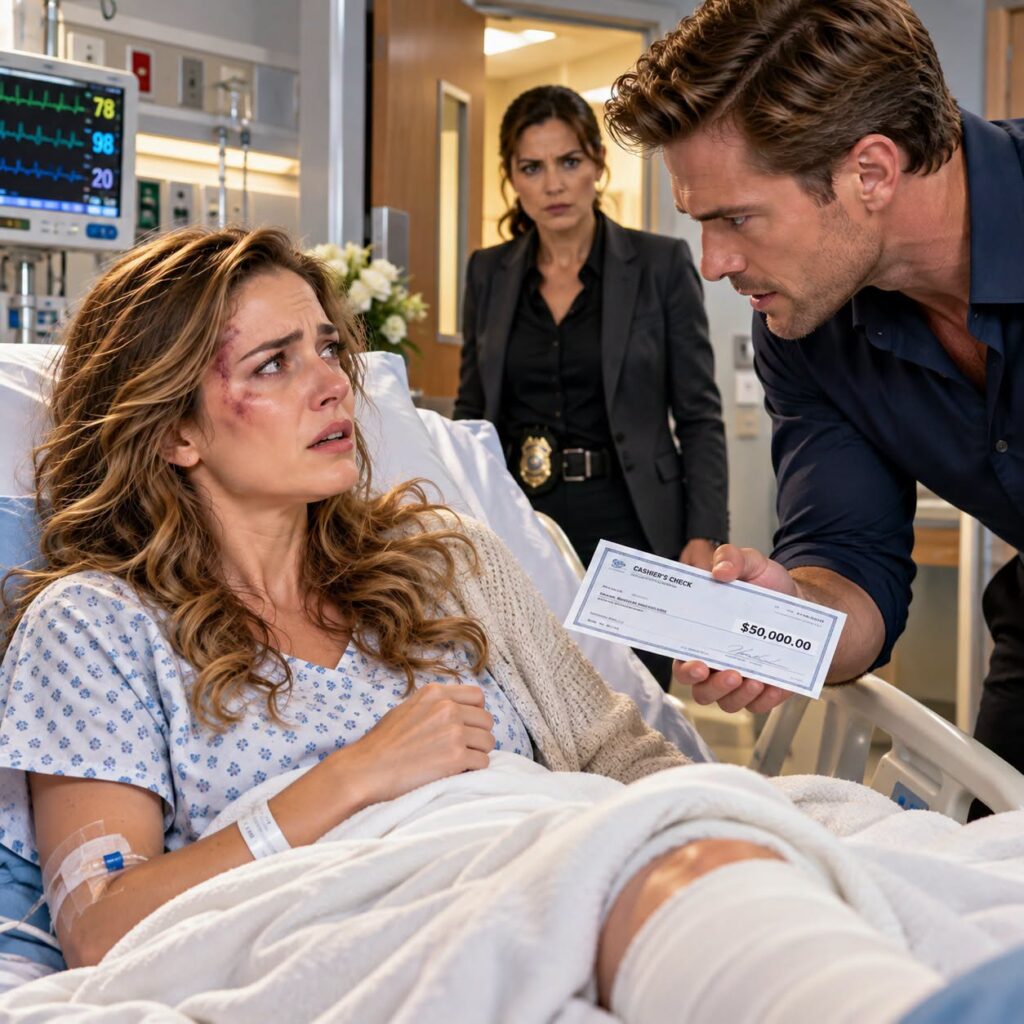
A private lender had recorded a $290,000 mortgage against the house.
“That’s almost six times what Derek offered me,” I whispered.
“And you never received any of it,” Elena said.
My stomach twisted. Derek had tried to buy my silence while they used the home my mother left me as collateral.
Elena began contacting the lender and the recorder, and prepared an emergency civil action to challenge the deed and protect the property. Rivera took my statement about the forgery and referred the documents to the financial-crimes unit.
Then Lucille called me.
I almost ignored it.
“He told me you wanted to sell,” Lucille said, her voice shaking. “He told me you’d ruin us.”
“Who told you?”
“Derek.”
A door slammed on her end. She whispered, “He said he would stand behind me. Now he’s telling police I confused the gas and brake.”
“So you did mean to hit me.”
Silence.
Then: “I didn’t know he would let you lie there.”
The line went dead.
That evening, Rivera returned with an evidence bag containing a small digital recorder. Lucille had brought it to the station with her lawyer.
“It contains a conversation from the morning of the crash,” Rivera said.
She pressed play.
Derek’s voice filled the room: “Don’t hit her hard enough to kill her. Just make sure she can’t get to that lawyer tomorrow.”
Then came Lucille’s reply, sharp and unmistakable.
“You promised me the money would save the business.”
Derek laughed. “Mom, there won’t be a business by Friday.”
I stared at the recorder until Rivera stopped the playback.
“The business?” I repeated.
Rivera nodded. “We’re still verifying the recording. But Lucille says Derek promised to handle the police, then began blaming her alone.”
For the first time since the collision, I understood why Lucille had come forward. She wasn’t suddenly sorry. She was terrified of being abandoned by the son she had helped.
That didn’t make her innocent.
It made her useful.
I agreed to give investigators every document I had. From my hospital bed, I forwarded emails Derek had sent about “unlocking our equity,” photographs of the recorder’s notice, and a message where I had explicitly refused to sign anything.
Elena helped me notify the lender in writing that the deed was forged. She sought an injunction preventing another transfer while the ownership dispute proceeded. The lender agreed to pause enforcement while it investigated, though the lien wouldn’t vanish simply because I challenged it.
I changed my banking passwords, froze my credit, and asked the hospital to remove Derek from my approved visitor list.
He still tried one final move.
Two days later, he called from an unfamiliar number.
“Please, Claire,” he said. “My company was drowning. Mom said she knew a notary who could help. I was going to put the money back.”
“You watched me under a car.”
“I panicked.”
“No. You planned for me to be hurt. Panicking came later.”
He went quiet.
I ended the call. I wrote down his exact words immediately and gave Rivera the call details.
Investigators later obtained Derek’s messages and the financial records through warrants. Those records connected him to the forged deed, the lender’s payout, and a transfer of most of the money into an account he had opened without telling me.
They also exposed one last lie.
He hadn’t been trying to save his company. He had already arranged to close it, leaving unpaid subcontractors behind. The money from my house was supposed to finance a move to Florida.
Without me.
When Lucille learned that, she agreed to cooperate fully. Her lawyer negotiated a plea agreement. Derek was charged in connection with the assault conspiracy and the property fraud. I attended every hearing my doctors cleared me to attend.
Months passed. My leg healed slowly. The scar remained.
At the criminal proceedings, Lucille admitted she had deliberately struck me. She received a prison sentence. Derek pleaded guilty to fraud-related charges and his role in arranging the attack; he was also sentenced to prison. The court ordered restitution, although collecting it would take time.
The civil case took longer. Eventually, a judge ruled the deed forged, cleared the fraudulent transfer, and addressed the disputed lien. The house was legally mine again.
I filed for divorce. I sold none of my mother’s furniture.
On the first evening I could climb the porch steps without crutches, I sat beneath her old wind chimes and listened to them move in the breeze.
I once thought keeping the house meant holding on to the past.
Now I know it means something else.
They tried to bury me beneath a car, but all they buried was the woman who believed love required her silence.



