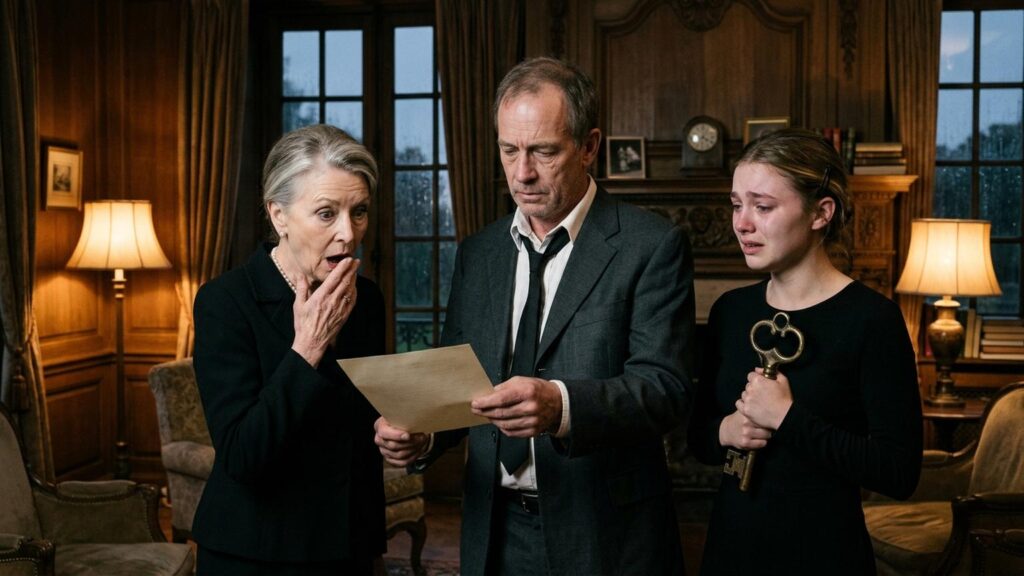
Frank took out his phone. “Then let’s put that in writing for the lawyer.”
Her face tightened, but she stopped packing.
That night I stayed with my friend Megan rather than argue in a house that still smelled of Dad’s aftershave. I set his flannel shirt beside my pillow and listened to the rain against the window.
By morning, Susan had obtained the recorded filing. She also confirmed something Frank hadn’t told me: Dad had signed a private letter during that same appointment.
“He insisted Frank keep it,” she said. “And he asked that you hear it before making any decisions about Victoria.”
I met Frank outside her office. He held out a sealed envelope with my name in Dad’s uneven handwriting.
On the back, Dad had written one sentence.
I had to read it twice.
The sentence on the envelope said, “I should have protected you sooner.”
I stood in the parking lot with my thumb against the uneven letters. Dad’s handwriting had grown smaller during his illness. Toward the end, he could barely hold a pen long enough to finish a birthday card.
Frank waited while I opened it.
Dad wrote that he had heard Victoria speaking to a realtor about selling the house while he was still alive. She believed he was asleep in the next room. She said I would be gone within a week of the funeral and that the money from the sale would finally give her a fresh start.
“I asked her about it,” Dad wrote. “She told me she was only planning ahead. I wanted to believe her because admitting the truth meant admitting how often I had let you stand alone.”
I stopped reading.
Frank looked toward the street. “Your dad asked me to drive him to Susan’s office the next morning.”
There, Dad had signed the transfer-on-death designation, naming me as the person who would receive the house after his death. Susan had explained the consequences, arranged the notarization, and ensured the affidavit was recorded. The earlier will remained valid for assets that passed through his estate; it simply didn’t determine who received this house.
Susan also explained that the house still carried its ordinary expenses and that Victoria could seek legal advice about any spousal property rights. Nothing gave either of us permission to throw the other’s belongings onto the lawn.
Victoria hired an attorney and initially challenged Dad’s decision, claiming he hadn’t understood the document. Susan’s notes from their meetings, the completed recording, and Frank’s account of the appointment supported that Dad had acted deliberately. After both lawyers reviewed the relevant property and marital documents, they reached a written agreement settling the remaining claims.
Victoria received the assets left to her under the will, after the estate’s bills were handled. She agreed to move out within sixty days. We arranged a supervised time for her to collect her furniture, and neither of us pretended we wanted to see the other again.
I didn’t celebrate when she left.
For several weeks, the house was unbearably quiet. I kept expecting Dad to call from the kitchen and ask whether I’d seen his reading glasses, which were usually on top of his head.
Then one Saturday, Frank came over with a toolbox.
“The front door sticks,” he said.
“I know. Dad kept saying he’d fix it.”
Frank smiled without looking up. “Mike said a lot of things.”
We worked on the hinges together. When we finished, Frank handed me the screwdriver and sat on the porch steps, breathing heavily.
“He was proud of you,” he said.
I swallowed. “I wish he’d said it more.”
“Me too.”
Later, I returned to Dad’s letter. Near the bottom, he’d written: “I cannot give back the days I should have stood beside you. But I can make sure you never need anyone’s permission to come home.”
I folded the pages and placed them in the drawer where Dad kept his impossible-to-fix watches.
That evening, I stepped outside to bring in the mail. The brass key was still in my coat pocket, its blue paint worn almost smooth.
I turned it in the repaired lock and listened to the familiar click.
For the first time since the funeral, the sound didn’t feel like something ending.
It sounded like Dad keeping a promise.



