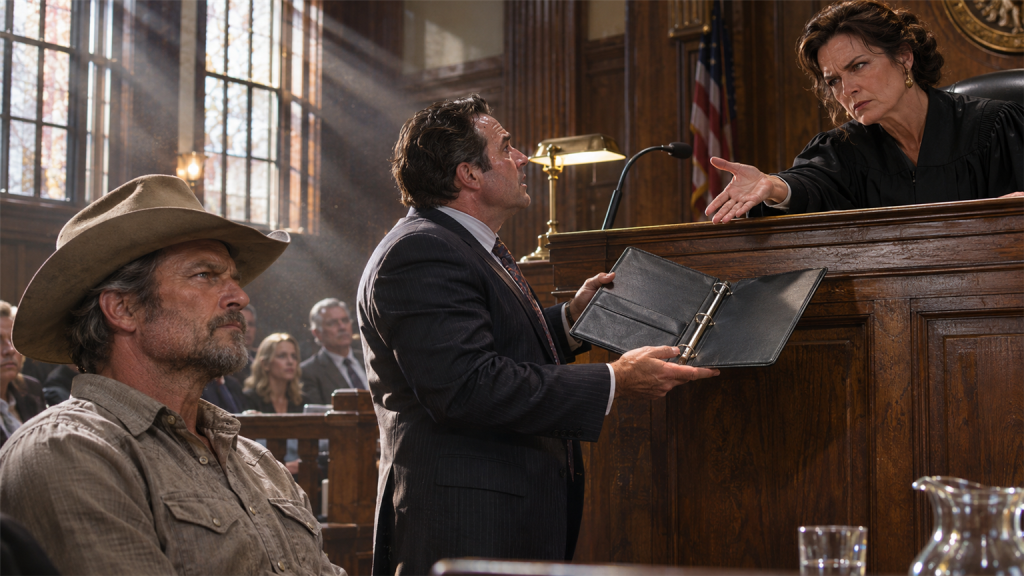
The first concrete truck rolled onto my ranch at 6:17 on a Monday morning.
By Wednesday, bulldozers had torn out part of my north fence.
By Friday, someone had poured a foundation.
That was when I finally asked the question nobody at Silver Creek Estates seemed willing to answer.
“Who gave you permission to build a school on my land?”
My name is Ethan Cole. I was thirty-eight when an HOA outside Red Hollow, Texas, decided thirty acres of my family’s ranch would make the perfect site for a twenty-million-dollar elementary school campus.
Two stories.
Gymnasium.
Cafeteria.
Playground.
Bus loop.
Parking for more than a hundred vehicles.
There was only one problem.
They had never bought the land.
My grandfather Thomas Cole purchased the ranch in 1958.
Three hundred acres of pasture, mesquite, creek bottom, and pecan trees.
He raised cattle there until my father took over.
Then the ranch passed to me.
I knew every fence corner.
Every limestone marker.
Every place water collected after a summer storm.
So when orange survey stakes suddenly appeared in the northern pasture, I noticed.
At first, I assumed county utility crews were working nearby.
Then excavators arrived.
I drove straight to the site.
The foreman, Miguel Santos, shut down a bulldozer when he saw me waving.
He was in his fifties, gray mustache, faded hard hat, tired eyes.
“Sir, you can’t be inside an active construction zone.”
“This is my ranch.”
Miguel stared at me.
Then at the equipment.
Then back at me.
“We were told this is Silver Creek property.”
“Did they give you a deed?”
“They gave us a site plan.”
“That isn’t a deed.”
His expression told me he knew.
I asked who authorized the work.
He gave me the project manager’s card.
Nobody returned my calls.
So I contacted the county appraisal district.
The clerk pulled my parcel.
Cole Family Trust.
Same acreage.
Same legal description.
No recorded sale to Silver Creek Estates.
No transfer to any school entity.
Nothing.
The next morning, I drove to the HOA office.
Linda Mercer sat behind a glass desk large enough to host a board meeting.
She was in her early fifties, blonde, polished, and completely unsurprised to see me.
“Mr. Cole,” she said, “I understand you’ve been disrupting the school project.”
“Your contractors are building in my pasture.”
“The school site is community property.”
“Show me the deed.”
She folded her hands.
“The development agreement transferred that land years ago.”
“Then show me the recorded transfer.”
“The legal department is handling documentation.”
“You’ve already poured concrete.”
“The project has county approval.”
“Approval to build isn’t ownership.”
That was the first time her smile disappeared.
She told me hundreds of families were counting on the school.
Children had already been placed on enrollment lists.
Contracts were signed.
Millions committed.
I told her those were excellent reasons to verify who owned the land before starting construction.
Linda leaned back.
“Your family has been sitting on unused acreage for decades.”
“It’s cattle pasture.”
“It’s underutilized.”
“It’s mine.”
She picked up the phone and called security.
Before leaving, I turned around.
“If you’re right, producing the deed should take five minutes.”
She stared at me.
“And if you’re wrong, every day you keep building makes this more expensive.”
That night, I opened the old steel filing cabinets in my farmhouse.
My grandfather saved everything.
Receipts.
Tax statements.
Livestock records.
Survey notes.
The original 1958 deed was still inside a brown envelope.
So was a 1961 survey.
The northern boundary crossed a shallow creek, turned west at a limestone marker, and ran directly through what Silver Creek now called its “school parcel.”
There was no sale.
No easement.
No conveyance.
I called Rachel Bennett, the attorney who handled my father’s estate.
She listened, then said, “Stop confronting them.”
“They’re pouring a school foundation.”
“I know. That’s why we need evidence, not arguments.”
She hired Daniel Price, a licensed surveyor with twenty-five years of county work.
Daniel walked the old legal description with me.
Near the creek, he found one of my grandfather’s iron pins beneath several inches of soil.
Then another.
Then the limestone marker.
By late afternoon, he stood beside the new foundation staring at his equipment.
“This structure is inside your parcel.”
“How far?”
“Not inches.”
He looked toward the school frame.
“Hundreds of feet.”
Four days later, Daniel obtained the survey submitted with the project.
Its northern ranch boundary had shifted almost four hundred feet south compared with the recorded deed.
That artificial shift placed the school neatly inside Silver Creek’s development.
Rachel asked the county clerk to search everything.
My grandfather’s name.
My father’s.
Mine.
The ranch parcel.
The developer.
The HOA.
The education nonprofit involved in the project.
No deed transferring those thirty acres existed in the records they located.



