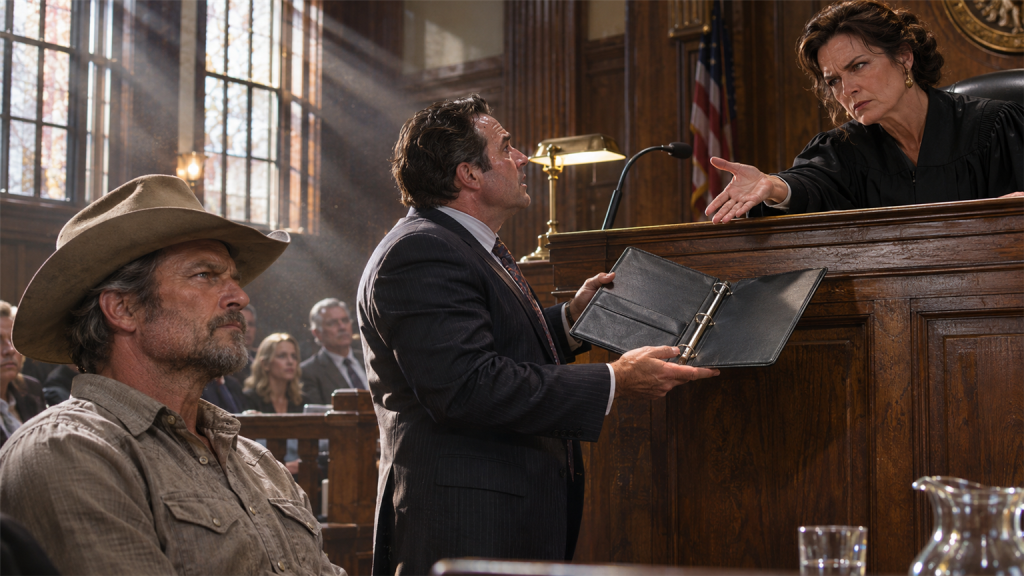
Toward me.
Rachel whispered, “You don’t owe them a speech.”
“I know.”
I stood anyway.
“I’m not trying to take your school away.”
The room quieted.
“I’m not asking anyone here to choose between my ranch and your children. I’m asking the people who authorized this project to take responsibility for building before they had the legal right to use the land.”
A man asked, “Would you sell?”
“Maybe.”
That surprised them.
Linda looked up.
I continued.
“But not as a reward for trespassing.”
The room stayed silent.
“If Silver Creek wants to discuss land, first repair what was damaged. Replace my fence. Address the pasture. Reimburse the legal and survey expenses I incurred proving something the county records already showed. And tell every homeowner exactly what happened.”
A woman asked, “And then?”
“Then we can talk like neighbors instead of pretending bulldozers create ownership.”
Afterward, Rachel told me that was either helpful or catastrophically generous.
“Which?”
“I’ll tell you when negotiations end.”
They lasted two months.
The restoration agreement came first.
Silver Creek would replace the destroyed ranch fencing.
An agricultural contractor—not the school builder—would restore disturbed pasture outside the permanent construction footprint.
Drainage alterations would be corrected.
Construction debris would be removed.
My documented legal and survey expenses would be reimbursed.
The HOA would also issue a written statement to every household acknowledging that no recorded deed conveying the original school parcel to Silver Creek had been located and that the certified survey placed the construction site inside the Cole Ranch boundary.
I added one sentence.
“The statement must say construction began before ownership was resolved.”
Linda objected.
Rachel looked at her.
“Is it inaccurate?”
Linda said nothing.
The sentence stayed.
Then came the harder question.
What happened to the unfinished school?
Removing the foundation immediately would cause enormous additional disturbance.
Leaving it indefinitely made no sense either.
Silver Creek wanted to purchase the thirty acres.
Their first offer was based on ordinary pasture value.
I rejected it.
Not because I wanted a fortune.
Because the land was no longer ordinary pasture.
They had already changed it.
They needed a parcel large enough for a school, bus access, drainage, setbacks, and utilities.
And because their mistake had already tied millions of dollars to that exact location, its value to them was different from its value to a neighboring cattle operator.
Rachel hired an independent appraiser experienced in institutional land.
Silver Creek hired another.
We eventually reached a number between them.
Then I changed the terms.
“I don’t want to sell thirty acres.”
Linda stared.
“We need the entire site.”
“You don’t.”
The revised engineering plan showed that the school could operate on roughly twenty-two acres if the parking layout changed and part of the bus loop shifted.
The remaining land included an old pecan grove and the area near the creek where my father had taught me to ride.
I wasn’t selling that.
The HOA protested.
The architect complained.
The developer said redesign would cost money.
I reminded them that bulldozing property before purchasing it also cost money.
They redesigned.
The final agreement transferred twenty-two acres.
Properly surveyed.
Properly appraised.
Properly signed.
Properly recorded.
I retained the creek corridor, the pecan trees, and access along the western edge.
A permanent buffer separated the school from the cattle pasture.
Silver Creek paid the restoration expenses separately from the purchase price.
No one got to fold their earlier damage into the cost of acquiring the land.
That mattered to me.
Before I signed, Linda requested a private conversation.
We stood in Rachel’s conference room.
For months, I had known her only as the woman behind the glass desk who told me my family’s land was underutilized.
She looked tired now.
“I should have stopped the project when the title warning came in,” she said.
“Yes.”
“I believed legal would solve it.”
“Yes.”
“And I believed delaying construction would destroy the school.”
I waited.
She looked down.
“I was wrong.”
That was the apology.
No dramatic tears.
No begging.
Just four words.
I was wrong.
I could work with that.
“Why didn’t you call me?” I asked.
She looked surprised.
“Before any of this. Why didn’t anyone knock on my door and say, ‘Ethan, the school site moved. Would you sell?’”
“I don’t know.”
“That’s the part I still don’t understand.”
She was quiet for a long time.
Then she said, “I think we stopped seeing the parcel as somebody’s property. On the maps, it was just the school site.”
There it was.
The real mistake.
Not paperwork.
Perspective.
The line on the planning map had become more real to them than the man whose cattle stood behind the fence.
I signed the agreement three days later.
Construction resumed months after that.
But not before the new deed was recorded.



