What did exist was an approved master development plat showing a future school site.
Rachel explained the problem simply.
“A planning map can show what someone intends to develop. It does not, by itself, prove they acquired title.”
We filed for an emergency injunction.
Silver Creek responded immediately.
Their attorneys accused me of interfering with a project benefiting hundreds of children.
Linda gave interviews saying one landowner was threatening years of community planning.
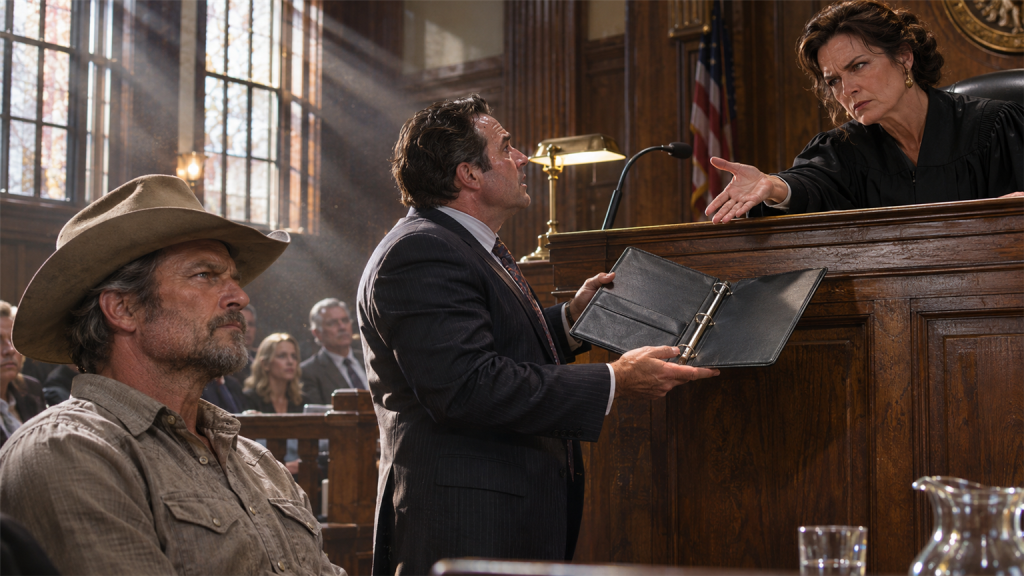
At the hearing, the judge reviewed my deed.
Daniel’s preliminary survey.
The county records.
Then she turned to Silver Creek’s attorney.
“Do you have a recorded deed conveying this parcel?”
He opened a binder.
“We have an approved development plat.”
“That was not my question.”
Silence.
The judge repeated it.
“Do you have a deed?”
“We are continuing to investigate the historical conveyance.”
The judge stopped construction.
By sunrise the next morning, the machinery was silent.
Steel columns stood above exposed concrete in the middle of my pasture.
Then a former project administrator named Paul Hensley contacted Rachel.
He arrived carrying a box of old Silver Creek planning records.
The original plan placed the school north of the creek.
That parcel had drainage problems.
So somebody moved the proposed school south.
Onto my ranch.
Rachel asked the obvious question.
“Was the new property ever acquired?”
Paul shook his head.
“Not while I was there.”
Then he handed her an email chain.
One message from nearly two years earlier read:
Ownership of revised school parcel must be confirmed prior to final site authorization. No recorded conveyance currently identified.
The warning had been forwarded directly to Silver Creek’s project committee.
The next email contained only one instruction:
Proceed with schedule. Legal can reconcile parcel documentation concurrently.
Rachel read it twice.
Then she looked at me.
“They didn’t discover the problem after construction started.”
My stomach tightened.
“They knew?”
“At minimum, somebody warned them.”
Outside her office window, traffic moved through downtown Red Hollow.
I stared at that email.
Silver Creek hadn’t simply made a mapping mistake.
Someone had been told they might not own the land.
And they had ordered the bulldozers forward anyway.
Daniel’s final survey removed the last ambiguity.
Using the original deed, historic markers, county plats, and modern measurements, he concluded that the entire construction site sat inside Cole Ranch. The county records he reviewed showed no recorded conveyance transferring the land to Silver Creek.
Rachel filed everything.
The judge ordered the project side to produce whatever deed or legal instrument supposedly gave them ownership.
They produced the development plat again.
No deed.
No purchase agreement signed by my family.
No construction easement.
Nothing.
The court kept the injunction in place.
Two days later, Linda called me.
“The HOA would like to discuss purchasing the parcel.”
I almost laughed.
“You want to buy the land after building on it?”
“We’re trying to find a practical solution.”
“You already destroyed pasture, removed fencing, and poured concrete.”
“We can compensate you.”
“Why didn’t you ask before construction?”
“The project schedule was extremely compressed.”
“That’s not an answer.”
Silence.
Then she tried the argument I knew was coming.
“Ethan, children are depending on this school.”
“I know. That’s why the adults responsible should tell their parents what happened.”
Her tone hardened.
“What do you want?”
“Restore my property. Reimburse my documented costs. Release the project records to the homeowners. And publicly acknowledge that Silver Creek never acquired this parcel.”
“That’s unreasonable.”
“Then don’t call me.”
Before hanging up, I asked one final question.
“Linda, when did you first learn there was no confirmed deed?”
She didn’t answer. She didn’t need to. By then, homeowners had started asking the same question.
And Silver Creek’s twenty-million-dollar school project was beginning to look less like a construction problem and more like an accountability problem…
The questions spread faster than the HOA could contain them.
Silver Creek had spent years advertising the school as the centerpiece of the community’s future.
Families had bought houses partly because of it.
Special assessments had been discussed.
Donors had contributed through the affiliated education foundation.
Renderings appeared in sales offices.
Children had toured temporary classrooms while parents were told the permanent campus was coming.
Now the unfinished building sat behind temporary fencing on land the HOA could not prove it owned.
The board issued a statement calling the matter a “historic title discrepancy.”
Rachel read it at my kitchen table.
“That phrase is doing a lot of work.”
“It sounds better than ‘we built on somebody else’s ranch.’”
“Most things do.”
Then Paul Hensley provided more records.
The school had originally been planned on Parcel 14, land clearly controlled by the developer.
Engineering studies later found expensive drainage problems there.
Moving the campus south saved significant money.
But the alternative site overlapped my family’s northern pasture.



