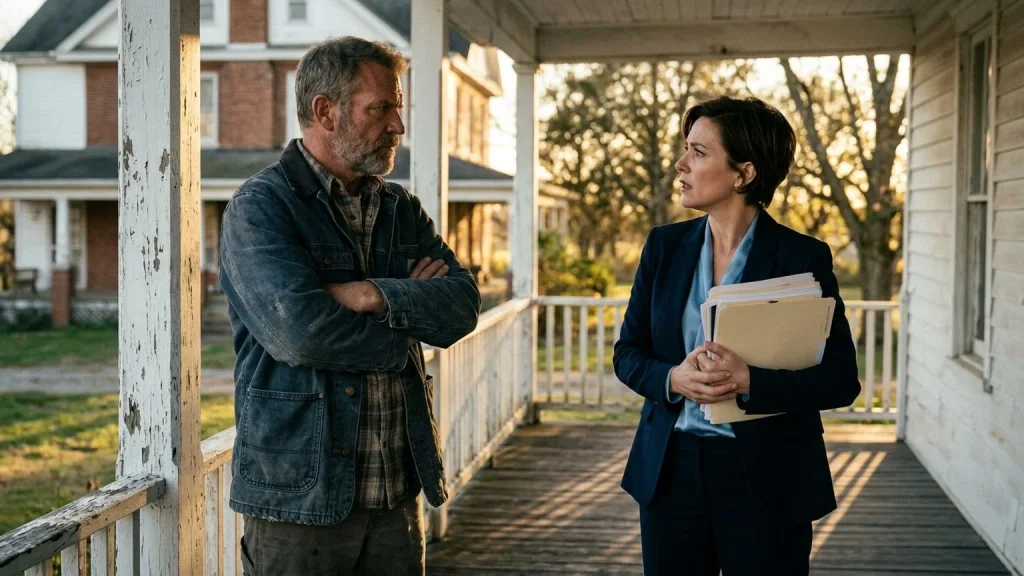
The lien notice was stapled to a front door built in 1846.
I stood there at six-thirty in the morning, coffee in one hand, staring at three sheets of white paper pinned into walnut my family had been opening and closing for 179 years.
PROPERTY LIEN — $4,260
Filed by Briarwood Hills Homeowners Association.
I read it twice.
Then I looked down my driveway.
A black Lexus sat near the road.
The driver’s window lowered.
Margaret Voss, president of Briarwood Hills, leaned toward me.
“You could’ve avoided all this, Thomas.”
“Avoided what?”
“Joining the community you’re benefiting from.”
My name is Thomas Harper. I was fifty-six years old, a retired title examiner, and Harper Farm had belonged to my family since before anyone around there had indoor plumbing.
Briarwood Hills had existed for seventeen years.
My farmhouse had survived the Civil War, two barn fires, the Great Depression, and one tornado that carried our chicken coop half a mile.
I was reasonably confident it could survive Margaret Voss.
She smiled.
“Pay the dues, sign the compliance agreement, and this gets easy.”
Then she drove away.
Harper Farm sat on thirty-eight acres outside Winchester, Virginia. The subdivision began beyond my eastern fence: seventy-four large homes, stone entrances, ornamental streetlights, and an HOA that considered itself the organizing principle of civilization.
For years, we coexisted.
Then Margaret became president.
Her first letter informed me that my barn violated architectural standards.
The barn was built in 1891.
Her second letter objected to my farm trailer being visible from Briarwood’s entrance road.
Her third demanded $3,900 in back dues because, according to the HOA, my property had been “incorporated into the Briarwood community interest area.”
I answered the only way I knew.
With documents.
My 1846 deed.
The 1963 boundary survey.
A 1998 title policy.
The Briarwood subdivision plat.
My parcel was outside it.
No covenant.
No annexation.
No HOA signature.
Nothing.
Margaret replied:
The board’s determination remains unchanged.
That sentence bothered me.
Not because it was threatening.
Because it was specific.
She wasn’t saying they believed I should belong to the HOA.
She was saying they had already determined that I did.
So after finding the lien on my door, I drove straight to the county land records office.
I had worked title for twenty-nine years.
I knew exactly what I was looking for.
Recorded covenants do not appear through confidence.
They appear through instruments.
Book numbers.
Document numbers.
Signatures.
Notaries.
I found the original Briarwood declaration from 2008.
My land wasn’t included.
I found two later amendments.
Still nothing.
Then the clerk said, “There’s one more.”
A supplemental declaration.
Recorded in 2019.
I opened it.
The first five pages annexed three undeveloped parcels east of Briarwood.
The sixth page made my hands stop.
Parcel 17-B — Harper Farm.
Someone had added my thirty-eight acres to an HOA declaration eleven years after the subdivision was created.
Attached was a document titled:
OWNER CONSENT TO ANNEXATION
The owner listed was my father.
William Harper.
His signature was at the bottom.
I stared at it.
The clerk asked if I was all right.
“No.”
My father had hated signatures that slanted. His handwriting was square, deliberate, almost mechanical.
This signature looked close.
Close enough that someone unfamiliar with him might accept it.
But that wasn’t what made the room tilt.
The document was dated May 14, 2019.
My father died in February 2017.
Two years before he supposedly signed away our farm.
I made certified copies and called attorney Claire Donnelly from the parking lot.
She listened without interrupting.
Then she asked, “Who notarized it?”
I looked.
The name was Helen Voss.
“Any relation to Margaret?”
“I don’t know.”
I found out twenty minutes later.
Helen Voss was Margaret’s sister-in-law.
Claire went silent.
“Thomas, do not call Margaret.”
“I wasn’t planning to.”
“Do not confront the notary.”
“Wasn’t planning to.”
“Do not post this online.”
“I definitely wasn’t planning to.”
“Good.”
She paused.
“Because if this is what it looks like, your HOA dispute just became something else.”
That afternoon, we pulled the full recording packet.
The false annexation had been submitted with a cover letter from Briarwood Hills.
Signed by Margaret.
The document stated that all annexed landowners had voluntarily consented.
And beneath my father’s impossible signature was one more detail.
A handwritten notation:
Consent confirmed in person.
I sat at Claire’s conference table staring at those words.
My father had been buried for twenty-seven months.
Claire turned one more page.
“Thomas.”
“What?”
“There’s a map attached.”
I looked.
It wasn’t just an HOA boundary map.
It was a development concept.
A new Briarwood phase.
Thirty-six additional homes.
And the proposed secondary entrance road ran straight through my apple orchard.
Claire pointed to a note beside it.
Access dependent upon Harper parcel annexation.
Then she turned to the signature block.



