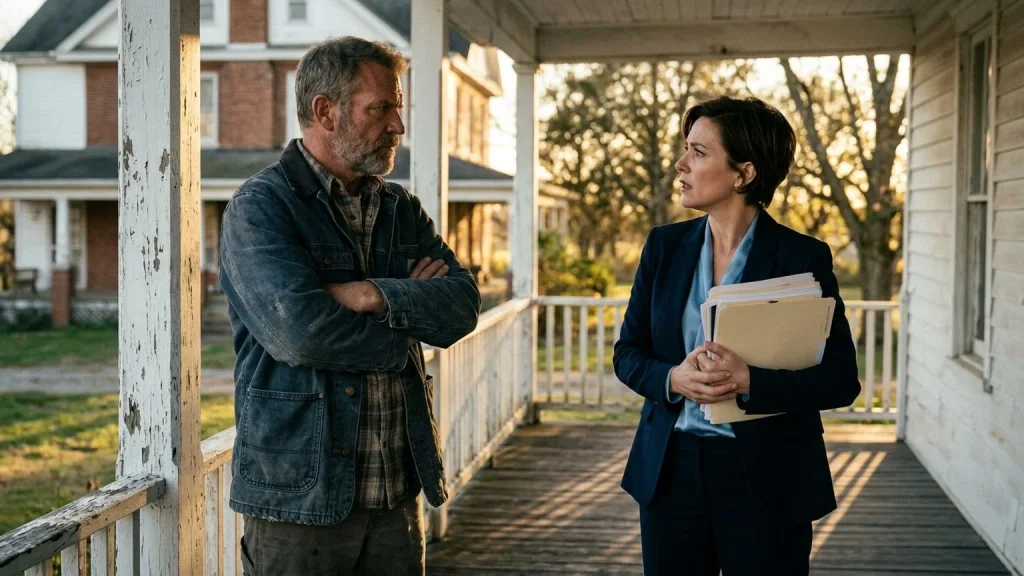
“That was the problem.”
She looked back at me.
“You think presidents personally verify every signature?”
“No.”
“Then what was I supposed to do?”
“Stop when I showed you the deed.”
That silenced her.
Not the forged signature.
Not the investigation.
Not the development emails.
The beginning.
The first moment she had a chance to reconsider.
I had shown her records proving the farm was outside Briarwood.
She could have stopped.
Instead, she treated disagreement as defiance.
That was where everything after it came from.
Margaret picked up a packet of flower seeds.
“I was trying to protect the neighborhood.”
“I believe you.”
She looked surprised.
“I do,” I said. “I just think you eventually decided protecting it meant you could decide what belonged to it.”
She said nothing.
We walked away separately.
The farmhouse still stands.
The door still has two small staple holes.
The barn still leans slightly north.
My old tractor is still visible from the county road.
The wildflower strip returns every summer.
And Briarwood Hills still sits beyond my eastern fence.
We get along fine now.
That is the ending people find least satisfying when I tell them the story.
They want the HOA dissolved.
They want Margaret arrested.
They want the developer ruined.
They want some enormous punishment equal to the audacity of stapling a lien to a house older than the neighborhood itself.
I understand that feeling.
But permanence is better than spectacle.
The lien is gone.
The false annexation is void.
A court order now sits permanently in the county land records stating that Harper Farm is not, and never was, part of Briarwood Hills.
That matters more than seeing somebody humiliated.
My father used to tell me that land remembers everything people put on paper.
When I was young, I thought that sounded sentimental.
After twenty-nine years in title work, I learned it was almost literal.
People die.
Boards change.
Developers dissolve companies.
Memories become arguments.
Paper survives.
A deed from 1846 can outlast the man who wrote it.
A false signature can cause trouble decades later.
A judge’s order can stop the same fight from reaching your children.
That is why you read before you sign.
Why you save records.
Why you check what was actually filed instead of believing the person with the confident voice.
The morning I found that lien, Margaret thought she had turned my farm into an HOA problem.
What she actually did was force me to look more closely at everything beneath it.
And once I did, the oldest document in the room turned out to be stronger than the newest threat.
Every October, when families come for heritage weekend, children run through the orchard where a subdivision road was once supposed to go.
Most of them have no idea.
They just see apple trees.
Grass.
An old farmhouse.
A barn.
Exactly the things that were already there before somebody decided the land needed to become something else.
Sometimes protecting a place doesn’t mean stopping time.
It means making sure change still has to ask permission.
The end
Disclaimer: This content is entirely AI-generated for fictional and entertainment purposes only. Any resemblance to actual persons, living or dead, events, or locations is purely coincidental, and the creator assumes no liability for any interpretation of this content.



