The concept plan had been approved internally in 2019.
By Margaret Voss.
Suddenly the lien made sense.
They had never wanted my dues.
They wanted my land to belong to rules they controlled.
And someone had forged a dead man’s signature to make that happen…
Claire filed an immediate challenge to the lien and requested that the county flag the disputed annexation instrument. A handwriting expert compared my father’s genuine signatures with the 2019 consent and concluded they were inconsistent in several significant features, while the funeral record established the simplest problem of all: William Harper had been dead for more than two years when the document was supposedly signed.
Then we found Helen Voss.
She was no longer a notary and initially refused to speak with us. But after receiving a subpoena in the civil case, she admitted Margaret had brought her a stack of HOA documents in 2019 and told her the signatures had already been verified. Helen notarized several without witnessing them personally.
That did not prove who forged my father’s name.
It proved the consent had never been properly witnessed.
Meanwhile, Briarwood homeowners began asking why their HOA was spending legal fees defending a claim against land outside the neighborhood. Margaret called an emergency meeting and told residents I was exploiting “an old paperwork irregularity” to block necessary community expansion.
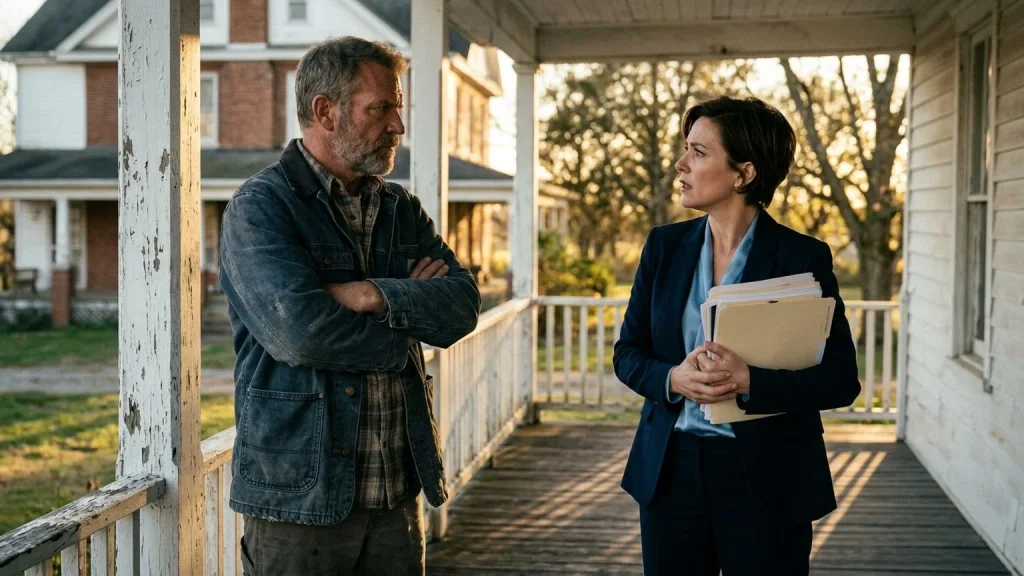
Claire attended with me.
So did two county officials.
Before the meeting began, an HOA board member named Steven Cole approached us carrying a cardboard archive box.
“I think you need these.”
Inside were old board packets from 2019.
One contained the development concept showing the road through my orchard.
Another contained an email from Margaret to the developer.
Claire read it once, then handed it to me.
Harper will never sell voluntarily. If annexation is recorded first, the association can create enough compliance pressure to bring him to the table.
Below that was the developer’s reply.
Then get the annexation done.
I looked toward Margaret at the front of the room. She was arranging her notes. She still thought the meeting was about an HOA lien. It wasn’t anymore…
The emergency meeting started at seven.
By seven-oh-five, every chair in the Briarwood clubhouse was filled.
People stood along the walls.
Several homeowners had printed copies of the county parcel map after rumors about my farm started circulating.
Margaret sat beneath the association seal.
She wore navy blue and looked completely composed.
That was one thing I learned to respect about her.
Margaret never entered a room unprepared.
Her mistake was assuming everyone else had entered less prepared.
She began with a ten-minute statement.
According to Margaret, Briarwood had acted in good faith based on records available to the association.
My farm, she said, had been part of a “long-standing community integration plan.”
The lien was routine.
The annexation discrepancy was administrative.
And I was using a technical defect to interfere with a project that would improve emergency access and property values.
When she finished, several people nodded.
Margaret was good at framing things.
Then Claire stood.
“I’d like to clarify what the technical defect is.”
She placed my father’s death certificate on the projector.
February 3, 2017.
Next came the annexation consent.
May 14, 2019.
Nobody moved.
Claire said nothing for several seconds.
She didn’t need to.
A man in the second row finally said, “Wait.”
Another homeowner whispered, “That can’t be right.”
Margaret leaned toward her microphone.
“The association did not prepare Mr. Harper’s personal paperwork.”
Claire clicked to the next slide.
The recording cover letter.
Signed by Margaret.
Then the statement saying all owner consents had been verified.
Her signature appeared again.
Margaret looked toward the board’s attorney.
He did not look back.
Claire continued.
“The notarization is also disputed. The notary has testified that she did not witness William Harper sign this document.”
Now the room shifted.
People who had arrived expecting an argument about development were beginning to understand they were looking at a document problem serious enough to affect the county record.
Margaret raised one hand.
“There were multiple professionals involved in that process.”
Claire nodded.
“That’s why we’re determining who did what.”
She did not accuse Margaret of forging the signature.
That mattered.
We had evidence the consent was false.
We did not yet have evidence identifying the person who physically created the signature.
Facts first.
Always.
Then Steven Cole stood from the board table.
Margaret looked at him.
“Steven?”
He carried the archive box forward.
“I should have brought these out sooner.”
Her face changed.
Only slightly.
But I saw it.
Steven had joined the board three years earlier, long after the annexation.
While reviewing old storage files, he found the 2019 packets.
He gave the originals to the board attorney and copies to Claire.
One document was the concept plan.



