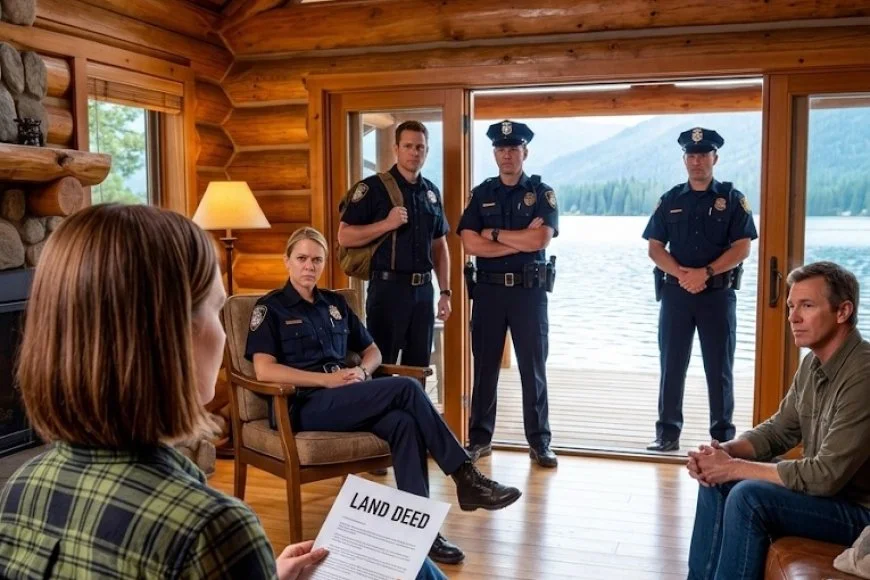
The woman who called me a squatter was standing on my grandfather’s porch.
“Thirty days,” she said. “After that, we’ll have the sheriff remove you.”
Victoria Ashford wore cream linen and carried a tablet like it was a badge. Behind her, the lake my grandfather built caught the morning light through the white oaks.
I looked at the eviction notice taped to my front door.
“Remove me from what?”
“This cabin. This land. The lake. The trails. They’re part of Ridgeline Estates.”
I almost laughed.
Instead, I asked, “Have you ever looked at the county plat?”
Her mouth tightened.
“I manage property professionally, Ms. Sutton.”
“That wasn’t my question.”
My name is Claire Sutton. I was forty-four, an environmental compliance specialist, and the cabin behind Victoria had been in my family since 1961.
My grandfather, Wallace Sutton, bought two hundred acres in the Blue Ridge foothills in 1958. He was a civil engineer who believed a boundary should be measured once, recorded correctly, and never argued about again.
He built the cabin with his brother and three church friends. Then he built the lake.
Seven acres of spring-fed water behind an earthen dam he designed himself. He stocked it with bass, built a cedar dock, and cleared a trail through the hardwoods.
When I was eight, he walked me to a brass survey cap near the eastern ridge.
“If you know where your lines are,” he said, “nobody gets to invent new ones.”
I remembered that sentence the morning Victoria tried to evict me.
My father inherited the property. Then I did.
Every transfer was recorded.
Every tax bill was paid.
The chain of title never broke.
Ridgeline Estates arrived next door in 2016 when a developer bought the old dairy farm along our eastern boundary and turned it into sixty-eight luxury homes.
The brochures were beautiful.
They also included photographs of my lake.
My dock.
My trail.
The developer called them community amenities.
Nobody asked me.
At first, I thought the marketing language was sloppy.
Then residents started appearing.
Families fishing from the dock. Kids swimming. Kayaks stacked beside my trail.
Most people were embarrassed when I explained the lake was private.
“The HOA told us we could come here,” they would say.
One man showed me a laminated Lake Access Pass with a QR code.
That was when I stopped thinking this was a misunderstanding.
I sent certified letters.
No response.
Then signs appeared.
RIDGELINE ESTATES RECREATION AREA
RESIDENTS AND GUESTS ONLY
On my land.
I removed them.
They came back.
Then Victoria became HOA president and formalized the whole thing.
Basic lake access cost $200 per household.
Premium access cost $400 and included dock privileges, fishing, and kayak storage.
The HOA even hired a “recreation coordinator” to check membership cards.
My family’s lake had become a business.
I met Victoria when I found a contractor installing a split-rail fence forty feet inside my property line.
Twelve hundred feet of posts.
Concrete footings.
No permit.
No permission.
I walked the line with the GPS equipment I used professionally and tagged every post.
Victoria arrived before the contractor finished.
“You’re interfering with community improvements,” she said.
“You’re building on my land.”
“We have established recreational rights.”
“Show me.”
She produced an HOA letter claiming years of continuous use had created a legal right to the lake.
Ridgeline Estates had existed for five years.
Whatever theory she thought she was invoking, the calendar alone should have embarrassed her.
I called Margaret Chen, a property attorney who had practiced locally for more than twenty years.
“They built how far inside your line?”
“Forty feet.”
“For how long?”
“About twelve hundred feet.”
Margaret sighed.
“That isn’t a close boundary problem. That’s a very long trespass.”
She told me not to remove the fence yet.
Document it.
Photograph it.
Map it.
Preserve everything.
So I did.
Three weeks later, I drove up on Friday evening and found Victoria’s next move taped to my cabin door.
NOTICE OF UNAUTHORIZED OCCUPANCY.
The letter claimed my home was not an approved residence within Ridgeline Estates and ordered me to vacate within thirty days.
I read it twice.
The cabin was fifty-five years older than the HOA.
Victoria had walked across my land, onto my porch, and taped an eviction notice to the house my grandfather built.
I sat in his old porch chair and looked across the lake.
For the first time, I wasn’t angry.
I was curious.
Victoria was too experienced to be making this many mistakes by accident.
She wasn’t confused about the lake.
She was monetizing it.
She wasn’t confused about the fence.
She had ordered it.
And now she wasn’t merely claiming access.
She was claiming the land itself.
Monday morning, Margaret pulled the county records.
By noon, she called.



