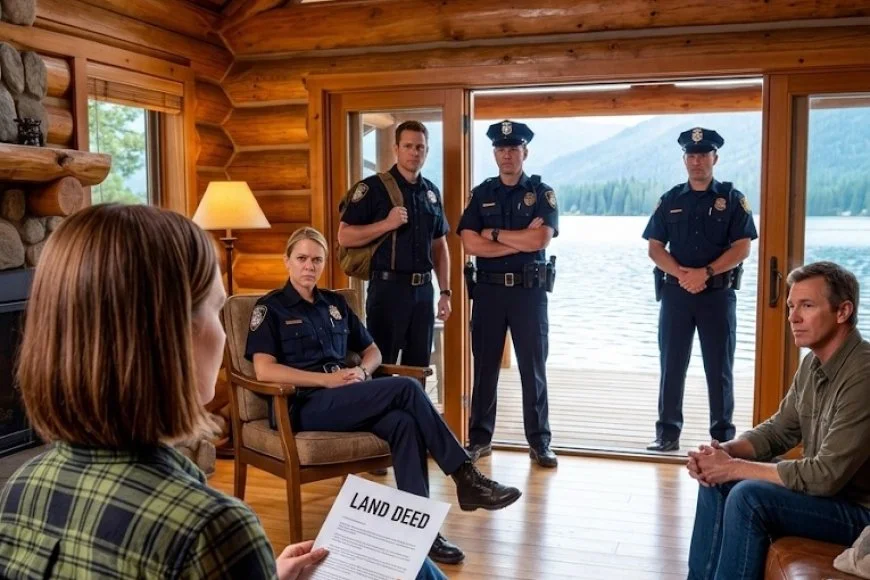
She did not go to prison.
I was fine with that.
I had never wanted revenge.
I wanted my property back.
The fence came out first.
Then the kayak rack.
The fire ring.
The signs.
By spring, the shoreline looked like itself again.
The developer who had marketed my lake as a community amenity faced separate civil claims from homeowners.
I stayed out of those negotiations.
Then Diana, now the new board president, came to my cabin.
She did something Victoria had never done.
She knocked.
“Can we talk about the lake?”
“What about it?”
“Not ownership,” she said. “We understand that part now.”
She asked whether I would consider allowing residents limited recreational access under a written agreement.
Not an assumption.
Not an invented access card.
A real license.
I thought about my grandfather.
He had built the lake for family, friends, and children who wanted to fish before sunrise.
He had never been a man who locked beauty away.
He simply expected people to respect whose land they were standing on.
So we negotiated.
The agreement required liability coverage, maintenance contributions, rules protecting the dam and shoreline, and one clause I insisted be written plainly:
THE LAKE, DOCK, TRAILS, AND SURROUNDING LAND ARE PRIVATE PROPERTY OF THE SUTTON FAMILY.
The first Saturday after the agreement took effect, someone knocked on my door.
A Ridgeline family stood there carrying fishing rods.
The mother smiled nervously.
“Ms. Sutton, would it be all right if we fished today?”
For a second, I heard my grandfather’s voice.
Know where your lines are.
Nobody gets to invent new ones.
I smiled.
“Of course.”
I walked them down the trail myself.
The younger boy caught a bluegill near the dock pilings twenty minutes later. He held it out with both hands, grinning while his mother took a photograph.
I had one almost exactly like it from childhood.
Same lake.
Same dock.
Different child.
For two years, Victoria had made ownership feel like a weapon.
Standing there, I remembered what it actually was.
Responsibility.
A boundary is not a wall around generosity.
It is what makes generosity possible, because sharing means something only when the person granting permission has the right to give it.
Victoria had letterhead, signs, fees, meetings, and confidence.
My grandfather had brass survey caps, a recorded deed, and a simple rule.
His rule lasted longer.
If someone tells you they own your land, your road, your lake, or your rights, don’t argue with the volume of their voice.
Ask for the document.
Then read the line.
The end
Disclaimer: This content is entirely AI-generated for fictional and entertainment purposes only. Any resemblance to actual persons, living or dead, events, or locations is purely coincidental, and the creator assumes no liability for any interpretation of this content.



