“Claire, I found the HOA financial reports.”
“What do they show?”
“Three years of lake-access revenue.”
“How much?”
“About sixty-three thousand dollars.”
I looked through the window at the water.
Then Margaret said, “And there’s something else.”
“What?”
“The developer’s original subdivision plat.”
I stood up.
“Does it show the lake?”
“Yes.”
“Inside Ridgeline?”
“No.”
Margaret’s voice went flat.
“It shows the lake entirely on your property.”
And suddenly Victoria’s eviction notice stopped looking like arrogance.
It looked like evidence…
Margaret moved first. She filed a boundary action, a trespass claim, and a demand that every HOA structure be removed from Claire’s land. She mailed homeowners copies of the recorded plats showing where Ridgeline Estates ended and Claire’s property began.
The neighborhood erupted.
Victoria called an emergency meeting and proposed a $50,000 legal assessment to “defend community assets.” Retired teacher Diana Whitfield asked the question Victoria could not answer: “If the lake belongs to us, why isn’t it on our plat?”
Meanwhile, Claire documented everything. The HOA fence sat forty feet inside her boundary for nearly a quarter mile. The fire ring, kayak rack, signs, and trail posts were all on her property. HOA financial records showed roughly $63,000 collected over three years in lake-access fees.
Then Victoria drove to Claire’s cabin and offered $15,000 for a permanent easement over the lake, dock, and trails.
Claire declined.
“You called me a squatter yesterday,” she said. “Today you want to buy an easement from me. Those two positions can’t both be true.”
Victoria’s face hardened.
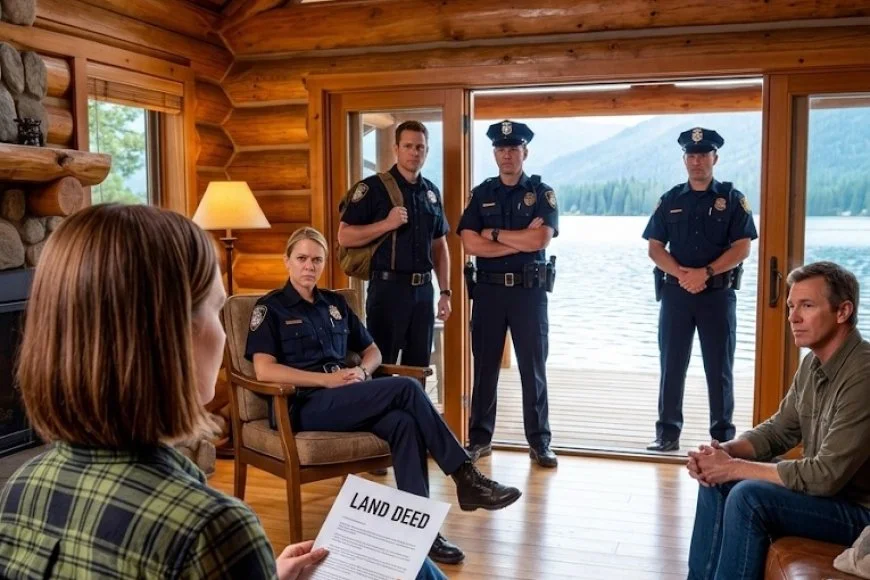
Two days later, she reported Claire to the sheriff as an unauthorized occupant.
The deputy refused to remove her after checking the deed.
Victoria responded by hiring counsel and seeking a court order to stop Claire from interfering with “established community recreational rights.”
At the hearing, the judge asked for one recorded instrument granting the HOA any interest in the lake.
Victoria’s lawyer had none.
The motion was denied.
Outside court, her attorney advised her to remove the structures and negotiate.
Victoria fired him in the parking lot.
Then she announced a $100,000 special assessment to keep fighting.
That was the moment the homeowners stopped asking whether Claire was telling the truth.
They started asking what Victoria had done with their money all along…
Part 3
The homeowners forced the issue before Victoria could.
Diana Whitfield, a retired teacher from Lot 44, went door to door with a petition demanding a special meeting, a forensic audit, and a vote on Victoria’s removal.
Forty-seven owners signed.
Victoria refused to schedule it.
Margaret went back to court, and the judge ordered the meeting held.
By then, the county surveyor had completed an independent verification. Wallace Sutton’s original monuments were still in place. The Ridgeline fence encroached roughly forty feet onto my parcel for nearly twelve hundred feet. The lake, dock, cabin, and trail were wholly outside the subdivision.
There was no gray area left.
Fifty-four homeowners filled the community building that night.
Victoria sat at the front with her tablet closed.
Diana called the meeting to order.
The first vote authorized an independent audit and passed overwhelmingly.
Then came Victoria’s removal.
She stood.
“This is a coordinated attack on leadership that has protected this community for years.”
Diana looked at her notes.
“You charged homeowners for access to property the HOA did not own. You authorized construction on that property. You called the owner a squatter. You asked the sheriff to remove her. Which fact are you disputing?”
Victoria’s answer was the same one she had used for months.
“I acted in the best interests of the community.”
Then Diana looked at me.
“Claire?”
I carried two maps to the front.
My grandfather’s recorded plat.
Ridgeline Estates.
I laid them side by side.
“This is my family’s boundary. This is yours. The lake, cabin, dock, and trail are all on my side.”
Nobody interrupted.
“You were told these things belonged to you. I don’t blame you for believing your HOA. But they never belonged to it.”
I looked toward Victoria.
“When I asked you to stop charging people for my lake, you built a fence. When I challenged the fence, you called me a squatter.”
Then I faced the room.
“My grandfather would have shared this lake with neighbors who asked. The problem was never people fishing. The problem was someone deciding permission was unnecessary.”
The vote was called.
Forty-seven to three.
Victoria Ashford was removed as president.
She gathered her tablet and walked out without speaking.
The audit came back the following week, confirming roughly $63,000 in lake-access fees and unsupported expenses requiring investigation.
The new board referred the records to counsel and law enforcement.
Months later, Victoria entered a plea resolving charges that included theft by deception and making a false report. The agreement required restitution, probation, community service, and payment toward removing the unauthorized structures.



