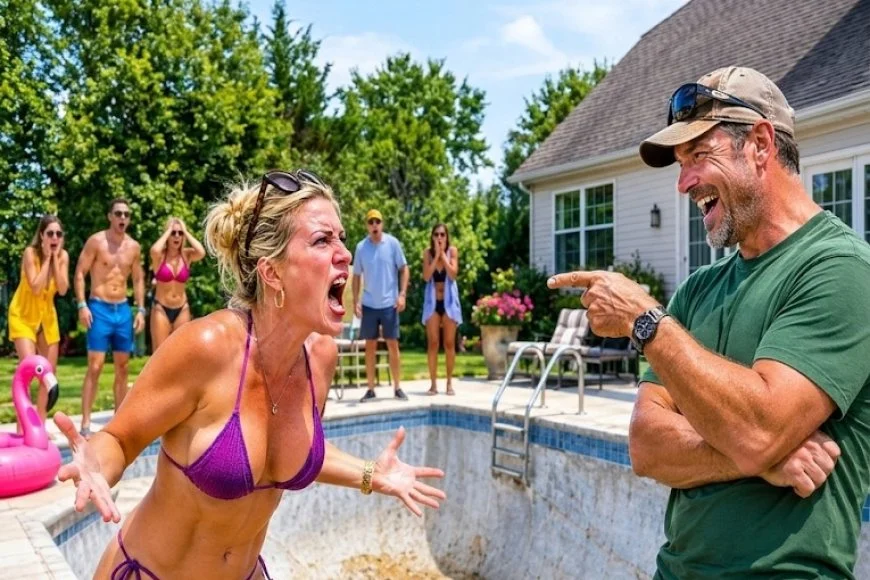
The first thing Karen Whitmore said when she saw my swimming pool was empty was:
“What have you done?”
She stood at the edge of my backyard in a bright yellow dress, clipboard in one hand and a Pine Ridge HOA event badge hanging from her neck.
Behind her, almost sixty people were packed outside my locked gate.
Coolers.
Towels.
Inflatable flamingos.
Folding chairs.
Food trays.
A hired lifeguard.
Two catering workers.
Someone had tied a banner across my fence.
PINE RIDGE SUMMER POOL PARTY
COMMUNITY AMENITY DAY
There was even a sign beside my driveway.
PUBLIC POOL PARKING.
Only one detail was wrong.
There was no public pool.
There was my pool.
On my property.
Behind my house.
And two days earlier, I had drained every gallon out of it.
Karen pointed toward the empty concrete basin like I’d destroyed city property.
“You knew we reserved this space.”
“No,” I said. “You announced that you reserved it.”
“You received the notice.”
“I also told you no.”
“You cannot shut down a community amenity after residents have planned around it.”
I laughed.
“Watch me.”
Her face reddened.
“Families paid for this event.”
“Refund them.”
“The association hired vendors.”
“Refund them too.”
“The clubhouse pool is closed.”
“That sounds like an HOA problem.”
Then she made the mistake that changed everything.
“We have legal recreational-use rights here.”
I stopped smiling.
“Show me.”
Karen opened her clipboard and produced a laminated document titled:
PINE RIDGE COMMUNITY AMENITY DESIGNATION.
My address appeared underneath.
A color map shaded my pool, patio, outdoor bathroom, and part of my driveway blue.
“The board approved this three months ago.”
“The board cannot vote itself ownership of my backyard.”
“We’re not claiming ownership.”
“What are you claiming?”
“Historic recreational access.”
That was when the sheriff’s cruiser arrived.
Karen smiled.
She had called them.
Deputy Laura Mitchell stepped out, followed by Deputy James Walker.
Karen hurried toward them.
“Officer, thank goodness. The property owner intentionally disabled a community amenity to interfere with an authorized HOA event.”
Laura looked past her at my empty pool.
Then at me.
“Sir, is this your property?”
“Every inch.”
Karen interrupted.
“The HOA has use rights.”
Laura held up a hand.
“I’ll get there.”
My name is Ryan Mercer. I was forty-nine when this happened, and I’d owned the house for eleven years.
My property sat beside Pine Ridge Estates, a neighborhood of roughly two hundred homes outside Raleigh, North Carolina.
The house was older than Pine Ridge.
When the development was built around it, the previous owner refused to sell.
Years later, I bought the house and four acres.
My deed was simple.
Private property.
No HOA membership.
No Pine Ridge covenants.
I did have a recorded easement allowing me to use Pine Ridge Drive because the development had changed the old road layout.
I paid a fixed amount toward road maintenance.
That was all.
And the pool?
It wasn’t historic.
I built it myself three years after buying the house.
Laura asked Karen for proof of the HOA’s claimed rights.
Karen handed her another document.
According to it, the previous owner, George Bennett, had granted Pine Ridge residents recreational access to the pool nineteen years earlier.
There was one obvious problem.
The pool hadn’t existed nineteen years earlier.
I had built it eight years after buying the property.
Laura stared at Karen.
“How could this agreement grant access to a pool that hadn’t been constructed?”
Karen opened her mouth.
Nothing came out.
James noticed something else.
The legal description didn’t match my deed.
The document included land once owned by Pine Ridge’s original developer.
It looked like pieces of unrelated paperwork had been stitched together.
“Where did this come from?” Laura asked.
“Association records.”
“Specifically?”
“Our consultant.”
“Name?”
“Paul Norton.”
I had never heard of him.
Then a homeowner near the gate raised her phone.
“Wait.”
She showed Laura the Pine Ridge website.
Under Amenities were the clubhouse, playground, tennis court, walking trail, main pool—
and:
MERCER AUXILIARY POOL — SEASONAL ACCESS.
There was a photograph.
My pool.
Taken from inside my backyard.
I stared at Karen.
“How long has that been online?”
She said nothing.
Then another resident spoke.
“Our recreation dues went up this year because we added a second pool.”
I turned.
“Second pool?”
A man beside her nodded.
“Six hundred dollars.”
Another resident said the same.
Then another.
Laura looked toward Karen.
“Residents were charged for access to this property?”
Karen’s voice became careful.
“They pay annual recreation fees supporting community facilities.”
“How much money was allocated to this pool?”
Karen didn’t answer.
The Pine Ridge property manager arrived twenty minutes later carrying a laptop.
Her name was Susan Parker.
She looked terrified.
She opened the HOA accounting system.
The annual recreation assessment had brought in more than ninety-six thousand dollars.



