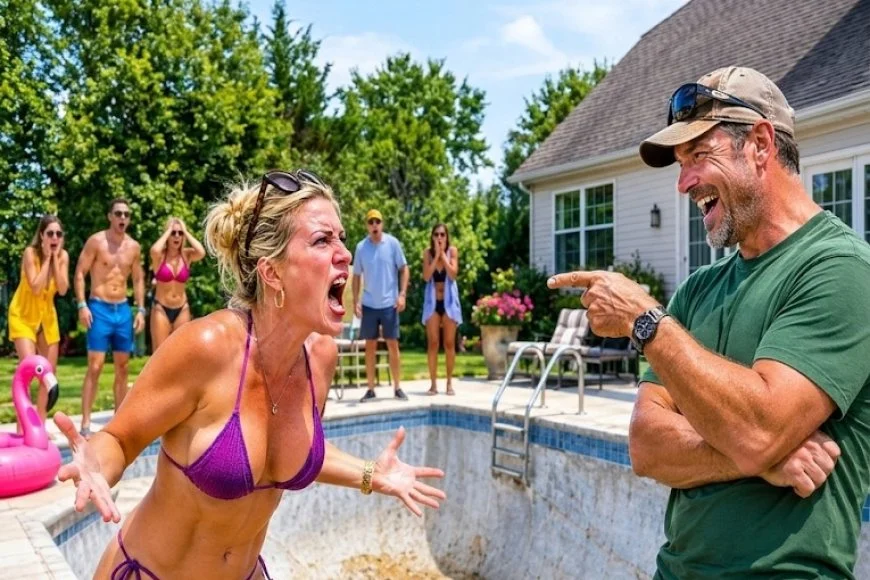
That was probably wise.
The next morning, I visited Harold at his daughter’s house.
I expected anger.
He had every reason to be angry.
Instead, he said:
“You didn’t hook up that hose.”
“No.”
“You told them not to use your pool.”
“Yes.”
“Then don’t carry somebody else’s stupid decision.”
His garage had burned.
And somehow he was the one making me feel better.
I asked what he needed.
Most things were covered.
The dog’s medication had been lost in the fire.
My daughter Jennifer worked near a veterinary clinic, and within two hours we had replacement medication arranged.
Small thing.
That weekend needed small good things.
The investigation took weeks.
It wasn’t dramatic.
Mostly documents.
Which is how complicated lies usually die.
Rebecca obtained the electronic version of the supposed nineteen-year-old recreational covenant.
The metadata showed it had been created four months earlier.
Author:
P. Norton.
A forensic examiner compared George Bennett’s authentic signature from my old purchase file with the signature on the covenant.
The image had been copied digitally.
Same angle.
Same line break.
Same imperfections.
Not forged by hand.
Copied.
Paul Norton had manufactured the document.
Then investigators examined the $22,000 payment.
Norton Community Amenities LLC had been created only eight months earlier.
Paul owned it.
His assignment from Pine Ridge was supposedly “amenity rights verification and activation.”
What he had actually done was much simpler.
He took old property documents.
Added language that didn’t exist.
Collected family photographs from social media.
Turned private invitations into alleged evidence of public use.
Then created a legal-looking story saying Pine Ridge had enjoyed recreational access to my property for years.
Rebecca called the theory nonsense.
Paul’s attorney called it aggressive.
I preferred Rebecca.
The important question became:
What did Karen know?
Emails answered part of it.
Three months before the party, Paul wrote:
Historic access claim not guaranteed. Owner opposition creates significant litigation risk. Do not schedule public use before counsel confirms.
Karen replied:
Counsel takes too long. Residents need a solution before summer.
Another exchange was worse.
Karen:
If residents begin using it regularly, that strengthens our position, correct?
Paul:
Potentially.
Karen:
Then we establish use first and deal with Mercer after.
That was when I finally understood why the party mattered so much.
Sixty residents.
A lifeguard.
Catering.
HOA banners.
Electronic check-in.
Maintenance logs.
Key-card access.
Photographs.
Invoices.
If the event succeeded, Pine Ridge could later point to all of it and say:
Look.
This pool is already operating as a community amenity.
My draining it had done more than ruin Karen’s Saturday.
It prevented her from creating the history she wanted to claim already existed.
The board suspended Karen within days.
Robert Jenkins, another director, became acting president.
The emergency meeting was packed.
Harold attended with a bandage on one arm.
When he entered, people stood.
Nobody planned it.
They simply did.
Robert read the board’s first actions.
Karen’s access to financial systems was revoked.
She could no longer issue contractor instructions.
The fake Mercer Pool listing was removed permanently.
The illegal rear gate would be taken out.
Residents would receive refunds for the portion of the recreation fee tied specifically to my pool.
All future work involving property outside Pine Ridge would require direct written verification from the owner.
Then Harold stood.
He looked at Karen.
“My garage burned while emergency water was being sent to a pool we had no right to use.”
Karen began crying.
Harold didn’t raise his voice.
“I don’t want revenge.”
The room went silent.
“I want to know nobody here will ever make a decision like that again.”
That became the tone.
Not revenge.
Accountability.
The board voted unanimously to remove the unauthorized fire-line connection and order a full system inspection.
No single HOA officer would ever again be able to authorize changes to emergency water infrastructure alone.
My fence was repaired.
The electronic gate disappeared.
A pool company cleaned the dirty reserve water from the bottom of my pool.
I paid to refill it with my own water.
No ceremony.
No announcement.
Jennifer brought Caleb over the first Saturday.
He jumped in before I finished telling him not to run.
Frank Miller came over with two folding chairs.
He looked at the pool.
“So when does public access begin?”
I stared at him.
He grinned.
“Too soon?”
“Leave.”
He laughed.
For the first time in months, the backyard felt like mine again.
Then the investigation revealed why Karen had pushed so hard.
The pool had never been the final goal.
Pine Ridge’s original developer was considering a northern expansion.
Dozens of additional homes.
That expansion needed more recreational capacity.
Building a second HOA pool on Pine Ridge land would be expensive.
My pool already existed.
Paul had produced a planning concept showing it as an “auxiliary amenity.”



