A later phase shaded part of my side yard for event parking.
Another section of my land was labeled future recreation lawn.
The HOA board had never approved those plans.
Then investigators discovered a separate company.
Pine Ridge Community Development LLC.
It sounded like part of the homeowners association.
It wasn’t.
Karen owned forty percent.
Paul owned thirty percent.
A company connected to Karen’s husband held the remaining thirty.
That private company had been positioning itself to acquire my four-acre property before the northern expansion became public.
A draft option valued my entire property at $620,000.
My signature appeared at the bottom.
I had never signed it.
The proposed resale price to the developer was more than twice that amount.
That explained the pressure campaign.
If I thought my property was nothing more than a difficult house beside an HOA, maybe $620,000 sounded attractive.
If I knew a developer considered it strategically valuable, I would negotiate very differently.
The fake amenity claim wasn’t just about recreation fees.
It was leverage.
Make Pine Ridge dependent on my pool.
Create fights over access.
Increase my legal costs.
Make ownership exhausting.
Then offer me a way out.
Paul eventually cooperated.
He admitted fabricating the covenant.
He admitted using social-media photographs to manufacture a history of community access.
He admitted creating the fake purchase paperwork.
He also admitted Karen had pushed him to move faster because she wanted the property issue resolved before the expansion became public.
Karen denied knowing every document was false.
But the emails showed she knew my consent had never been obtained.
She knew Pine Ridge’s attorney had warned against installing access infrastructure.
She approved the electronic gate anyway.
She knew the pool party was scheduled before the access claim had been legally confirmed.
And, according to Brian, she ordered the fire-reserve fill line opened after I drained the pool.
Those decisions were hers.
The criminal and civil cases took months.
Paul faced charges tied to forged documents and false filings.
Karen’s legal exposure centered on her role in the unauthorized access plan, financial conflicts, and the actions she approved despite repeated warnings.
Not every accusation became a charge.
Not every rumor proved true.
That mattered to me.
After watching people manufacture evidence against my property, I wasn’t interested in doing the same thing to them.
Karen ultimately accepted a negotiated resolution involving restitution, financial penalties, probation, and a long restriction from HOA leadership and community-property management.
Paul’s case was resolved separately.
The private development company was dissolved.
Pine Ridge recovered some of the money paid to Norton.
Insurance covered much of my property damage.
My legal costs were addressed through settlement.
Harold and Susan’s insurer repaired their home, and Pine Ridge voluntarily covered their deductible because the unauthorized water diversion had contributed to the response problem.
Nobody became rich.
Mostly, people got their lives repaired.
Pine Ridge elected Robert president.
Susan remained property manager.
The investigation cleared her of knowingly participating in the fake documents.
She became almost painfully careful afterward.
Frank joked that she would ask for fingerprints before approving a clubhouse reservation.
Susan told him it wasn’t funny.
It was a little funny.
The HOA adopted new rules.
Full conflict-of-interest disclosure.
No outside property advertised as an amenity without written owner permission.
No contractor entering private land based only on a board member’s instruction.
Emergency utility changes required licensed review.
No consultant could present an easement without association counsel seeing the complete recorded document.
And no community party could be scheduled in somebody’s backyard before that somebody said yes.
That last rule should not have required a lawsuit.
Yet there it was.
The northern development eventually survived.
But it changed.
The developer approached me directly.
No fake covenant.
No Karen.
No Paul.
Just a map, an attorney, and an offer for a narrow utility and pedestrian easement across the far northern edge of my property.
I didn’t accept immediately.
I hired my own appraiser.
Negotiated.
Changed the route.
Required drainage improvements.
Required a privacy buffer.
And added one sentence Rebecca insisted on placing in bold:
Nothing in this easement creates Pine Ridge HOA membership, recreational rights, pool access, or authority over the Mercer property.
Eventually, I said yes.
Frank couldn’t believe it.
“After everything, you sold them access?”
“I sold an easement.”
“They tried to take your property.”
“Some people did.”
“And now you’re helping the development?”
I looked at him.
“I’m making a deal I chose.”
He stopped talking.
Because that had been the point from the beginning.
Choice.
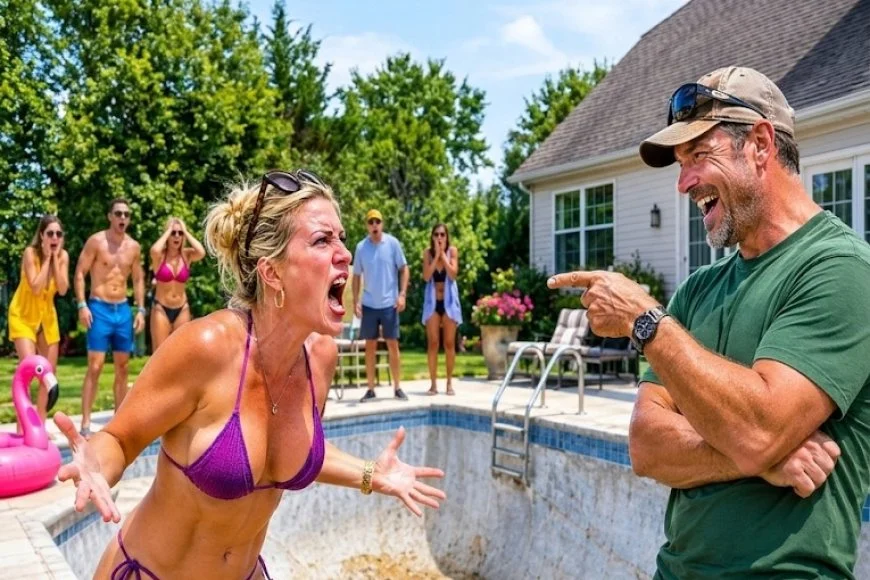
Karen never asked whether I wanted sixty strangers swimming in my backyard.
She designated my pool an amenity.
Paul never asked whether George Bennett had granted recreational rights.
He manufactured them.
The HOA never asked whether my family photographs proved public access.
They used them anyway.



