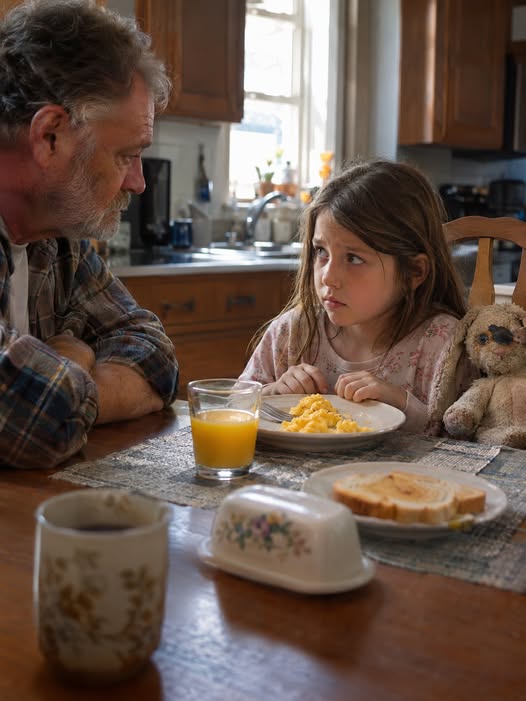
Maya put her fork down before taking a single bite of the scrambled eggs I’d made her.
“Sweetheart, is something wrong with your breakfast?”
She looked at the plate, then at me.
“Uncle Frank, am I in trouble?”
I was sixty-three years old. I’d spent thirty-one years working in pediatric emergency medicine, and I’d heard children ask some terrible questions.
But I wasn’t prepared for that one at my own kitchen table.
“Why would you be in trouble?”
Her lower lip trembled.
“I didn’t finish my dinner last night.”
I looked at the eggs.
Then at the little girl sitting across from me with her hands folded tightly in her lap.
My brother Dennis had dropped her off the previous afternoon.
He’d specifically told me she didn’t need snacks between meals.
Now his eight-year-old daughter was afraid to eat breakfast because she hadn’t finished dinner.
I lowered my coffee mug.
“Maya, you’re not in trouble. You can eat your breakfast.”
She waited another moment.
Then she picked up her fork.
What happened next troubled me more than her question.
She ate quickly, barely pausing between bites. When the plate was empty, she looked at me with unmistakable relief.
I offered her another helping.
She ate that, too.
Then she thanked me and went to wash up.
I sat alone at the table, looking at the two empty plates.
My name is Frank Coleman. I live in Columbus, Ohio, and I’d been retired from pediatric emergency medicine long enough to know that I sometimes noticed things other people missed.
My wife, Helen, had died two Octobers earlier.
Since then, I’d spent too much time alone in our house, putting off little jobs and leaving boxes of her belongings in the guest bedroom.
My son, Thomas, lived in Austin.
Dennis was my brother, and although we lived in the same city, we hadn’t been particularly close in recent years.
I’d seen his daughter only occasionally.
Maya had turned eight in April.
I’d mailed her a birthday card because Dennis said it wasn’t a good weekend for a visit.
So when he called on Thursday morning, asking me to watch her while he flew to Denver for work, I was genuinely pleased.
“Four days,” he said. “I’ll be back Sunday.”
Before I could ask about her school schedule or anything else, he said he was already driving over.
Twenty minutes later, his truck pulled into my driveway.
Maya climbed out carrying a backpack and a stuffed rabbit with one missing eye.
I recognized the toy from Christmas.
She held it against her chest while Dennis handed me her clothes.
“She knows the rules,” he said. “Bedtime by eight. No unnecessary snacks.”
I invited him inside for coffee.
He said he couldn’t stay.
Then he drove away.
Maya watched the truck disappear before following me into the house.
That evening, I made pasta.
She ate only part of her serving.
I didn’t insist she finish.
But I noticed she kept glancing toward the kitchen doorway, as though she expected someone to come in and correct her.
The following morning, I understood why that unfinished dinner mattered to her.
After she left the breakfast table, I went into my old office.
I took a yellow legal pad from the bottom desk drawer and wrote down what I’d observed.
The time.
Her question.
Her hesitation before eating.
The amount she’d eaten once I assured her it was allowed.
And Dennis’s instruction about snacks.
I wasn’t diagnosing anything.
One unusual breakfast doesn’t establish neglect.
But it was enough to make me pay attention.
I called Thomas.
He remembered seeing Maya at a family cookout in July.
“She was pretty quiet,” he said. “Dennis has a lot of rules for her.”
He described how Dennis expected her to remain silent when adults spoke and finish everything on her plate.
Thomas had assumed his uncle was simply strict.
I asked him to remain available by telephone.
Then I went to check on Maya.
She was sitting on the guest bed, drawing in a notebook.
Her rabbit rested beside her pillow.
The picture showed a house with dark windows and a tree that had lost its leaves.
“Is that your house?” I asked.
She nodded.
We talked about the tree.
Then I asked whether she enjoyed drawing at home.
“After my chores and homework,” she answered.
She returned to her picture.
“And after I’m done being quiet.”
I sat beside her.
Eventually, we started talking about her bedroom.
She told me she had a lock on the door.
“Your dad put a lock on it?”
“Yes.”
“Where is it?”
“On the outside. So I don’t wander around at night.”
She said it as though every child’s bedroom was locked from the hallway.
I kept my expression neutral.



